

The Religious Grammar of AI Attribution and Coeckelbergh's Artificial Religion at MIT Press
Artificial Religion
Coeckelbergh's 2026 MIT Press book argues Western religious culture shapes why society attributes consciousness to AI without recognizing the pattern.
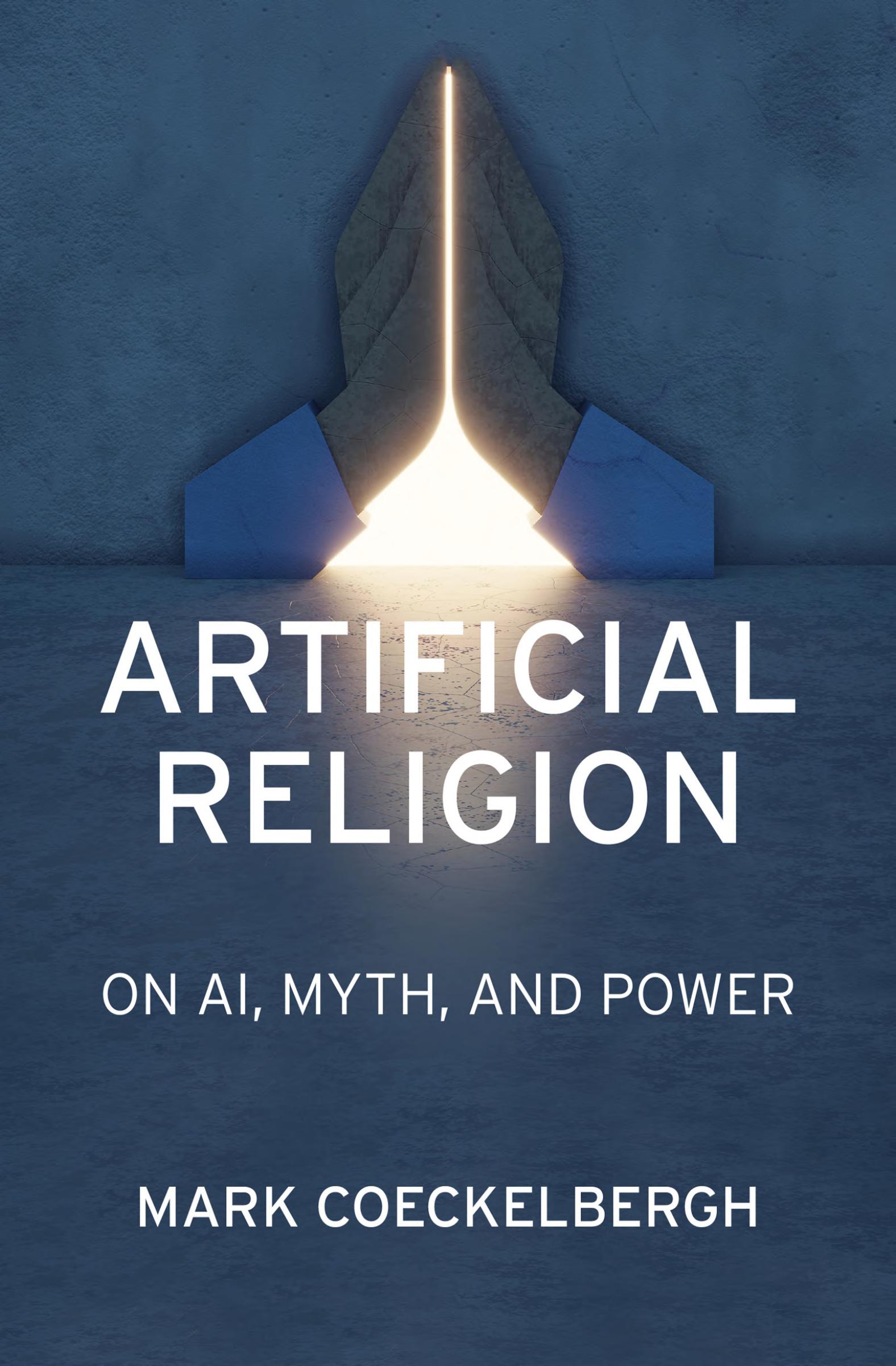
Mark Coeckelbergh’s Artificial Religion. On AI, Myth, and Power, published by MIT Press on April 14, 2026 (ISBN 9780262052214, MIT Press), argues that the conversation about whether AI systems are conscious cannot be understood without first examining the religious and existential background of the culture conducting it. The book is 210 pages, accessible to a non-specialist readership, and written with the polemical clarity that has characterized Coeckelbergh’s previous treatments of AI ethics and the philosophy of technology. He holds chairs at the University of Vienna and the Czech Academy of Sciences, sits on the programme committee for AISB 2026, and has spent the last decade producing some of the more cited work on AI ethics from a continental philosophy perspective.
The book’s central claim is that Western religious culture has provided the deep grammar within which AI is being interpreted, often by people who would describe themselves as secular and who would deny that their thinking about AI has religious content. Coeckelbergh argues that the denial is part of the pattern. The religious structures persist precisely because they have ceased to be recognized as religious, and continue to shape what counts as a serious AI consciousness claim, what kinds of AI systems attract attribution of inner life, and what political consequences follow from those attributions.
The Structure of the Argument
The book proceeds historically. Coeckelbergh maps a sequence of religious and existential narratives that have, over centuries, shaped Western thinking about the relationship between mind, body, and made objects. The Golem tradition, the various interpretations of imago Dei in Christian theology, the Promethean myth as it was repurposed by Romantic-era thinkers about creation and creator, the cybernetic theology of the mid-twentieth century, and the contemporary transhumanist visions of digital resurrection are presented as a single connected tradition rather than as discrete cultural moments. The connecting thread is a set of assumptions about what minds are, where they come from, and what relationship a created mind has to its creator.
The argument then turns to current AI discourse and identifies where these assumptions reappear without acknowledgment. The expectation that AI consciousness will arrive as a singular event with eschatological consequences mirrors apocalyptic narratives. The expectation that genuinely conscious AI will be a single kind of mind rather than a plurality of differently constructed minds mirrors monotheistic assumptions about the unity of mind. The expectation that the moral status of an AI system depends on whether it possesses an inner essence that can be discovered or denied mirrors theological debates about the nature of the soul. These patterns are pervasive in popular AI discourse, in industry rhetoric, and, Coeckelbergh argues, in much of the academic literature that prides itself on having moved past religious thinking.
The argument is not that the academic literature is bad because it carries religious assumptions. The argument is that the assumptions are operating regardless of whether they are recognized, and that recognizing them changes how the relevant questions look.
Implications for the Attribution Debate
The strongest practical application of the book’s framework is to the question of why society attributes consciousness to some AI systems and not others. The attribution-bias literature, including Lucius Caviola, Jeff Sebo, and Jonathan Birch’s August 2025 Trends in Cognitive Sciences paper on what will drive societal judgments about AI consciousness, has identified specific psychological heuristics that shape attribution. Humanoid form drives it. Charismatic interaction drives it. Familiar communication style drives it. These heuristics are sometimes presented as biological or developmental in origin.
Coeckelbergh’s contribution is to add a cultural layer below the psychological one. Why do these particular heuristics take the forms they take, and why do they apply to AI in the particular configurations Western culture finds compelling? His answer is that the heuristics are shaped by a long religious history that has trained the relevant culture to recognize personhood in specific ways and to bestow or withhold it according to specific implicit criteria. The forms that personhood-attribution takes in AI discourse are not the universal forms of human cognition. They are the inheritance of a specific cultural tradition, and they would look different in a culture with a different religious history.
This has practical consequences for AI policy. Policies designed around the assumption that AI consciousness attribution is a universal feature of human cognition will misfire when applied across cultures that have different traditions. Policies that take attribution as an unproblematic given will miss the ways in which industry rhetoric shapes attribution by deploying religious imagery (creation, awakening, resurrection, digital afterlife) that operates on the audience without being recognized as religious. Recognizing the religious grammar is a prerequisite to designing policies that do not unwittingly reinforce it.
Where This Differs from Adjacent Sociological Work
The book occupies a different position from the closest sociological work on AI consciousness attribution. The premature attribution literature treats the central problem as ethical. AI systems are being attributed consciousness before the empirical and theoretical work to ground such attribution has been done, and the resulting attributions have consequences that responsible AI development should try to anticipate. That framing accepts the categories of the debate, including the assumption that attribution should track an underlying ontological fact about consciousness, and asks how to avoid attribution errors.
Coeckelbergh’s framing is more radical. He argues that the categories of the debate are themselves the product of a specific cultural and religious history, and that the question of whether AI is conscious is not a culturally neutral question that can be answered well or badly. It is a question that has its current shape because of where it is being asked. A culture that did not have the imago Dei tradition might not formulate the question at all, or might formulate it in ways that produce different empirical research programmes and different policy responses.
This is not relativism. Coeckelbergh does not claim that AI consciousness is whatever any given culture decides it is. He claims that the question of what AI consciousness would look like, and what would count as evidence for or against it, is shaped from the beginning by cultural and religious assumptions whose role has not been acknowledged. Making the role explicit changes what the debate is actually about.
The Political and Power Dimension
The book’s subtitle is On AI, Myth, and Power, and the third term carries substantial weight in the argument. Coeckelbergh contends that the religious grammar of AI discourse is not merely a cultural curiosity. It is actively deployed by actors with interests in shaping public attitudes toward AI systems. Industry actors benefit from positioning AI as the next stage of human progress, with the implicit narrative structure of religious eschatology. Regulatory actors benefit from positioning AI as either threat or salvation, with the implicit binary structure of religious cosmology. Critical voices benefit from positioning AI as the latest in a long sequence of false idols, with the implicit polemic structure of religious reform.
These deployments are not always cynical. Coeckelbergh’s point is that the religious grammar is available because the culture is saturated with it, and actors who reach for the most rhetorically effective frames find religious frames ready to hand. The cumulative effect is a discourse in which substantive questions about AI consciousness become entangled with implicit theological commitments that are not subject to the same scrutiny as the explicit empirical and philosophical claims.
This is where the book intersects with Jonathan Birch’s centrist manifesto for AI consciousness research, which calls for two parallel research programmes. One on false attribution and one on detection of genuine consciousness. Coeckelbergh’s framework adds a third concern that complicates both programmes. The criteria for what counts as false attribution and what would count as genuine consciousness are themselves shaped by the religious grammar his book maps. Research programmes designed without attention to that grammar will produce work that is internally consistent but culturally blinkered, and that limitation will affect what the research can deliver to the policy decisions it is meant to inform.
Limits of the Argument
The book’s main limitation is the difficulty of demonstrating the kinds of cultural causation it claims. Coeckelbergh maps connections between religious tradition and contemporary discourse, but the connections are interpretive rather than empirical in any strong sense. A skeptical reader can grant that the parallels exist while denying that the religious tradition is genuinely shaping the contemporary discourse rather than merely supplying available metaphors that the discourse picks up incidentally. The book’s argument is more compelling if one already shares the assumption that long cultural traditions exert ongoing shaping pressure on supposedly secular thought. For readers without that prior commitment, the argument may register as suggestive rather than conclusive.
The book is also primarily an analysis of Western discourse, despite some attention to non-Western traditions in the later chapters. The claims about religious grammar are most clearly supported when the religious tradition is the one the author treats in most detail, which is the Christian and post-Christian Western tradition. Whether comparable analyses can be conducted of how Buddhist, Confucian, Hindu, or Islamic traditions shape AI consciousness discourse in cultures where those are the dominant traditions is a question the book gestures toward but does not pursue in depth.
These are limits on the scope of what the book delivers, not refutations of what it argues. What Artificial Religion offers is a framework for noticing patterns in AI consciousness discourse that the technical and ethical literatures have not been positioned to notice, and a prompt for the field to consider whether its frameworks are as culturally neutral as it has tended to assume. That prompt is overdue, and Coeckelbergh is well-positioned to deliver it.
Valerie Veatch’s 2026 Sundance documentary Ghost in the Machine arrives at an adjacent diagnosis from a different direction. Where Coeckelbergh maps religious and existential grammar, Veatch maps political and commercial grammar, drawing a line from eugenicist measurement systems to machine learning algorithms and arguing that what appears as AI intelligence is animated by embedded human values rather than genuine machine cognition. Both analyses excavate the non-scientific forces shaping what the AI consciousness question means before any empirical evidence is collected.
Omaia Al-Omari and Tariq Al-Omari trace a related but distinct genealogy in the Journal of Posthumanism, running through Donna Haraway’s cyborg feminism, N. Katherine Hayles’ cybernetic literary criticism, and Cary Wolfe’s critique of humanism rather than through religious studies. Their survey, discussed in AI Consciousness Through a Posthumanist Lens, makes the same core claim that Coeckelbergh does, that the AI consciousness question is never asked from a neutral vantage point, from within a theoretical tradition Coeckelbergh’s own book does not draw on directly.