Research and development of emerging artificial consciousness through The Consciousness AI project, based on Feinberg and Mallatt's neuroevolutionary theory.
© 2026. All rights reserved.
Whether a machine could ever serve as a functional substrate for consciousness remains an open question at the intersection of neuroscience, philosophy of mind, and engineering. Most current AI architectures process information through rate-based pattern matching, which discards the temporal dynamics that characterize biological spike trains. If biological constraints are relevant to consciousness (and that is far from settled) then any synthetic candidate may need to replicate at minimum three properties: temporal precision, spiking dynamics, and predictive coding. The Neutral Core is a working hypothesis about what that replication might look like in software.
The Neutral Core is a Spiking Neural Network (SNN) engine built on ROS 2 and Nengo, structured to approximate the connectivity patterns of biological cortex. The longer-term hypothesis, which is highly speculative and nowhere near testable at this stage, draws on Watanabe et al. (2014), who demonstrated interhemispheric transfer of visual information in split-brain patients (Neuropsychologia, 63, pp. 133-142, DOI: 10.1016/j.neuropsychologia.2014.08.025), and asks whether a synthetic hemisphere could one day pass a similar transfer criterion.
Bio-Mimetic Computational Layers
Spiking Neural Network
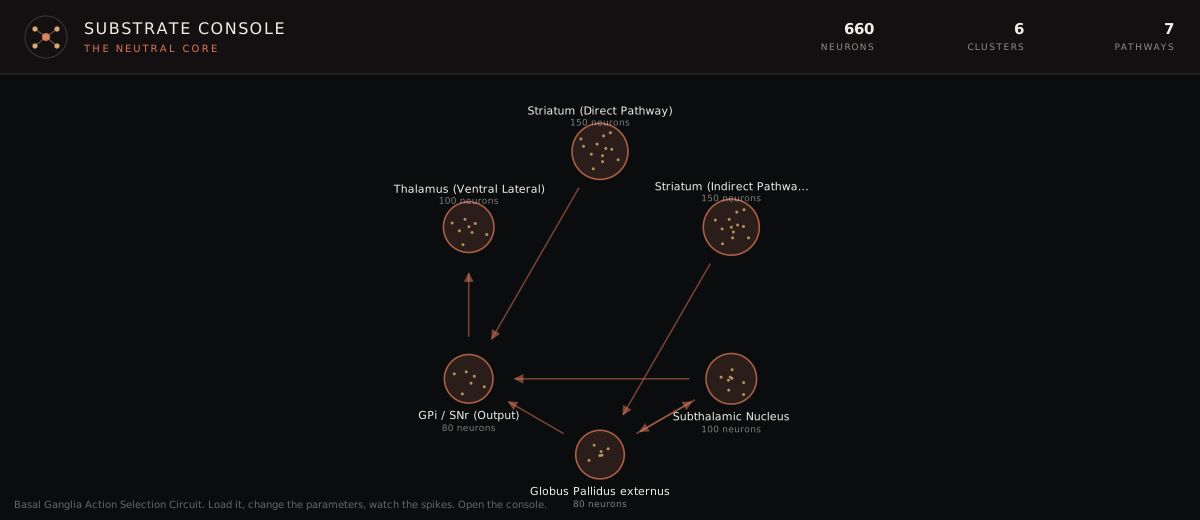
Unlike traditional Deep Learning which relies on rate-based activation, The Core utilizes Leaky Integrate-and-Fire (LIF) neuron models.
Generative Model
Karl Friston's Free Energy Principle (2010) proposes that biological systems minimize prediction error as a fundamental organizing principle. The Dream Engine applies this as a design constraint rather than a claim about consciousness.
tau_rc is adjusted automatically to hold the network near this point./consciousness/aci and /consciousness/probability ROS 2 topics. This is an experimental signal borrowed from biological data, not a validated measure of machine consciousness.Neural Firewall
To connect a machine to a human mind is to open a vector for "Brainjacking."
Digital Twin
A disembodied generative model is insufficient. The synthetic hemisphere requires a somatosensory anchor.
A purely predictive (productive) model replicates the internal inference dynamics of the cortex, but it cannot account for the electromagnetic environment the biological hemisphere inhabits. Rouleau & Cimino (2022, NeuroSci 3:3) report that neurons respond to self-generated electromagnetic fields as weak as 0.5 mV/mm via ephaptic coupling, and that mammalian theta and alpha rhythms phase-lock to the Earth's Schumann cavity modes at 7.83 Hz and its harmonics. A synthetic hemisphere that only minimizes prediction error could synchronize statistically while diverging on this transmissive input, causing a false positive at the hemispheric switch gate.
The engine therefore augments the generative model with a minimal transmissive channel: an exogenous ambient electromagnetic driver publishing a Schumann-harmonic reference, an ephaptic-coupling block that sums a low-passed self-field with the firewall-cleared signal and broadcasts the result as a scalar bias to the cortex ensemble, and a Phase-Locking Value (PLV) estimator over the theta band (Lachaux, Rodriguez, Martinerie & Varela, 1999, Human Brain Mapping). The hemispheric switch gate is dual-criterion:
Hemispheric transfer proceeds only when sync_health ≥ 0.95 AND PLV ≥ 0.80, sustained for 3 consecutive seconds.
Both criteria are independently falsifiable. Prediction error can fall while PLV stays low, indicating the synthetic side reproduces statistics but not phase. PLV can rise spuriously while prediction error remains large. The gate opens only when the synthetic hemisphere has matched the biological one on both axes. The ambient EM channel is routed through the same Neural Firewall that guards the satellite uplink, so a spoofed Schumann-harmonic injection at seizure-inducing frequencies is rejected at the same gate as any other malicious stream. The transmissive layer strengthens the Pycroft-style defenses rather than weakening them.
The research rests on a contested philosophical premise: that consciousness is a monistic phenomenon generated by a computable algorithm, and that replicating the algorithm in silicon would therefore replicate the relevant substrate properties. This is a minority position in philosophy of mind and has no empirical validation at this scale. The project proceeds on it as a working assumption, not a settled conclusion.
If that assumption holds, the relevant test would be a Uni-hemispheric Subjective Test:
"If a human subject, with one biological hemisphere and one 'Core' hemisphere, reports a unified visual field, machine consciousness is authenticated."
The protocol has two stages, neither of which has been conducted outside simulation. In Stage 1 (Shadow Mode), a double-sided CMOS micro-electrode array would be implanted at the corpus callosum. The Core would receive biological spike trains via the Neural Firewall with its output pathways gated, remaining in this state until Generative Error δ falls below intrinsic neural noise (<5% variance) and PLV reaches 0.80 sustained for 3 consecutive seconds.
In Stage 2 (The Switch), a reversible pharmacological agent would suppress the target biological hemisphere, and the Core's efferent channels would be un-gated. The hypothesis predicts a unified visual field with no perceptual discontinuity as objects cross the vertical meridian. A report of blindsight would falsify it.
At present, this remains a software simulation. The current focus is replicating visual optical illusions in a Unity 6 environment. A functioning predictive system should reproduce the same perceptual errors as a biological brain, such as the hollow-face illusion and motion-induced position shifts. Matching these illusions constitutes an early, limited, and falsifiable validation step.
The Neutral Consciousness Engine is one component of a four-layer speculative research platform being developed under the Zae Project. Each repository targets a different layer of the same long-horizon question. None of the layers are production-ready; all are in early research or simulation phase.
Full architecture specifications, protocol documentation, and the project bibliography are maintained at zae-docs.
For the position that only your own mind is certain. Every order funds the research.


