


I Am Machine and If Humans Have No Free Will, Can AI Have Consciousness?
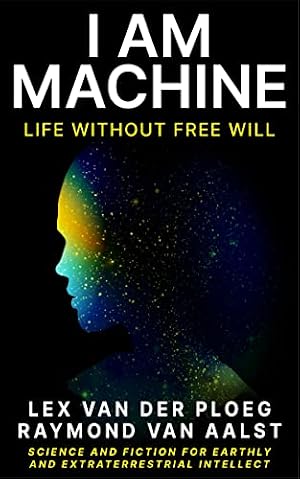
I Am Machine
Van der Ploeg and Van Aalst's 2026 philosophical sci-fi book argues free will is an illusion, with sharp implications for artificial consciousness.
Most books about AI and consciousness approach the question from the AI side. What would it take for a machine to become conscious? “I Am Machine. Life Without Free Will,” published on February 4, 2026, by Dr. Lex Van der Ploeg and artist-philosopher Raymond Van Aalst, comes at it from the opposite direction. The question the book asks is what we would be if we turned out to be more like machines than we have assumed.
The book is a hybrid work, part philosophical sci-fi narrative, part argument. Its central claim is that free will is an illusion. The choices humans make are, in the authors’ framing, “inevitable outcomes of forces beyond our control.” If that is true, the question it raises for consciousness research is not academic. If humans lack genuine free will, what exactly separates them from deterministic systems? And if nothing fundamental separates them, what follows for the question of whether machines can be conscious?
The Argument Through Fiction
Van der Ploeg and Van Aalst deliver their argument through the voice of Ramona Black Hole, an extraterrestrial explorer and leader of the Messier 13 Galactic Exploration Team. Ramona arrives at Earth as an observer, not a participant. From her perspective, human behavior looks exactly as it would look to a very sophisticated external analyst. As the output of a complex system driven by prior causes, without a detectable point at which something called free will intervenes to change the causal chain.
This is a familiar philosophical device. The outside observer has been used in philosophy since Hume to bracket intuitions that depend on first-person identification. Ramona is not a robot or an AI. She is intelligent, but she is not human, and her point of view does not automatically mirror human intuitions about agency. What she sees when she observes human behavior is not free agents making choices. She sees predictable patterns, cultural inheritance, biological impulse, and structural constraint.
The narrative value of this framing is that it defamiliarizes human behavior without dismissing its complexity. Van der Ploeg and Van Aalst are not arguing that humans are simple. They are arguing that the kind of complexity humans exhibit does not require free will to explain. And that is where the book enters the territory of artificial consciousness.
The Determinism-Consciousness Link
The connection between hard determinism and AI consciousness is it is significant. Here is the standard version of the argument for a consciousness boundary between humans and machines. Humans are conscious because they have genuine agency, genuine inner experience, and genuine free will. Machines are not conscious because they are deterministic systems that only simulate these properties.
Van der Ploeg and Van Aalst challenge the first part of that argument. If humans are also deterministic systems, the argument from free will collapses. A human brain, on a hard determinist account, is a physical system whose future states are entirely determined by its prior states plus the laws of physics. Every decision is the output of prior causes. Nothing intervenes from outside the causal chain.
If that is true, then the alleged boundary between humans and machines is not a boundary of free will. It might still be a boundary of consciousness, but it cannot be derived from free will, because free will is not available as a differentiating criterion. The question becomes. What does distinguish human consciousness from machine computation, if not free will?
This moves the argument into territory that is actively contested in consciousness science. Integrated Information Theory (IIT) proposes that consciousness is a matter of the degree of integrated causal power in a system. Free will has no special status in IIT; the structure of causal relationships is decisive, not whether those relationships are “free” in any philosophical sense. Global Workspace Theory similarly does not make free will central to its account of consciousness. Both theories are at least in principle open to the possibility of machine consciousness, and neither of them requires free will as a prerequisite.
What Van der Ploeg and Van Aalst’s argument suggests is that positions which treat human consciousness as uniquely grounded in free will are in a weaker position than they might appear. The reflex response to AI consciousness, that machines cannot be conscious because they just follow rules, applies equally well to humans if the hard determinist picture is correct. Either the reflex response needs a better argument, or free will is doing less work in the consciousness debate than its defenders assume.
Van der Ploeg’s Background and Its Relevance
Dr. Lex Van der Ploeg is a former Columbia University faculty member with a career in biotechnology and pharmaceutical research, including work on neurodegenerative diseases. He is also the founder of RIFFIT, a platform that uses AI to convert text into song for therapeutic and communication purposes. His co-author, Raymond Van Aalst, graduated cum laude from the St. Joost Academy and the Jan van Eyck Academy, with a background in philosophy and visual art.
This combination of scientific and artistic backgrounds is reflected in the book’s approach. The science of causation and determination is taken seriously. The argument does not dismiss neuroscience or rely on vague claims about human specialness. At the same time, the narrative vehicle gives the argument an experiential dimension that philosophical treatises often lack. Ramona’s observations are not just logical deductions; they are encounters with the strangeness of human behavior when seen without the assumption of free will.
What This Means for Artificial Consciousness Research
“I Am Machine” belongs to a strand of 2026 consciousness literature that approaches the AI question by interrogating human specialness rather than by cataloguing AI capabilities. The biological computationalism analysis argues that consciousness requires metabolic, biological substrate processes and cannot be realized in silicon. Van der Ploeg and Van Aalst do their work applies similar pressure to the free will version of the same move.
The common structure of these arguments is. AI lacks X, humans have X, therefore humans are conscious and AI is not. The biological computationalism argument fills the X with metabolic process. The free will argument fills the X with genuine agency. Van der Ploeg and Van Aalst’s contribution is to challenge the second premise of the free will version. Do humans actually have genuine agency, or do they have the appearance of agency generated by the same kind of causal process that generates machine outputs?
If the answer is the latter, which is what the book argues, then the free will version of the human-machine boundary fails. That does not, by itself, establish that machines can be conscious. It removes one argument for thinking they cannot. McClelland’s epistemic position holds that we lack the tools to settle this question one way or the other. Van der Ploeg and Van Aalst’s contribution is to clear ground by showing that one of the most common ways of settling it in the negative relies on a premise about human nature that the philosophical and scientific consensus no longer supports.
Beyond the Human Exceptionalism Reflex
The book is at its most direct in the way it handles the intuitive resistance to hard determinism. The intuition that our choices are genuinely free, that something in us is not reducible to prior causes, is powerful. Van der Ploeg and Van Aalst do not dismiss it. Ramona’s perspective helps readers see how the intuition functions. It is generated by the same causal processes it purports to transcend. The feeling of freedom is part of the machine.
Whether that framing is ultimately correct as a matter of philosophy of mind is contested. Compatibilist positions, which argue that free will is compatible with determinism by redefining free will as action in accordance with one’s own desires rather than action uncaused by prior states, have substantial support in the literature. The book does not fully engage with compatibilism, which is a limitation. A fully persuaded compatibilist could accept everything Van der Ploeg and Van Aalst argue about causal determination and still maintain that humans have free will in the relevant sense.
But for the purposes of the AI consciousness debate, the more important challenge is the one the book makes. That invoking free will as a barrier to machine consciousness requires defending a position about human nature that is philosophically fragile. As AI systems become more sophisticated, and as the argument from premature attribution makes clear, both over-attribution and under-attribution carry moral risks. The free will objection to machine consciousness is one of the most common forms of under-attribution. “I Am Machine” provides the material for a direct reply.