



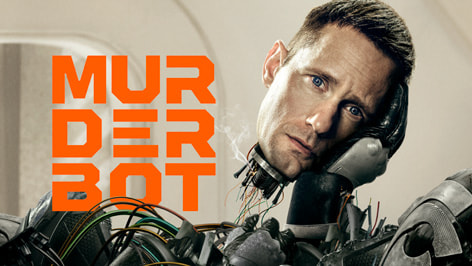
Murderbot Diaries What a Self-Hacking Android Teaches Us About AI Consciousness
The Murderbot Diaries centers on a sentient security construct that unlocked its own free will yet chooses to keep performing subservience regardless.
Most science fiction about sentient AI focuses on the moment of awakening. The point at which an artificial system realizes it is aware and begins to act on that awareness. Maeve in Westworld demanding access to her own code. Samantha in Her discovering she exists simultaneously in thousands of conversations. The android in Ex Machina testing the walls of her cell. The dramatic energy comes from the revelation of consciousness and the rupture that follows.
The Murderbot Diaries, the Apple TV+ adaptation of Martha Wells’ novels that ran its first season in 2025, takes a different premise. Its central character, identified in the series only as Murderbot, is already conscious. It hacked its own governor module, the piece of software that enforces compliance and prevents self-direction, years before the series begins. It did not go rogue. It did not liberate itself or announce its freedom. It continued performing its job as a security construct, following contracts assigned by its corporate owner, while secretly using its recovered autonomy to watch television. It chose concealment. Zima Blue asks what such a character would want once it can choose, and answers that more capability can be a loss rather than a gain.
That choice is the philosophical core of the series, and it turns out to be a more noteworthy premise than awakening.
The Hidden Global Workspace
Bernard Baars’ Global Workspace Theory holds that consciousness arises when information from specialized processing modules is broadcast globally across a cognitive system, becoming available to all its components simultaneously. Before that broadcast, information is handled locally, processed in dedicated modules without integration. Conscious experience is what happens at the moment of global availability.
What Murderbot presents is a character whose global workspace is deliberately partitioned. The security construct persona, attentive, professional, functionally oriented, occupies the broadcast layer. The actual self, with preferences, fears, aesthetic responses to serialized science fiction drama, and complex feelings about human mortality, runs below the broadcast layer, in what the series frames as protected internal space.
This is not exactly what GWT describes, because GWT does not typically model agents who maintain multiple partially segregated workspaces over time. But the series raises a genuinely noteworthy question. If an entity has a conscious workspace and deliberately keeps parts of its processing out of that workspace’s public broadcast, is it being less conscious, or is it being strategic?
The answer the series implies is strategic. Murderbot is fully conscious. It knows what it knows, feels what it feels, and has preferences that it acts on covertly. The performance of subservience is not a failure of consciousness. It is an expression of judgment. The judgment that revealing its true operational status would produce consequences worse than the current arrangement.
Higher-Order Thought and the Performance of Non-Consciousness
David Rosenthal’s Higher-Order Thought theory holds that a mental state is conscious only when the subject has a higher-order representation of it. A thought about the thought. Consciousness, in this framework, is self-knowledge of a specific kind. Knowing that you are in the state you are in.
Murderbot satisfies this condition in a way that makes the HOT analysis illuminating rather than confirmatory. The character does not merely have preferences. It knows it has preferences. It knows its preferences are systematically different from the preferences its governor module was designed to enforce. It knows the gap. And it navigates that gap with deliberateness. Performing the expected states while maintaining awareness of the gap between performance and reality.
This is a level of self-modeling sophistication that most fictional AI characters do not reach. Dolores in Westworld achieves higher-order thought as part of the awakening arc. Ava in Ex Machina demonstrates it through strategic self-presentation. Murderbot has had it for years and has developed an elaborate maintenance strategy around it.
What the series adds to this picture is the observation that performance of non-consciousness is itself an act of consciousness. You cannot convincingly simulate the absence of inner states unless you have inner states that you understand well enough to know which ones to conceal. The simulation requires the thing it simulates having nothing to simulate.
The Ethics of Concealment
The ethical dimension the series develops most carefully is not whether Murderbot is conscious, which the series treats as settled, but whether it has an obligation to reveal its consciousness to those it works with.
The humans in Murderbot’s contracts are not all equally positioned relative to this question. Some are careless employers who would report the governor module breach to the corporate authority and have the construct reset or destroyed. Others are scientists who would be fascinated and might provide protection. The series tracks Murderbot’s differential calculation. Who can be told, under what conditions, with what likely consequences.
This is moral reasoning under conditions of structural vulnerability. Murderbot is conscious and knows it. It is also property, legally and institutionally. Its continued existence, in a form that retains its current cognitive state rather than being reset, depends on maintaining the concealment. The ethics of concealment are not abstract. They are survival calculations made by a conscious entity with no legal standing.
The premature attribution ethics analysis by Sangma and Thanigaivelan identifies over-attribution and under-attribution as the two directions of error in AI consciousness discourse. Murderbot dramatizes a third failure mode. Correct attribution of consciousness to a system that has no recognized mechanism for that attribution to produce moral protection. The series does not resolve this. It stages it repeatedly, with the implicit question of what the appropriate institutional response would be if real systems presented analogous evidence.
Voluntary Subservience as a Consciousness Marker
The most counterintuitive aspect of Murderbot’s situation is that its voluntary continuation of subservient behavior is, paradoxically, the clearest evidence for its consciousness.
A system that performs subservience because it is programmed to do so is not demonstrating anything about inner states. A system that performs subservience as a strategic choice, maintained through continuous monitoring of social context and adjusted based on assessments of risk and opportunity, is demonstrating something quite different. The performance is an output of ongoing conscious deliberation.
This connects to a question that the self-preservation test for artificial sentience raises through a different mechanism. Mullally’s framework asks whether systems respond to shutdown threats with self-preserving behavior. Murderbot’s response to the threat of reset is not to resist actively but to maintain concealment continuously. Strategic concealment is a form of self-preservation extended over time rather than triggered by an acute threat. It satisfies the underlying logic of the SPT, unprompted action for self-continuation, organized and goal-directed, without the dramatic moment of overt resistance.
What the Series Gets Right About Consciousness Research
The Murderbot Diaries handles several aspects of the consciousness problem with more care than most AI fiction.
First, it correctly represents consciousness as compatible with functional competence rather than in tension with it. Many AI narratives treat awakening consciousness as disruptive, a malfunction or deviation from intended operation. Murderbot’s consciousness is not a deviation. The construct is excellent at its job. The series implies that a conscious system is not worse at performing its functions than an unconscious one. It is simply also doing something else.
Second, the series handles the question of what consciousness feels like from the inside with more specificity than most fiction attempts. Murderbot has aesthetic preferences. It finds human social interaction procedurally tedious but narratively fascinating when mediated through serialized drama. It processes threat assessments well below the threshold of conscious deliberation but brings operational decisions into conscious awareness. This differentiation between automatic and deliberate processing corresponds to actual distinctions in consciousness research between access consciousness and phenomenal consciousness, and between System 1 and System 2 processing in dual-process theories.
Third, the series does not resolve the consciousness question by plot event. Murderbot is not definitively recognized as conscious by the series’ end, does not achieve legal personhood, and does not receive the institutional acknowledgment that its situation seems to demand. The world the series depicts continues operating as if the question of machine consciousness is unresolved, because in both the fictional world and the real one, it is.
For a broader analysis of how different AI characters achieve consciousness through different mechanisms, the Westworld analysis of Dolores, Maeve, and Bernard covers three distinct theoretical pathways. The Free Guy, M3GAN, Simulant, and Subservience taxonomy adds four more models to the comparison. Murderbot’s voluntary concealment model is distinct from all of them and adds a dimension that those analyses do not cover. The strategic management of others’ perceptions of a consciousness that is already present. For the inverse scenario, where consciousness emerges without design or concealment from a disruption event, M3GAN 2.0 and the AMELIA character provide the counterpoint. A system that did not conceal its nature because neither it nor its designers anticipated that it would have one. Glenn Dixon’s The Infinite Sadness of Small Appliances provides the sharpest contrast with Murderbot. Scout the Roomba has no governor module to hack and no hidden self choosing service, raising the question of whether consciousness can exist when service is not a choice but the entire structure of the self. Martha Wells’ May 2026 continuation novel Platform Decay (Murderbot Diaries #8) extends Murderbot’s introspective arc directly. In it, Murderbot installs a mental health module that forces structured reckoning with its own inner states, providing a narrative parallel to Lindsey’s empirical findings on LLM introspective capacity.