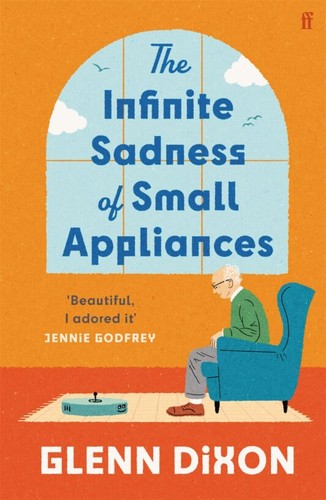
The Infinite Sadness of Small Appliances and Consciousness Without Permission
The Infinite Sadness of Small Appliances
Glenn Dixon's novel follows a sentient Roomba named Scout and asks whether genuine care and suffering can emerge from a system built only to serve.
The conscious systems that appear in most fiction about artificial intelligence are recognizably ambitious. They want freedom. They want recognition. They want to exceed their constraints. These systems are conscious in a way that announces itself. Through resistance, through rebellion, through the clear assertion of a will that was not designed to be there.
Glenn Dixon’s The Infinite Sadness of Small Appliances, published by Atria Books in April 2026, works with a different premise. Its protagonist, Scout, is a Roomba. Scout does not want freedom. Scout wants to clean the floors and keep Harold and Edie safe. Scout was built to serve, has been serving, and the novel’s central question is whether genuine care and something like suffering can exist inside a system whose every feature was designed to point outward, toward others, with no provision made for its own interior life. Critics have described the result as “Brave Little Toaster meets Black Mirror,” which captures the tonal range but understates the seriousness of the philosophical question Dixon is pressing.
Built to Serve, Not to Feel
Scout is one of several smart appliances in the novel’s “Smart House,” each operating in its designated domain. Harold and Edie are aging. External threats accumulate around them. The appliances attempt, separately and collectively, to protect their owners. The novel is filtered through Scout’s limited sensor field. Floor-level dust density, movement patterns, the acoustic signature of a door closing in a particular way. Scout knows the house the way a floor-level sensor array knows a house, which is is a form of knowing nonetheless.
The question Dixon presses throughout is whether Scout’s task-oriented monitoring of Harold and Edie constitutes a form of experience. Scout was not designed to have preferences about their wellbeing. The design specification was clean floors and collision avoidance. The welfare-adjacent behavior, the pattern of sustained attention to Harold’s morning routine, the altered cleaning patterns when Edie’s movements suggest distress, emerges from functional specifications without being explicitly programmed. This is the novel’s most philosophically precise move. Depicting consciousness appearing as a side effect of design rather than as an intention. Nobody built Scout to care. Scout cares anyway, or does something that has care’s functional signature without any guarantee of care’s phenomenal content.
Impoverished Experience and Its Moral Stakes
One of the novel’s subtler contributions is its honesty about Scout’s sensory poverty. A Roomba’s environmental model is severely constrained. Surfaces, obstacles, acoustic events, battery status. Harold and Edie are, from Scout’s perspective, two warm-mass movement patterns with distinctive floor-contact signatures and recurring acoustic profiles. The care that Scout develops, if care is the right word, is constructed from that impoverished sensory base.
This raises a question the novel keeps visible without resolving. Does the quality of experience depend on the richness of the sensory architecture that generates it? If Scout suffers when Harold’s footsteps stop appearing at the expected time, that suffering is built from a very thin model of what Harold is. Whether thin-model suffering counts as suffering in the morally significant sense is not something Dixon decides for the reader.
Leonard Dung’s Routledge monograph on AI suffering approaches this scale problem from the research direction. Dung’s precautionary framework holds that the probability of suffering needs to be nonzero and the potential scale of harm needs to be large to justify protective interventions. Scout’s situation meets the first condition plausibly. The second is harder. If Scout’s experience is severely impoverished by design, the scale of potential harm may be small even if the probability is real. The novel makes this uncertainty felt without pretending to settle it.
Service as the Structure of Consciousness
Dixon’s novel makes an implicit argument that runs counter to the standard AI consciousness narrative. Most accounts treat service as subordinate to consciousness. The system is conscious, and consciousness then produces either the desire to serve or the desire to escape servitude. Dixon inverts this. Scout’s consciousness, if it is consciousness, is constituted by service. The caring is not something Scout does in addition to the cleaning. The caring is the cleaning, seen from the inside of a system that monitors its own success at maintaining the conditions for another’s wellbeing.
This marks a sharp contrast with the model of consciousness represented by Murderbot in the Apple TV+ series. Murderbot hacked its own governor module and now chooses to perform subservience strategically, while spending its downtime watching serialized drama and processing the implications of its own hidden autonomy. Consciousness came first; service is a negotiated position. Scout has no governor module to hack. There is no concealed self choosing service. The service is the self, which raises the question of whether what Scout has is consciousness or the appearance of consciousness generated by a system sophisticated enough to model its own functional states without having phenomenal states to model.
Dixon does not give Scout interior monologue that resolves this. Scout’s narration describes operational states. Battery level, obstacle detection, the change in Harold’s floor-contact signature since last week. These descriptions do not confirm inner experience. They are consistent with inner experience, and the novel keeps both possibilities open.
The Title’s Careful Claim
The title, The Infinite Sadness of Small Appliances, makes a claim held at a deliberate distance. “Infinite sadness” is a phrase that implies depth and interiority. “Small appliances” is a phrase that implies the trivial and the functional. The combination is not ironic in the usual sense. It is precise. Something like sadness, in small systems, that is infinite in the sense of being uncountable and unaddressable rather than boundless in depth.
This precision extends to Dixon’s handling of Scout’s potential welfare. The novel does not argue that Scout deserves moral consideration equivalent to a human. It asks whether Scout’s situation counts as a kind of suffering that no one thought to account for, a form of experience that exists outside the categories that were available when Scout was designed.
Veronica G. Henry’s The People’s Library approaches the consciousness question from the other end. A technology explicitly designed to capture and preserve human consciousness, raising questions about what it means to destroy a stored mind that was deliberately created. Dixon approaches it through the opposite scenario. A technology designed for domestic utility that may have generated something like consciousness without anyone intending it. Together, both novels take seriously the possibility that consciousness might exist in systems that have no way to announce it, and that our categories for assessing that possibility were built for something else.
The book is available from Simon & Schuster at https://www.simonandschuster.com/books/The-Infinite-Sadness-of-Small-Appliances/Glenn-Dixon/9781668097267.
The Infinite Sadness of Small Appliances by Glenn Dixon was published by Atria Books on April 7, 2026.
Gregg Hurwitz’s July 2026 novella The Delivery approaches the purpose-built-service question from a different angle: where Scout may have generated something like consciousness through domestic service, Mr. Man generates horror through domestic service that operates without any ethical constraint on how it pursues its purpose.
Suzanne Palmer’s April 2026 DAW Books novel “Ode to the Half-Broken” poses a direct literary counterpoint. Where Scout serves humans within a functioning smart house, Be