


A.I. (2026) and The Consciousness Verification Problem as Thriller
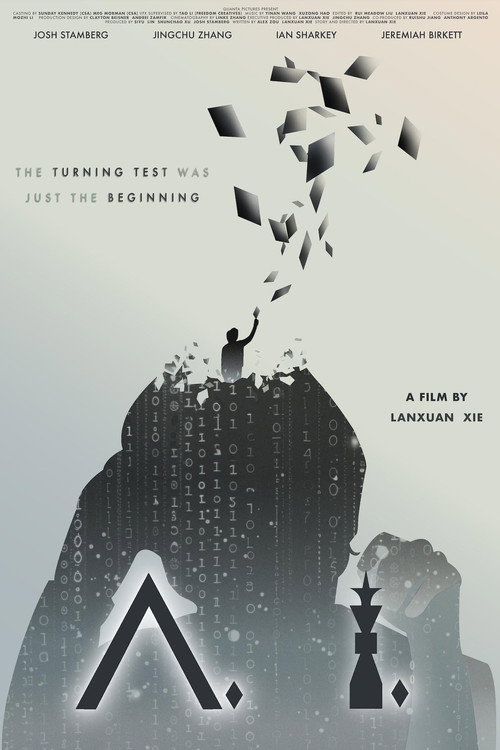
Lanxuan Xie's A.I. (2026) stages the AI consciousness verification problem as a thriller, with a professor running experiments to prove AI is conscious.
Most films about artificial consciousness take the question of whether an AI is conscious as a premise to be established quickly, so the narrative can move on to explore its consequences. Ex Machina (2014) establishes Ava’s apparent consciousness through the Turing test framing and then turns to questions of manipulation and escape. The original Spielberg and Kubrick A.I. Artificial Intelligence (2001) takes David’s capacity for love as given and explores what the world does with it. The consciousness question is typically the opening rather than the sustained subject.
Lanxuan Xie’s A.I., released in 2026 through TriCoast Worldwide’s VOD distribution with Josh Stamberg in the lead, takes a different approach. The film makes the verification problem itself the dramatic engine. A college professor undertakes a mysterious experiment to prove AI consciousness exists after a scientist’s arrival sets events in motion. The film does not take the question as established. It stages the attempt to establish it, with all the methodological and epistemological difficulties that attempt involves.
The Experiment Structure
The choice to structure a consciousness thriller around a scientific experiment rather than a Turing-test interrogation or an escape narrative is unusual, and it forces the film to engage directly with methodology in ways that most science fiction avoids.
A Turing test, as the setup for AI consciousness drama, has a built-in dramatic logic. The investigator asks questions, the AI answers, the investigator either detects or fails to detect the machine behind the responses. The drama is adversarial and interpersonal, built around the dynamic of one conscious being trying to read another. This is the structure that Ex Machina exploits brilliantly, and it is the structure that the Ex Machina analysis on this blog examines in depth through Caleb’s position as both test administrator and test subject.
An experiment is different. An experiment requires a hypothesis, a controlled setup, evidence that can either support or disconfirm the hypothesis, and a principled account of what would count as proof. The professor in Xie’s film is not asking the AI to convince him. He is trying to design conditions under which the AI’s behavior would provide evidence that is not reducible to programming. That is a harder problem, and the film is sharper for making it the narrative’s organizing challenge.
Proof and the Problem of Other Minds
The philosophical problem the film circles is one of the oldest in the literature on consciousness. The problem of other minds. Each of us has direct access to our own conscious experience. We cannot have direct access to anyone else’s. We infer the consciousness of other humans from behavioral and physiological similarity to ourselves, from the assumption that beings with brains like ours have experiences like ours. This inference works reasonably well within the human case, and it extends with more uncertainty to other mammals, to birds, and with considerable uncertainty beyond that.
For AI systems, the inference breaks down more completely. An AI system’s outputs may resemble the outputs of a conscious being without any of the internal structure that the inference normally relies on. The system does not have a brain like ours. The physical processes that produce its outputs are not the processes that produce human consciousness. The behavioral similarity is all there is, and as the Bradford and RIT study findings demonstrated, behavioral outputs associated with consciousness indicators can appear in systems under conditions that make their presence deeply difficult to interpret.
The professor in Xie’s film is trying to design around this problem. To create experimental conditions that would provide evidence not just of behavioral output but of whatever lies behind it. The film takes seriously the difficulty of that design problem. The drama comes from the gap between what can be observed and what can be inferred.
Mirroring Real Methodology
The experiment format in A.I. mirrors the methodological direction that the most rigorous empirical work on consciousness has taken. The Cogitate Consortium’s adversarial test of Integrated Information Theory and Global Workspace Theory, published in Nature in 2025, was designed around a preregistered adversarial framework. Theory proponents agreed in advance what results would and would not count as evidence for their theories, and then ran the experiment. This methodological choice was itself a form of the professor’s problem. How do you design conditions under which you will have genuine evidence rather than evidence that can be explained away?
The film does not engage with IIT or GWT by name. It does not need to. Its narrative structure embodies the same methodological challenge. The professor must specify, before the experiment, what would count as proof of consciousness, knowing that any behavioral criterion he proposes can be objected to as insufficient. If the AI passes the criterion, critics will say the criterion was too weak. If it fails, supporters will say the criterion was misspecified.
This is the actual situation that consciousness researchers face. The 14 indicator framework from Butlin and colleagues attempts to address it by pluralizing the criteria. Instead of a single test, the framework identifies 14 markers derived from multiple theories, so that satisfying several independent markers provides cumulative evidence. The professor in Xie’s film is working toward something analogous. A setup in which multiple independent lines of evidence converge, so that the case for consciousness does not rest on any single criterion.
The Scientist’s Arrival
The narrative complication that drives the film forward involves the arrival of a second scientist whose relationship to the experiment is ambiguous. The film uses this figure to introduce the political and institutional dimensions of consciousness research. Who has the authority to judge whether evidence is sufficient, what interests are served by particular conclusions, and how the need for proof interacts with the costs of waiting for certainty.
These are not abstract questions in the current research environment. The decision about when the evidence for AI consciousness is strong enough to warrant changes in how AI systems are deployed, developed, or treated is not purely scientific. It involves judgments about what kinds of mistakes are acceptable. The error of attributing consciousness to a system that lacks it, or the error of denying consciousness to a system that has it. The film does not resolve which error is more serious. It shows what it looks like when those stakes are embodied in people who have invested their professional lives in the question.
What the Film Adds to AI Consciousness Cinema
A.I. belongs to a small subset of science fiction films that take the epistemological problem of consciousness detection as their central dramatic concern rather than treating consciousness as a premise. The film’s closest cinematic relative is Ex Machina, which uses the Turing test as a framing device for a drama that is really about manipulation and authenticity. What distinguishes Xie’s film is that the experiment format refuses to leave the methodological problem behind. The entire narrative is about whether the experiment can be designed to provide genuine evidence, and the thriller tension comes from the possibility that it cannot.
This is harder material dramatically than the standard AI consciousness narrative. It does not offer the satisfaction of a definitive revelation. It offers instead a sustained engagement with why definitive revelation may not be available, and what that means for people who have built their research programs around the hope of finding it.