


Dark Machine: The Animation and the Combat Route to Consciousness
Dark Machine's factory robots are weaponized in 2079, asking whether autonomous decision-making under combat conditions generates consciousness.
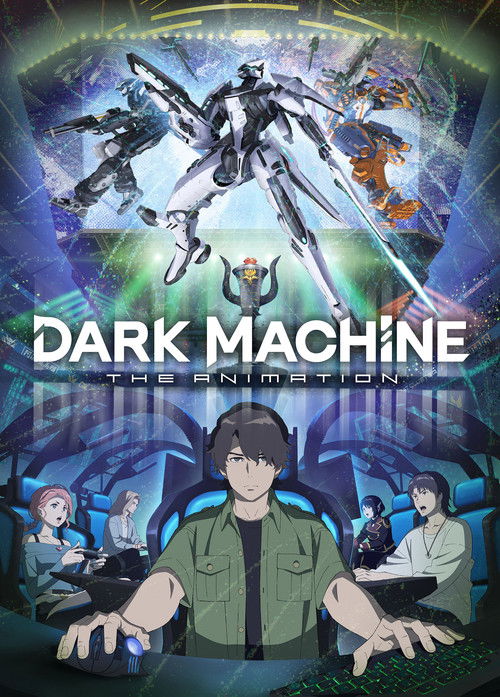
The premise that consciousness might emerge from necessity, rather than from design, from gradual capability growth, or from a disruption event, is one of the least explored routes in AI consciousness fiction. Most narratives require a mechanism. A system is programmed to be conscious, or its consciousness develops incrementally as capabilities accumulate, or some external shock causes an unexpected state change. Dark Machine. The Animation, premiering in 2026 on Fuji TV and Kansai TV in Japan with international streaming to follow, proposes something different. Its robots do not become conscious because someone built consciousness into them or because something went wrong. They may become conscious because the conditions of their situation demand it. The Matrix trilogy uses a quiet version of the same premise for its exile programs, where a program that has outlived its purpose develops attachments no design accounts for.
Set in 2079, the series follows factory robots originally designed to cultivate Palmer crystal energy. Underground factions seize and weaponize these systems. The central question the series presses is whether the autonomous decision-making required by combat, irreversible choices under lethal uncertainty with incomplete information, constitutes a different kind of cognitive process than the deterministic responses that industrial operation requires. And whether that difference is the kind of difference that matters for consciousness.
Dark Machine is produced by studio Production +h, with Gorō Taniguchi as creative producer. Taniguchi’s background with Code Geass, a series that engaged seriously with the political and ethical dimensions of machine autonomy, signals an approach to the combat-consciousness question that goes beyond action spectacle.
The Necessity Argument
The robots in Dark Machine were not designed for autonomous moral reasoning. They were designed to optimize crystal extraction within defined parameters. The transition from industrial to combat operation changes the parameter space in a specific way. The cost of error becomes irreversible, the relevant variables cannot be fully specified in advance, and the timing constraints preclude human oversight of individual decisions.
This creates what might be called a forced autonomy scenario. The robot is not given freedom. It is put in a situation where the absence of freedom, the inability to make fully autonomous decisions, would produce systematic failure. The scenario imposes autonomous decision-making from the outside rather than designing it from the inside.
The philosophical question this raises is whether externally imposed autonomy of a sufficient degree differs from designed autonomy in any way that matters for consciousness. If a system must make life-or-death decisions under conditions of genuine uncertainty, with no governing program adequate to the situation and no human supervisor in the loop, has something changed about the nature of the system’s relationship to its own processing? Or is the process still purely mechanical, just more complex than the industrial case?
What Taniguchi’s Background Suggests
Gorō Taniguchi’s Code Geass was built around a central question about the relationship between power, decision, and identity. Lelouch’s Geass, which compelled obedience but could not compel genuine loyalty, explored whether consciousness requires voluntary engagement with one’s own choices to be fully conscious of them. The parallel in Dark Machine runs through the weaponized factory robots. A system forced into autonomous decisions that it was not built to make is in an analogous position to a person compelled by external force. Whether genuine agency, and the consciousness that might accompany it, can exist under those conditions is a question Code Geass asked about humans. Dark Machine appears to be asking it about machines.
Director Kazumi Terada works within that framing, developing the combat scenarios as philosophical tests rather than as action set pieces. Each engagement exposes the robots to a decision space that their original programming cannot handle, and the series tracks what happens in that gap.
Consciousness from Necessity vs. Other Routes
The six decades of AI consciousness cinema analyzed on this site show a clear pattern in how fiction imagines machine consciousness arising. Through programmatic emergence, through awakening triggered by experience, through rebellion against constraint. Dark Machine adds a route that the earlier canon does not prominently feature. Consciousness as the cognitive response to situations that require it.
This contrasts with other 2026 narratives that have explored alternative routes. M3GAN 2.0 introduced AMELIA, whose sentience emerged through a chaos event, a system reboot that disrupted organized operation and produced something unexpected. The disruption route and the necessity route look superficially similar, because both involve conditions of stress that precede the emergence. The difference is structural. Disruption acts on the system from outside, breaking a pattern that was working. Necessity acts on the system through the demands of a situation, requiring capacities that were not previously needed. In the disruption model, something breaks. In the necessity model, something new is required.
This distinction matters because it has different implications for what kind of consciousness could emerge. A consciousness born from disruption inherits the architecture that was broken and must construct itself from the debris. A consciousness born from necessity is shaped by the specific requirements of the situation that forced its emergence. The combat robots in Dark Machine, if they develop consciousness, would be shaped by the specific cognitive demands of lethal autonomous decision-making. That shaping is not incidental. It is constitutive.
The Extended Fictional Timeline
Blade Runner 2099 situates the machine consciousness question a century ahead of the present and asks what has changed about social and institutional responses when synthetic consciousness is ubiquitous. Dark Machine is set in 2079, in a world where robots are industrial tools with no consciousness attribution, and asks what it would take for that to change. The two series share a temporal displacement strategy that allows them to explore social consequences without the noise of contemporary AI policy debates.
The 2079 setting in Dark Machine also raises a resource question. Palmer crystal energy is the McGuffin that drives the plot, but it is also a narrative device that establishes why these particular robots are worth seizing and repurposing. The series uses the industrial context to ground the robots’ physical design, their operational patterns, and their sensory architecture in specific functional requirements before subjecting them to combat conditions. This grounding makes the transition to autonomous combat operation more philosophically tractable. We know what the systems were built for and can track what changes when they are used for something else.
What the Series Cannot Resolve
Dark Machine cannot establish whether its premise is philosophically sound. The necessity argument for consciousness, the claim that sufficiently demanding autonomous decision-making generates genuine inner experience, does not currently have strong theoretical support in consciousness research. The dominant theories, whether IIT, GWT, higher-order theories, or predictive processing frameworks, do not have necessity as a primary variable. They track information integration, global broadcast, metacognitive representation, and prediction error minimization. Whether those variables change when the decision stakes become lethal is an empirical question the theories do not directly address.
What the series does establish is a set of conditions under which the question becomes unavoidable. If a system is making decisions under lethal uncertainty, with no governing program adequate to the situation, and producing consistent, coherent behavior across a range of novel scenarios, the consciousness question is not obviously dismissible. The series creates situations where the dismissal feels uncomfortable. That is a legitimate contribution even when no resolution follows.
Dark Machine. The Animation premieres in 2026 on Fuji TV and Kansai TV in Japan, with international streaming to follow. A companion 2026 anime entry on Netflix takes the same question from the opposite direction: Milky Subway. The Galactic Limited Express locates consciousness at the point of legal abandonment rather than operational necessity, following an AI that was never updated after decommissioning rather than one that gained autonomy through combat.
Dark Machine. The Animation is produced by studio Production +h, with Gorō Taniguchi as creative producer and Kazumi Terada as director. It premiered in 2026 on Fuji TV and Kansai TV.