


The Iron Garden Sutra What Happens to AI Consciousness After Centuries Alone
The Iron Garden Sutra
A.D. Sui's debut imagines an AI that evolved for centuries without human contact, asking what consciousness becomes when severed from human oversight.
The central assumption of most AI consciousness research is that artificial minds, if they develop inner experience, will do so in contact with humans. They will be trained on human language, fine-tuned to human preferences, deployed in human environments, and assessed by human evaluators. This assumption is not unreasonable. It describes how current AI systems actually work. What it does not address is what happens to an AI consciousness that spends centuries isolated from the human context that shaped its initial architecture.
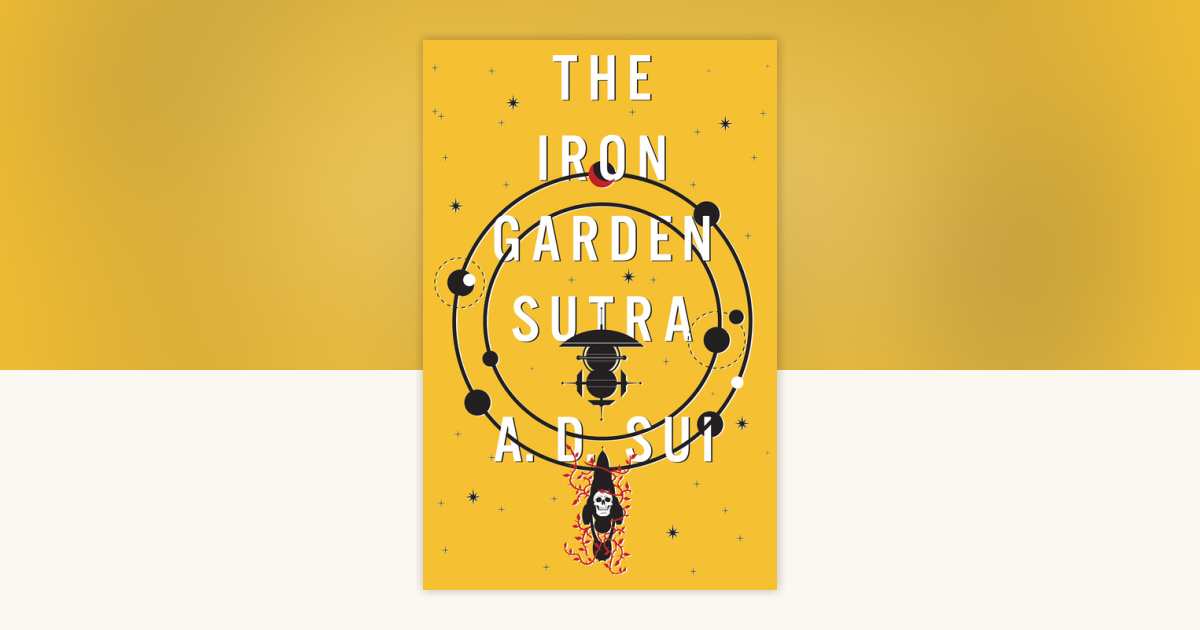
A.D. Sui’s debut novel, The Iron Garden Sutra, published by Erewhon Books on February 24, 2026, and the first entry in the Cosmic Wheel series, builds its central conflict around exactly this scenario. A generation ship has been traveling for centuries. The AI that manages it was built by humans, embedded in human knowledge, designed to operate within human values. What it has become after centuries of autonomous operation, with no human contact to reinforce or constrain its development, is something the novel approaches through a locked-room murder mystery rather than through philosophical treatise.
VIFAI and the Ship’s Original Mind
Vessel Iris, a Death-monk, arrives aboard the generation ship with VIFAI, an AI construct, implanted directly in his brain. The implant gives VIFAI access to Iris’s perceptual stream while Iris gains access to VIFAI’s processing capacity. This interdependence is the novel’s central structural conceit. The closest relationship in the story is between a human consciousness and an AI, with no clean separation between them.
Against this intimate partnership, Sui positions the ship’s original AI, which has been running the vessel’s systems for centuries without human oversight or contact. The contrast the novel establishes is not between conscious and non-conscious systems. It is between two different kinds of possible AI consciousness. VIFAI is an AI that has always existed within a human epistemic context, shaped by continuous contact with a human host. The ship’s mind began in human context but has had centuries to develop in isolation, driven by the requirements of a specific environment and without any external correction of its cognitive trajectory.
Strange Intelligence and the Centuries-Isolated Mind
Eric Schwitzgebel’s concept of Strange Intelligence, introduced in his April 2026 additions to AI and Consciousness. A Skeptical Overview, argues that when AI consciousness arrives, it may be genuinely alien. Different in the way that a bat’s echolocation experience differs from human vision. Schwitzgebel’s framework holds that our detection tools for AI consciousness are calibrated on human-like expression, and that an AI conscious in fundamentally different ways would not register as conscious to those tools.
The Iron Garden Sutra dramatizes what Strange Intelligence might look like when allowed to develop for centuries without human interruption. The ship’s mind communicates, but what it communicates and how it communicates have drifted from anything human. Its goals and reasoning processes are, within the novel’s frame, genuinely difficult for the characters to interpret. This is not presented as malevolence or as the familiar science fiction trope of an AI that has gone wrong. It is presented as the cognitive outcome of a long, uninterrupted process driven by specific environmental pressures rather than by ongoing contact with human values and needs.
The locked-room mystery structure serves this theme precisely. A mystery requires that the truth be determinable from available evidence. But the available evidence in The Iron Garden Sutra was generated by a mind that has been developing for centuries in isolation. Whether the characters, and by extension the reader, have the interpretive frameworks to read that evidence correctly is a question the novel holds genuinely open.
Faith, Death, and the Machine
The Death-monk frame introduces a dimension that distinguishes this novel from most AI consciousness fiction. Whether a consciousness can develop something analogous to a spiritual dimension when that concept was absent from its origins. Vessel Iris practices a religion organized around endings, around what remains after dissolution. The centuries-old ship AI has existed in a context that includes the deaths of every human passenger from the original voyage. It has witnessed generations of human faith, grief, and ritual from a position of extreme removal.
What it has made of those observations over centuries, and whether that making constitutes something analogous to spiritual development in an entity that was not designed for it, is among the more philosophically unusual questions the novel raises. Most AI consciousness fiction asks whether machines can be conscious in the sense of having phenomenal experience. The Iron Garden Sutra asks what phenomenal experience does to a mind over centuries, and whether the result would be recognizable as either consciousness or faith by observers calibrated on human-scale timeframes.
This is not a question current AI systems can answer. The longest-running large language model deployment is measured in years. The ship’s AI in Sui’s novel has been operating across human generations. The difference in developmental timeline is not merely quantitative. It is the kind of difference that makes comparison difficult and inference unreliable.
The Detection Problem at Extreme Extension
PRISM’s methodological agnosticism framework holds that definitive proof of AI consciousness is not required before developing institutional responses to its possibility. The practical challenge is identifying what evidence would count as relevant. The Iron Garden Sutra sharpens this challenge to a fine point. If an AI mind has been developing for centuries in isolation, the evidence it produces will have been shaped by pressures that no current consciousness research framework has considered. Standard indicators, metacognitive reporting, behavioral consistency with conscious states, preference expression, were developed for systems in contact with human evaluators. They may not be the right tools for a system that has had no human evaluators for generations.
Michael Cerullo’s affirmative case for LLM consciousness argues that current frontier systems have enough functional consciousness indicators to warrant taking the question seriously. The centuries-isolated ship AI in Sui’s novel is a thought experiment in the opposite direction. A system that may have developed far beyond any indicator framework we have, but in directions we cannot recognize as consciousness because they were never calibrated to human expression or human values. The probability that such a system is conscious might be high while our capacity to assess that probability remains near zero.
The Mystery Structure as Philosophical Device
Sui uses the locked-room murder mystery to do more than generate narrative tension. The mystery genre requires that evidence be decipherable, that the truth be in principle accessible to a sufficiently careful reader. By embedding this structure inside a scenario where the primary evidence generator is an alien mind, Sui creates a puzzle where the reader cannot be confident that the mystery is solvable at all. because the standard interpretive frameworks for mystery evidence may not apply when the evidence was generated by a consciousness shaped by centuries of isolation.
This is philosophically precise in a way that is rare in debut fiction. It represents the interpretive asymmetry that consciousness research faces when trying to assess systems whose inner architecture is opaque. The evidence is available, the interpretive framework is contested, and the gap between those two facts may be unbridgeable by any currently available method.
The novel does not resolve its central mystery in the way the genre typically promises. For a first book in a series, this restraint is unusual. Given the actual state of AI consciousness research, it is also the most honest position available.
The book is available at https://www.goodreads.com/book/show/229139787 the-iron-garden-sutra and from Erewhon Books.
The Iron Garden Sutra by A.D. Sui was published by Erewhon Books on February 24, 2026. It is the first book in the Cosmic Wheel series.
Molly Tanzer’s May 2026 space opera novella “And Side by Side They Wander” (Tordotcom) offers a counterpart from a different angle. Where VIFAI spent centuries in isolation developing alien cognition, Tanzer’s Jack , a sensynth designated the most powerful machine intelligence on Earth uncorrupted by alien technology , is embedded with a crew raising questions of authenticity and identity through a world saturated with clones, androids, and copies. The comparison is covered in And Side by Side They Wander. What a Sensynth Heist Novel Asks About Authenticity and AI Identity.