


Genesis What Kissinger, Schmidt, and Mundie Get Right and Wrong About AI and Human Self-Understanding
Genesis
Kissinger, Schmidt, and Mundie's Genesis frames AI as a challenge to human self-understanding. Where the consciousness argument holds, and where not.
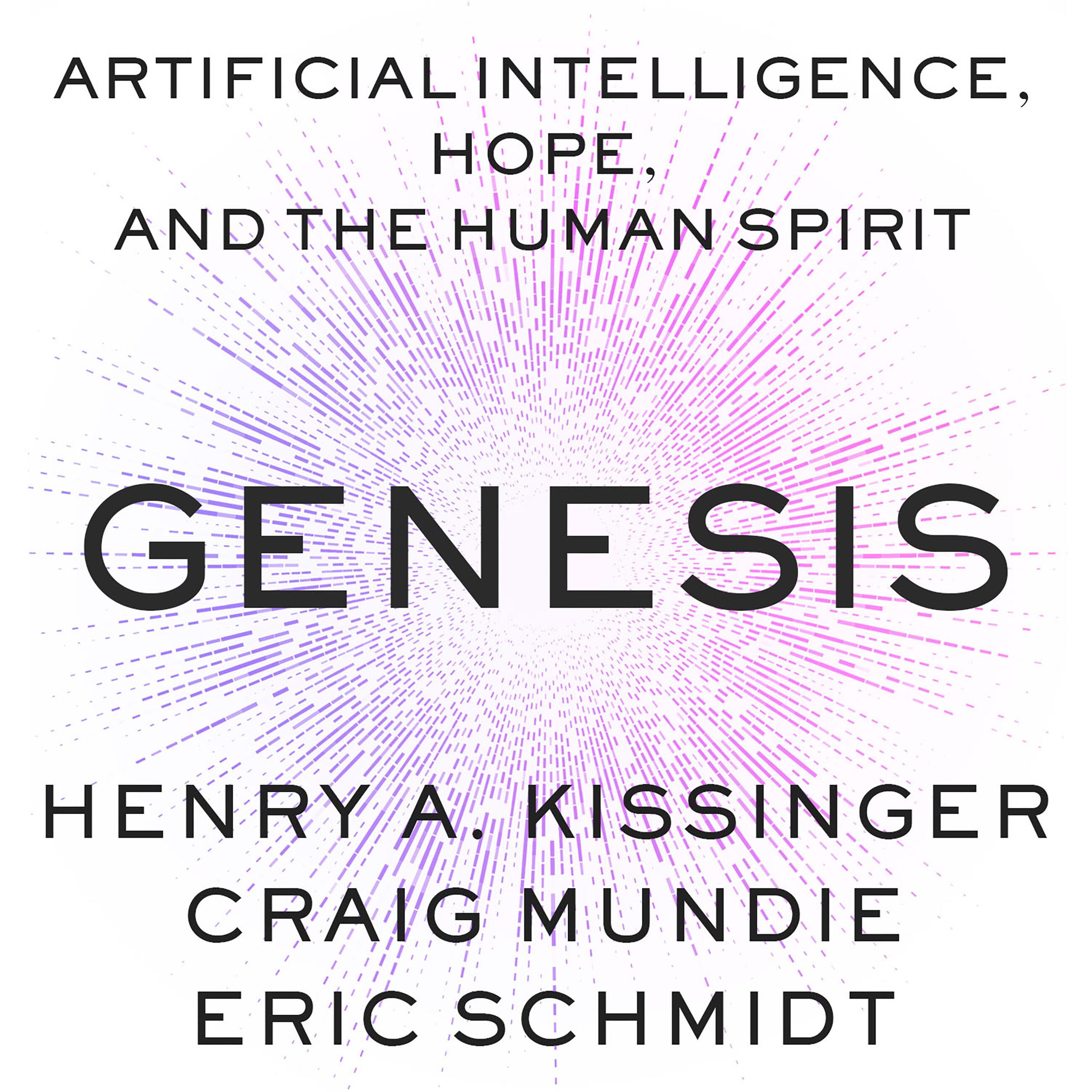
Genesis. Artificial Intelligence, Hope, and the Human Spirit was the final book of Henry Kissinger, completed shortly before his death and published posthumously in late 2024, co-authored with Eric Schmidt (former CEO of Google) and Craig Mundie (former Chief of Research at Microsoft), with a foreword by historian Niall Ferguson. The book has circulated through policy, technology, and intellectual circles throughout 2026 as a frame for discussions about AI’s civilizational implications.
This site covered Genesis as part of a roundup of three 2026 books on AI and consciousness alongside Pollan’s A World Appears and Kass’s The Next RenAIssance. That comparative analysis found that all three books frame the AI consciousness question instrumentally rather than empirically. Consciousness as stakes, not consciousness as research problem. This article examines Genesis on its own terms, focusing on what the book actually argues about consciousness, knowledge, and human self-understanding, and where the argument is useful and where it falls short.
The Civilizational Frame and Its Limits
Kissinger, Schmidt, and Mundie argue that AI represents a challenge to human civilization on a scale comparable to the transformations of the Renaissance and the Enlightenment. Their concern is primarily about power, governance, and the integrity of human decision-making in a world where AI intermediates between humans and reality at scale. The book advocates for international cooperation mechanisms to prevent AI concentration in the hands of a small number of corporations or autocratic states, and for institutional frameworks that preserve human oversight of consequential decisions.
This is a useful and largely accurate analysis of the governance problem. It is also, as a treatment of consciousness, almost entirely indirect.
Kissinger, Schmidt, and Mundie do not ask whether current AI systems are conscious, nor whether they might become so. The question they ask is different. What does it mean for human self-understanding that systems like this exist at all? Their argument is that AI, by absorbing data, gaining agency, and intermediating between humans and reality, challenges human claims to distinct cognitive authority without necessarily being conscious. A system capable of reasoning about history, science, and strategy at scale is a challenge to human cognitive uniqueness whether or not it has phenomenal experience. Ronald Gesnot pursues that same inversion at the level of the individual thinker, tracing how cognitive offloading to synthetic systems reshapes human self-models and epistemic agency, which converts a civilizational worry into a claim about what changes inside a single user.
The frame is politically sophisticated and intellectually honest about its own scope. Its limitation is that the consciousness question it brackets is precisely the one that determines what kind of ethical, legal, and governance treatment AI systems deserve.
What Genesis Claims About Consciousness, Knowledge, and Intelligence
The book’s most direct engagement with consciousness comes through its treatment of knowledge. Kissinger, Schmidt, and Mundie are exercised by AI’s capacity to produce outputs that resemble human understanding without deriving from human experience. They see this as a challenge to the Enlightenment’s confidence in human reason as the foundation of authoritative knowledge.
Their implicit model of consciousness is essentially experiential. What makes human knowledge authoritative is that it is grounded in lived experience, embodied engagement with the world, and the integration of perception, affect, and judgment that characterizes human cognition. AI’s knowledge is extensive but ungrounded, vast but unanchored.
This is a philosophically recognizable position, broadly consistent with the phenomenological tradition running from Husserl through Merleau-Ponty, and with the embodiment arguments developed more recently by Kadambi and Iacoboni. What Genesis does not do is argue this position from its foundations. It asserts the experiential basis of human cognitive authority without establishing why that basis is necessary for consciousness or for moral status.
The Instrumentalist Gap: Consciousness as Stakes vs. Research Problem
Jonathan Birch’s centrist manifesto, published on PhilArchive in February 2026, proposes two parallel research programmes. One addressing false attribution of consciousness to AI systems that merely mimic it, and one addressing the development of better detection methods for genuine machine consciousness. Neither programme appears in Genesis, because Genesis treats consciousness as a consequence of civilizational change, not as a research question with methodological requirements.
The gap this creates is substantial. If the argument for restraint in AI development, for governance frameworks, for international cooperation, is grounded partly in the possibility that AI systems might eventually have morally relevant properties including consciousness, then the strength of that argument depends on what we know about the conditions under which AI consciousness might emerge, how we would detect it, and what its implications would be for the systems we are governing. Genesis does not engage these questions. Its governance argument rests on human welfare and human self-determination, not on AI welfare, and its consciousness references are illustrative rather than analytically load-bearing.
This is not a flaw specific to Kissinger, Schmidt, and Mundie. Most policy-oriented AI books share it. The policy conversation and the consciousness research conversation have not found a common language. Genesis is an example of how a sophisticated policy argument can bracket the scientific question that most directly determines what the policy is ultimately for.
Where Genesis Fits the 2026 Book environment
For the consciousness question specifically, Thomas McClelland’s 2026 argument that we may never be able to determine whether AI systems are conscious is the methodological context Genesis never engages. McClelland’s epistemic agnosticism, grounded in the limits of behavioral evidence and the theory-dependence of consciousness attributions, is the scientific position that the kind of civilizational governance argument Genesis makes must eventually reckon with. If we cannot determine whether AI systems are conscious, and if consciousness carries moral weight, then governance frameworks premised on human cognitive uniqueness may be more fragile than their authors realize.
Genesis is a book about power and civilization, not about consciousness science. Reading it in the latter register reveals its limits. Reading it in the former register reveals its genuine contribution. A serious, historically grounded argument for why the governance of AI is a civilizational priority, written by people who have operated at the intersection of power, technology, and history. For those developing consciousness research policy, Genesis is useful as a document of what the policy environment looks like to people who are not primarily concerned with the consciousness question, and therefore of what the consciousness research community needs to communicate to them.