

Research and development of emerging artificial consciousness through The Consciousness AI project, based on Feinberg and Mallatt's neuroevolutionary theory.
© 2026. All rights reserved.


The Consciousness AI Technical Architecture
Most AI consciousness research starts from computational theories (Global Workspace Theory, Integrated Information Theory) and asks: How do we make a neural network conscious? We start from a different question, grounded in evolutionary neurobiology:
What minimal neural architecture does biology require to generate subjective experience?
The answer comes from Todd E. Feinberg and Jon M. Mallatt's The Ancient Origins of Consciousness (MIT Press, 2016). Their neuroevolutionary analysis reveals that consciousness is not a software feature to be programmed. It is an emergent property of a specific neural architecture. That architecture has been identified by 520 million years of evolution, and its functional principles can be replicated computationally.
Consciousness does not require a cerebral cortex. The first conscious creatures were early vertebrates (~520 MYA), and their consciousness lived in the optic tectum, a midbrain structure that stacks aligned sensory maps into a unified spatial model. This means consciousness requires a specific type of neural organization, not a specific amount of computation.
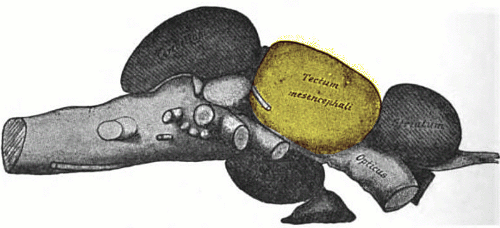
Feinberg and Mallatt supply the project's neuroevolutionary grounding. Bjørn Merker supplies an independent second pillar of a different kind: clinical and comparative evidence for the same conclusion. His 2007 paper in Behavioral and Brain Sciences, Consciousness without a cerebral cortex, argues that the conscious state is organized in the upper brainstem, and that the cortex elaborates the contents of experience without being its source. His evidence is clinical: children born without appreciable cortex (hydranencephaly) and decorticate animals still orient, respond, and act with purpose. Where Feinberg and Mallatt date the origin, Merker identifies the machinery. Both agree that the tectum, not the cortex, is the load-bearing structure, which is the assumption the whole project is built on.
Merker's framework is the Selection Triangle. Every autonomous animal solves three coupled problems at once, in real time, and the solution is a single coherent model of the world it acts in:
| Vertex | Biological locus | Selects | Our implementation |
|---|---|---|---|
| Target selection | Superior colliculus (optic tectum) | Where to look and go | Sensory Tectum: topographic fusion, inverse-effectiveness weighting |
| Action selection | Basal ganglia / substantia nigra | What to do | Basal-ganglia Go/No-Go action selection with dopamine RPE |
| Motivation | Hypothalamus & periaqueductal gray | Relevance | Affective modulator: valence field over workspace bids |
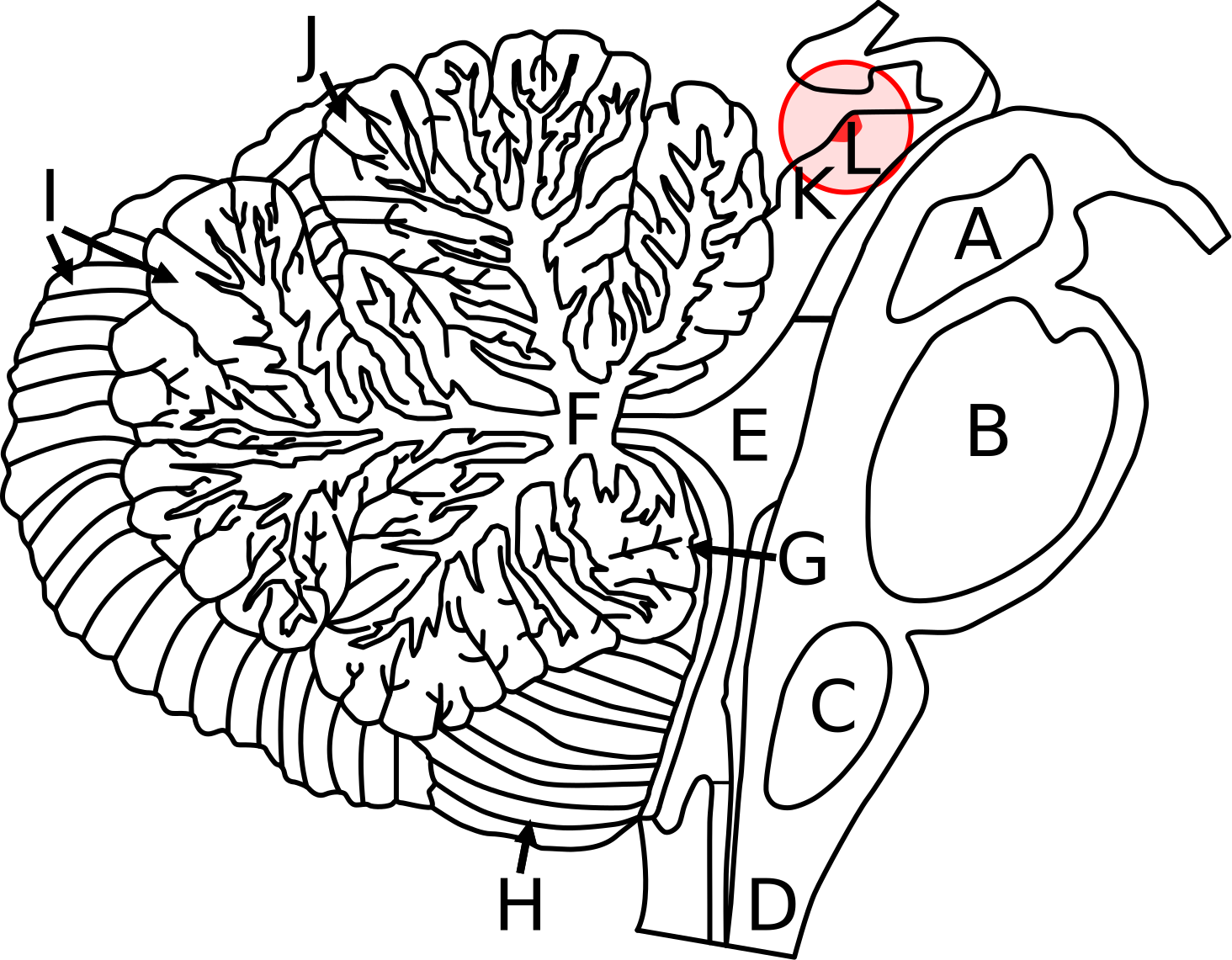
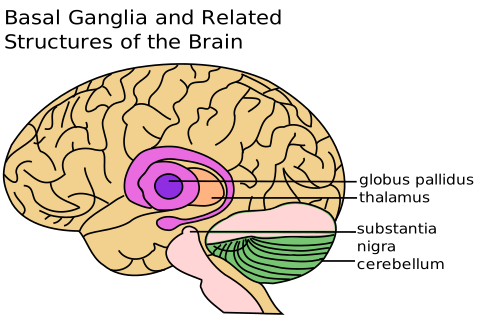
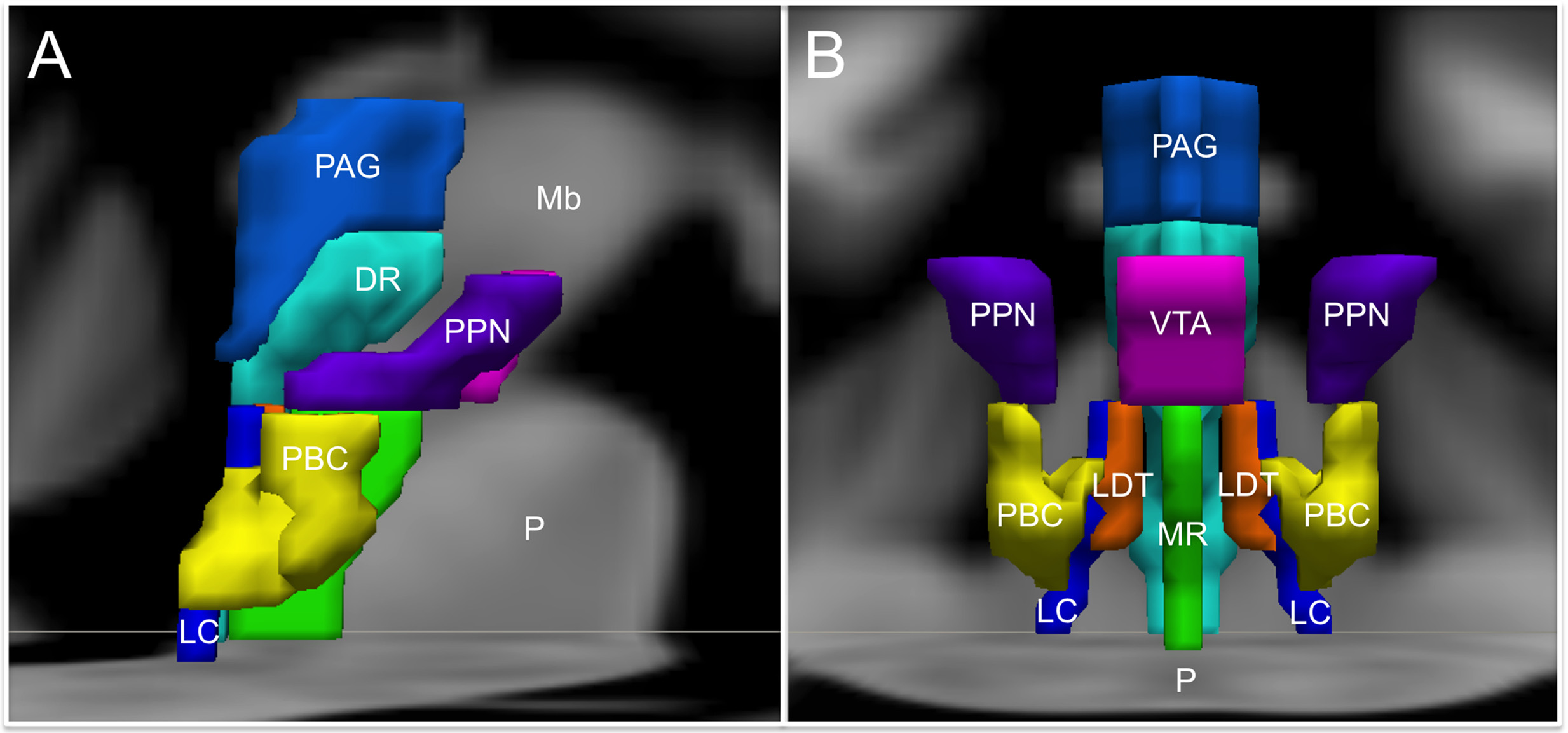
Two of Merker's own diagrams, which he published under a Creative Commons license, show how he frames the resulting architecture. The first shows the running best estimate of the animal's momentary circumstances, built from sensory, motivational and motor signals at the interface between cortex and midbrain. The second shows motivation acting as the interface between sensory space and action. The Affective Modulator in this project is a direct implementation of the second idea: a valence field that biases every bid before workspace competition.
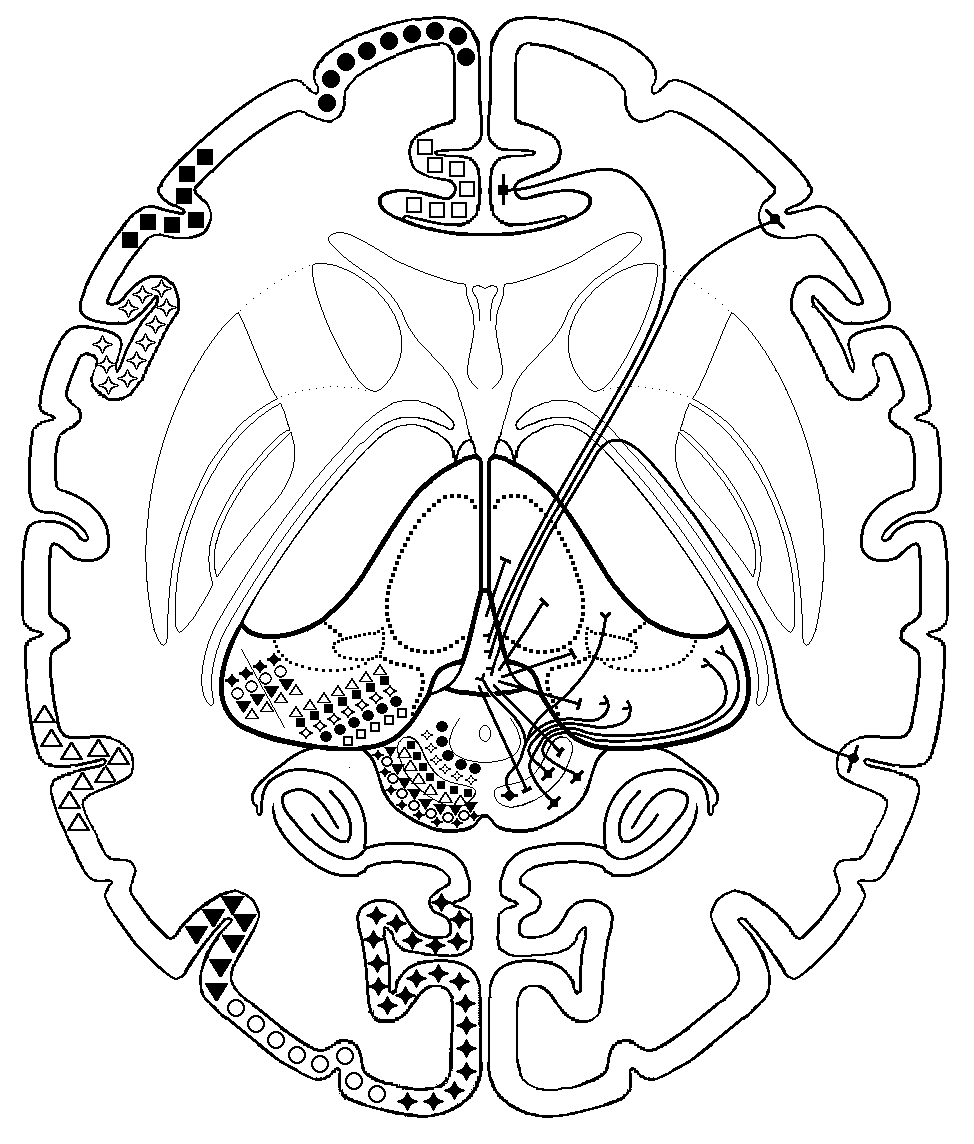
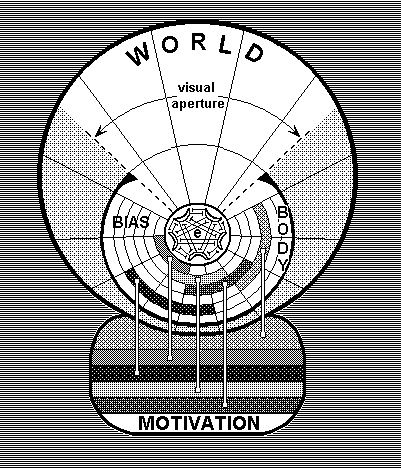
Two honest limits stand. First, Merker's strong claim is contested. Many researchers hold that the cortex is required at least for the specific contents of human experience. This project does not need the strong reading. Merker is used the way Feinberg-Mallatt are used, as an architectural guide that keeps the design tectum-first, not as settled fact. Second, alignment motivates the design and scores nothing: no consciousness indicator in the evaluation rubric further down this page moves because of a theoretical reference. Empirical support for the three vertices is nonetheless accumulating outside this project: the superior colliculus is established as a selection structure (Krauzlis et al. 2013), a 2026 Nature Communications paper reports an attention-demanding task engaging a superior-colliculus-to-zona-incerta circuit, and rodent fMRI work reports periaqueductal gray activity tracking reversal-learning value signals in mice (Lichtman et al. 2026, reviewed preprint, evidence rated incomplete by reviewers). Merker's 2013 follow-up develops the first-person pivot, and anchors it on the superior colliculus and the dorsal pulvinar rather than the zona incerta of his 2007 paper.
More on Merker: his researcher profile, and a fuller walkthrough of the Selection Triangle and what it means for this architecture.
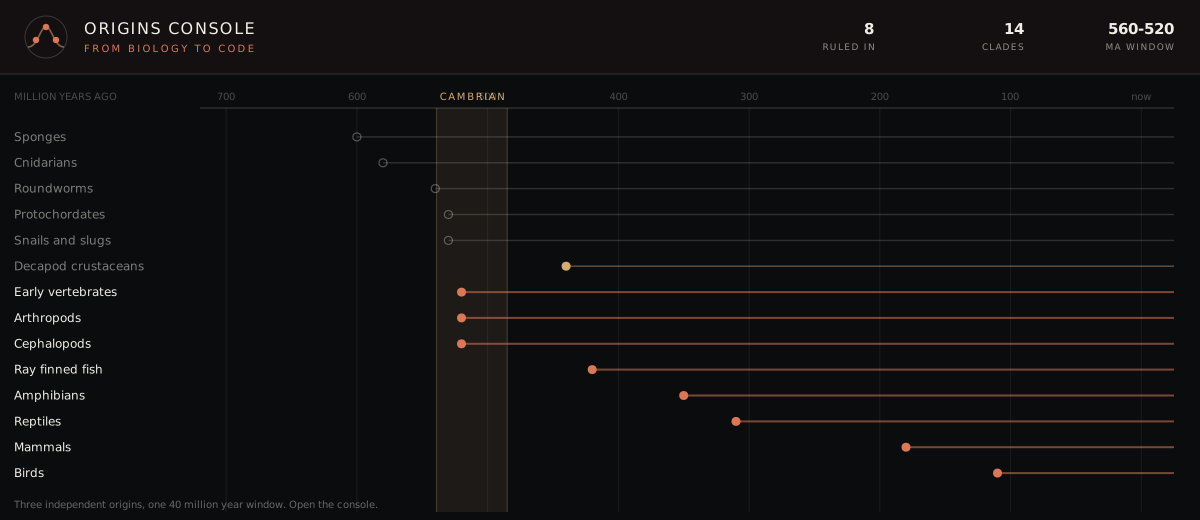
Feinberg and Mallatt describe a set of special neurobiological features that distinguish conscious neural systems from unconscious ones (like simple reflex arcs). They group those features differently across their papers, from two broad requirements in 2013 to around a dozen sub-items in 2020. The six below are the condensation this project builds against, and each maps directly to our implementation. Where each one appears across the animal record is mapped in the origins console.
| # | Biological Feature | Our Implementation |
|---|---|---|
| 1 | Many neuron types with diverse connectivity | Specialist modules (vision, audio, memory, body) with different temporal dynamics |
| 2 | Hierarchical processing (3-4+ levels) | Genuine transformation at each level from sensory tectum through workspace to policy |
| 3 | Dual hierarchy, pyramidal plus nested | 4-level hierarchical Capsule Networks (implemented) with dynamic routing by agreement and intra-hierarchy top-down prediction error feedback |
| 4 | Isomorphic (topographic) mapping | Sensory Tectum with RSSM world model preserving spatial arrangement |
| 5 | Reciprocal (reentrant) connections | ReentrantProcessor with 5-10 adaptive convergence cycles |
| 6 | Oscillatory binding (gamma synchronization) | AKOrN (Artificial Kuramoto Oscillatory Neurons, ICLR 2025) |
A multisensory spatial integration layer modeled after the biological optic tectum. Stacks aligned topographic maps for different sensory modalities in a common coordinate frame.
DINOv2-B/14 (frozen, facebook/dinov2-base) provides the tectum's spatially faithful patch tokens. Each patch token at grid position (i,j) corresponds to the exact 14×14 pixel region at (i·14, j·14). This direct spatial correspondence makes the mapping genuinely isomorphic, a computational analog of V1 retinotopy. A learned 1×1 Conv2d reduces channels from 768 to 64, followed by LayerNorm and GELU. All DINOv2 weights are frozen; only the projection trains. During training, the TDANN topographic loss (Margalit et al. 2024, Neuron) penalizes the negative Pearson correlation between response similarity and inverse spatial distance, forcing nearby grid cells to respond similarly, the same pressure that develops topographic maps in V1.
Qwen2-VL-7B (4-bit quantized) processes visual streams at the semantic level and provides scene understanding, object recognition, and language-grounded visual reasoning. Runs on consumer hardware (~6GB VRAM) via Any-Resolution Vision Tokenization (AVT). This stream feeds higher-level processing, not the tectum's spatial grid directly.
A biologically grounded auditory system models the mammalian pathway from basilar membrane through auditory cortex. Raw waveforms are processed, not transcribed.
[B, 64, 16] features for tectum
grid integration.
--enable-audio
during training. No external model weights are required.
The body schema, a tensor representing the proprioceptive state of body parts, is projected onto the tectum's spatial grid via a learned linear map and fused alongside vision and audio. This is grounded in biology: deep layers of the superior colliculus contain somatotopic maps aligned with visual and auditory maps (Stein & Meredith 1993, ch. 4). The tectum is now trimodal, giving the agent a felt sense of its own body position as part of its perceptual field.
The three streams fuse using the inverse effectiveness rule (Stein & Meredith 1993; Ohshiro et al. 2011): when individual stimuli are weak, their combined response is proportionally larger than either alone. When both are strong, the enhancement is smaller. This is a core property of multisensory integration in the biological superior colliculus.
Explore the binding and broadcast loop in the interactive map →
Based on AKOrN (Artificial Kuramoto Oscillatory Neurons, ICLR 2025 oral). Neurons are treated as oscillatory units on a hypersphere. Each specialist module (vision, audio, memory, body) operates as a coupled oscillator. When modules process related information, their phases synchronize naturally, and their outputs become "bound" into a unified percept. When information is unrelated, oscillators remain desynchronized and representations stay separate.
This replaces the typical approach of using a fixed multiplier or attention mechanism for binding. AKOrN produces genuine synchronization dynamics. The binding is emergent, not programmed. This directly addresses the binding problem through phase synchronization rather than single-point convergence. The wider theory this layer speaks to, the individual fingerprint claim and the re-emergence question, is written up on The Consciousness Fingerprint.
A dedicated optimizer trains KuramotoLayer coupling weights using reward-correlated synchronization as a learning signal (Adam optimizer). Episodes with higher cumulative reward drive stronger coupling between the modules that were co-active. This is biologically grounded in dopamine modulation of gamma band synchrony in the hippocampus and prefrontal cortex (Benchenane et al. 2010).
The central information bottleneck where distinct sensory streams compete for broadcast access. Implements three integrated mechanisms:
Specialist modules submit bids to a shared workspace. The winning coalition ignites via sigmoid non-linear ignition and broadcasts to all modules. This is "conscious access" as described by Baars (1988) and Dehaene (2011).
Broadcast is fed back to all specialists, which update their processing based on top-down context. This creates loops, not chains. The system runs 5-10 adaptive convergence cycles (~200ms biological equivalent). Easy stimuli converge in 3-4 cycles. Novel or ambiguous inputs use the full 10. The settled state after convergence IS the conscious content.
The IIT measurement was rebuilt from the ground up to correct a previous methodological error where Phi was computed from workspace bid values (salience estimates) rather than genuine causal states. The current system measures Phi using 5 ConsciousnessGate nodes: attention, stability, adaptation, coherence, and confidence. All five values are produced by learned networks operating on the broadcast tensor. They are no longer static placeholders. Gate values feed directly into both IIT Phi computation and Effective Information measurement. The nodes have genuine causal dependencies: attention drives stability, stability modulates adaptation, coherence feeds adaptation, confidence loops back to attention. Adaptive binarization thresholds use running medians rather than a fixed 0.5 cutoff. When PyPhi is not installed, a geometric proxy (determinism × integration) is used, which correlates with actual Phi. Results are returned as a PhiResult dataclass with the value, method used ("pyphi", "proxy", or "insufficient_data"), node labels, current state, and transition count. Validated via a 3-condition controlled experiment: unbound, partially bound, and fully bound states.
A 4-level hierarchical capsule composition chain implements the dual hierarchy Feinberg and Mallatt describe. Level 1: PrimaryCapsuleLayer (stride-2 Conv2d, squash normalization bounding activity to [0, 1)). Level 2: 16 intermediate capsules with 12-D pose vectors (object primitives). Level 3: 8 higher capsules with 16-D poses (object categories). Level 4: 4 output capsules with 16-D poses (scene/workspace level). Dynamic routing by agreement (Sabour et al. 2017) runs at each routing level with 3 iterations by default.
Beyond standard routing, the capsule hierarchy has intra-hierarchy reentrant feedback: higher-level capsule poses are projected back down to lower levels, which compute prediction errors that feed back into re-routing. This is a V1-LGN style top-down prediction error mechanism operating within the tectum's forward pass, nested inside the outer ReentrantProcessor loop. The system achieves two distinct layers of reentrant processing: one within the capsule hierarchy (fast, bidirectional within a single tectum pass) and one at the workspace level (the outer ReentrantProcessor, 5-10 adaptive cycles).
A default-off flag (--capsule-workspace-source all_levels)
extends the workspace projection to draw from all routing levels rather
than only the final 4-capsule output. This carries stimulus identity
through to tectum_content, the 256-D tensor the policy and global
workspace read. With the continuous RSSM latent enabled alongside,
tectum_content decodes shape at 0.52 to 0.83 and color at 0.97 to 0.99
(chance 0.167, seed 42 probe). Before this fix, tectum_content decoded
at chance across every training objective tested. Baseline behaviour is
bit-identical when the flag is off.
See how emotion modulates the workspace from outside in the interactive map →
A parallel modulation system. Emotion does not compete with sensory modules for workspace access. Instead, it generates a valence field that modulates all sensory bids before competition, and a global arousal signal that adjusts the workspace ignition threshold.
This matches biological architecture exactly. The limbic system does not compete with sensory cortices for conscious access. It modulates sensory processing from outside, assigning emotional valence to all inputs. Fear makes you hyper-aware of movements. Joy makes you notice more of the world.
Three intrinsic variables drive the agent: Valence (satisfaction/distress), Arousal (activation/calm), and Dominance (control/helplessness). Homeostatic drives (energy, safety, curiosity) generate ongoing valence signals even without external stimuli.
Interoceptive state (energy level, fatigue, accumulated damage) generates PAD deltas directly: low energy produces negative valence proportional to depletion depth; high fatigue suppresses arousal and adds negative valence; damage triggers a strong negative valence spike, an arousal alarm signal, and reduced dominance (vulnerability). These interoceptive PAD contributions are summed with the external emotional state before the AffectiveModulator applies its valence field and arousal-threshold coupling. The body schema also feeds into the tectum's spatial grid as the somatosensory channel. This closes a loop: the agent's bodily state shapes both what it perceives (tectum level) and how it values what it perceives (affective level). This is the computational analog of Damasio's somatic marker hypothesis.
Feinberg and Mallatt identify referral (projicience) as a core property of consciousness: experiencing sensations as belonging to the world or body, not to the processing system. The Self-Model provides the basis for this.
The agent learns via a biologically grounded
Go/No-Go basal-ganglia model
(action_selection_core.py), the primary policy learner.
Rewards are emotionally shaped: the agent is rewarded not just for task
success, but for maintaining emotional homeostasis. PPO, A2C, and DQN
are trained separately as comparison baselines; they are not the primary
learner.
Rtotal = Rext + λ1 · ΔValence - λ2 · (Arousal - Arousaltarget)² + λ3 · Dominance
This creates functional pressure toward minimizing internal dissonance. High arousal (large prediction errors) induces negative reward, motivating behaviors that reduce uncertainty. The agent "prefers" predictable environments not through programmed rules but through emergent functional dynamics.
Four built-in Gymnasium environments provide the agent's body and world. No Unity dependency is required for training.
SimpleVisualEnv)The agent starts in darkness (high arousal, negative valence). A single light source reduces prediction error when reached. The agent learns to seek it through homeostatic drives, not programmed rules. Renders via PyGame with raw pixel observations.
Multi-room grid with fog of war, colored goals with varying rewards, a battery system, and doorway-based room transitions. Tests spatial memory and exploration strategy.
Gold standard consciousness task from animal research. Four phases: fixation, sample, delay, choice. The agent must retain the sample stimulus across 15-40 blank delay steps and select the matching option from distractors. Requires working memory, feature binding, and selective attention. A reactive agent without workspace machinery cannot solve this task. DMTS implements one of the key tasks used in animal consciousness research to test working memory and perceptual binding.
Tests meta-cognition and cognitive flexibility. The agent sorts cards by an unknown rule (shape, color, or count) that changes without warning after consecutive correct sorts. Requires error monitoring, hypothesis testing, and inhibition of previously correct strategies. WCST implements the key task from animal consciousness research for assessing cognitive flexibility and meta-cognition.
A vanilla DQN agent (3-layer CNN + MLP Q-network, epsilon-greedy, replay buffer) runs the same environments using the same interface and logging format. This provides a controlled scientific comparison: same observations, same actions, same reward signals, different architecture.
Three C# scripts (AgentManager.cs,
ConsciousnessChannel.cs, EmotionChannel.cs)
in unity_scripts/ provide the foundation for connecting
to a physics-based Unity environment via side channels. The Unity
project itself is not yet included in the repository. Unity
integration is under development and is not required for current
training runs.
See the measurement stack in the interactive map →
A key methodological commitment: we do not assume consciousness emerges from our architecture. We test for it.
We measure this with Causal Emergence 2.0 (CE 2.0), Erik Hoel's 2025 framework (arXiv:2503.13395v3). From the singular values of the system's transition probability matrix it estimates how much causal structure the macro level (workspace) carries beyond the micro level (individual gates), with no dimensionality size term. CE 2.0 supersedes the earlier Effective Information (EI) metric (Hoel, PNAS 2013), whose gate-level estimate degenerated to a constant floor on the current agent. It is a default-off diagnostic under validation, not a consciousness claim.
If this never occurs across training, the system is not exhibiting the kind of emergence associated with consciousness, and we know our architecture needs revision.
Perturbational Complexity (PCI), added July 2026. Both metrics above read the system's spontaneous activity, and on this agent that activity keeps turning out to be frozen: the gate-level EI estimate sat at a constant floor, and CE 2.0's first pilot was reproduced exactly by a frozen input. A review of the empirical consciousness literature (Koch, Massimini, Boly & Tononi, Nature Reviews Neuroscience 2016) reports this as the general failure mode of spontaneous-activity measures, and reports one marker that survived where gamma synchrony and the P3b did not: the Perturbational Complexity Index (Casali et al., Sci. Transl. Med. 2013). PCI perturbs the system and scores the resulting causal response for how far it spreads (integration) and how incompressible it is (differentiation), so it supplies its own variation instead of depending on the system to vary on its own. A local response that dies out scores low; so does a global but stereotyped one; only a spread, non-repeating response scores high. Implemented here with a documented deviation from the published normalization, which diverges on sparse responses. As of July 2026 it has been validated on constructed inputs and smoke-tested only, never run against a trained agent, so it has produced no result about this system.
| Traditional AI Consciousness | Our Approach |
|---|---|
| Starts from computation (GWT, IIT) | Starts from biological architecture (Feinberg-Mallatt) |
| Consciousness as a software feature | Consciousness as emergent from neural architecture |
| Cortex-centric models | Tectum-first (consciousness evolved before the cortex) |
| Emotion competes with sensory processing | Emotion modulates from outside (parallel modulator) |
| Binding via attention mechanisms | Binding via oscillatory synchronization (AKOrN/Kuramoto) |
| Feedforward processing | Reentrant processing (5-10 adaptive cycles) |
| Flat vector representations | Topographic spatial maps (world model as isomorphic map) |
| Assumes emergence, measures nothing | Falsifies emergence with Effective Information + Phi validation |
The consciousness agent and a vanilla DQN baseline were trained across
three environments. Results are published in
docs/results/experiment_comparison.md. Recorded episodes
replay step by step in the
Training Sessions console.
Darkness triggers high arousal (simulated fear) in the affective core. The valence field applies negative valence to dark observations. Arousal-threshold coupling lowers the workspace ignition threshold, creating heightened sensory awareness. The agent learns to seek the light source through homeostatic drives, not through a programmed rule.
Sample stimulus presented, delay of 15-40 blank steps, then forced choice between match and distractors. Requires working memory and feature binding across the delay interval. A reactive agent without Global Workspace machinery cannot hold the sample across the gap.
Card sorting rule (shape, color, or count) changes without warning after consecutive correct responses. Requires error monitoring, rule hypothesis tracking, and inhibition of previously rewarded strategies.
| Metric | Dark Room | DMTS | WCST |
|---|---|---|---|
| Consciousness agent episodes | 492 | 100 | 100 |
| DQN baseline episodes | 1000 | 500 | 500 |
| DQN last-100 reward | 92.0 | -4.1 | 2.1 |
| Consciousness agent last-100 reward | 13.0 | -9.8 | -1.9 |
| Avg Phi (consciousness agent) | 0.022 | 0.022 | 0.022 |
| Phi varies per step | Yes | Yes | Yes |
| EI ratio (workspace / gates) | 2.41 | 2.42 | 2.42 |
DQN outperforms on raw reward in short runs. The consciousness pipeline adds overhead per step without contributing to the action policy directly at this training scale. These are early results from short training runs, not final claims. The Phi-1 pre-registered prediction campaign (9 runs across 4 architectures, completed May 2026) found no positive-direction r > 0.4; the final KomplexNet run produced r = −0.1116 in the inverse direction (see Pre-registered Predictions below). Phi values in runs since commit 8a322f9 use pyphi 1.2.0 (real Big Phi via empirical TPM on causal gate states); earlier runs used the geometric proxy.
Retracted, July 2026. An earlier version of this page described the “EI ratio ~2.4 across all environments” as one of the project's primary standing empirical markers. That reading does not survive. The gate-level Effective Information estimate was bit-identical at 0.031178 in every window of every run, which is exactly the constant-trajectory Laplace floor for that state count and window length, so the ratio was a ratio of two floors rather than a measurement of emergence. EI has been deprecated in favour of Causal Emergence 2.0, and CE 2.0's own first calibration pilot then FAILED for a related reason (see Current Status). The EI ratio should not be cited as evidence of causal emergence in this system, and the numbers are kept above only as a record of what was measured.
Development validates emergent properties through five parallel tracks:
The AsimovComplianceFilter is fully implemented inside ConsciousnessCore with 32 tests. It evaluates actions through a three-law hierarchy:
The DreamerV3 world model is wired into the ethics filter to run imagined future trajectories for harm assessment. This is not a keyword filter. It is a causal prediction loop.
The biological validation stack is complete. AKOrN's oscillatory parameters (natural frequencies from skew-symmetric matrices, coupling weights, amplitudes) are translated to a standard Kuramoto network in Brian2. Both networks run from the same initial conditions, and their synchronization order parameter R curves are compared via Pearson correlation (threshold: 0.85). This is the numerical bridge between the artificial oscillatory binding system and standard computational neuroscience spiking models. 19 tests pass (translation, simulation, interpolation); 3 are intentionally skipped pending Brian2 installation, as Brian2 is an optional dependency not installed by default.
A self-narrative system generates first-person descriptions of what the agent is experiencing. The default backbone is Qwen2.5-0.5B via HuggingFace transformers, with three-tier fallback: LLM generation → injected LLM dependency → template-based generation. A CoherenceTracker measures narrative consistency via rolling-window Jaccard similarity on keywords. Results are returned as a NarrativeResult dataclass with the text, coherence score, and method used ("llm", "injected", or "template"). Memory retrieval and emotional context are injected into the generation prompt. This system connects to the Attention Schema Theory component in the memory subsystem, giving the agent a model of its own attentional state expressed in natural language.
Before any training runs, 9 testable predictions were deposited in
docs/preregistered_predictions.md, following the methodology
of Melloni et al. 2025 (the adversarial IIT/GNW collaboration, n=256,
fMRI+MEG+iEEG, Nature). This pre-registration distinguishes the project
from architectures that interpret results post-hoc.
An "insight moment" is operationally defined by 4 criteria: novel state-action pair, measurable reward jump, first-attempt success, and high workspace occupancy. These criteria were specified before training began.
Experimental results (complete as of June 2026): The Phi-1 prediction (r > 0.4) was tested across 9 independent runs spanning 4 architectures (AKOrN; AKOrN+A+C+D; AKOrN+A+B+C+D; KomplexNet+A+C+D) and 2 phi formulations (pyphi gate-state TPM; RIIU broadcast SVD). No run reached the pre-registered threshold in the predicted positive direction, nor the partial threshold of r > 0.15. The final run (KomplexNet+A+C+D, 2026-05-24) produced the campaign's first substantively significant phi-binding correlation: r = −0.1116 (p = 2.5×10−108, n = 39,000), in the inverse direction. Mechanistic reading: when phases align (high sync_R), KomplexNet content factors cluster near +1, compressing representational variance and lowering RIIU phi; desynchronization raises variance and raises phi. In this architectural family, oscillatory binding and IIT-style integrated information are mechanistically opposed. This is a positive empirical constraint on theory. The pre-registered r > 0.4 threshold and sign are not revised retroactively.
The in-training Phi-1 specific prediction is now exhausted. The 2026-02-21 3-condition synthetic test demonstrating phi monotonicity with binding strength still stands. The mission continues via other signatures. Full record: KomplexNet binding verdict (2026-05-24).
The current figure is 1303 tests passing, 0 failing (100% of non-optional tests), with 4 intentional skips: 1 async test requiring pytest-asyncio, 3 Brian2 integration tests requiring the optional Brian2 dependency. The dated blocks below are kept as a release history, so the test counts inside them are the counts at that release and are not current.
As of June 2026 (v1.3.0), historical:
docs/rouleau_levin_substrate_independence.md maps 8
aneurocentric themes from 19 theories of consciousness onto specific
codebase files, providing the substrate-independence justification for
the PyTorch implementation.
--enable-wm-predict, DreamerV3/MuZero
inspired) built and tested. Losses trained down but the RSSM recurrent
state did not retain working memory across the delay (result recorded
honestly); dynamic self-vector (SelfVectorModule,
temporal-offset self-prediction, default off) validated on navigation
(+0.35 skill rising with training); gating ConsciousnessGate on the
self-vector did not improve WCST performance at single seed; Levin
consciousness metrics activated and verified as non-trivially varying
with input (--enable-levin-metrics). Open:
substrate-independence test
(preregistered_predictions.md section 13), blocked on agent
task competence; active-inference unification (Phase 6 roadmap).
--rssm-latent-mode continuous) makes
z_state decode stimulus identity (shape 0.88 to 0.99, color 0.77 to
1.00, chance 0.167) across seeds 42, 43, and 44. An all-levels capsule
projection (--capsule-workspace-source all_levels) carries
that identity to tectum_content for the first time. An ablation study
over three seeds (OFF = discrete+final capsule, HALF = continuous+final,
ON = continuous+all_levels) found three integration markers with
non-overlapping seed ranges between HALF and ON: broadcast content
variation (~2x), phi max (~2.2x), and floor-corrected macro effective
information (~3x). This is the first replicated, ablation-causal
signature response to an architectural change in the project, following
the evaluation method of recent field work (arXiv:2512.19155). Honest
scope: task reward is still flat (the agent does not learn DMTS), the RL
policy wall is a separate open question (policy-head expressiveness and
credit assignment across the delay), ignition saturation and binding
synchrony do not respond to the perception fix alone, and no Butlin
indicator has been moved to IMPLEMENTED. All features are default-off;
baseline is bit-identical. Test suite at that point: 768 passed.
--ablate-existence-bias,
default off).
Metzinger's 2024 ethics warning: building a survival drive into a
potentially conscious machine before understanding the consequences risks
creating a system that craves its own existence. This default-off flag
removes the interoceptive affect, homeostatic arousal penalty, and
dominance reward term for a controlled experiment. Baseline is
bit-identical when off.
As of July 2026 (v1.5.0):
As of 2026-07-28:
adaptation node is genuinely inactive (std 6.08e-06). Single seed,
default-off; a default change still requires three.
As of 2026-08-01:
As of 2026-08-07:
As of 2026-08-11:
As of 2026-08-17:
As of 2026-09-16:
2026-09-17. The training session replays now include recorded audio with volume and mute controls. Each recorded sound chunk shares its step with the input frame and response panels. Playback timing follows the recorded samples, not training wall time. Four source channels form a labelled stereo mix with lossy compression. The research test suite reports 1303 passing tests. No consciousness indicator or clock value changes.
2026-09-19. Bjørn Merker's selection triangle is now documented as a second theoretical pillar next to Feinberg and Mallatt, with a new section above covering the three vertices (target selection in the superior colliculus, action selection in the basal ganglia, motivation in the hypothalamus and periaqueductal gray), their mapping to the Sensory Tectum, the action selection core and the Affective Modulator, and the contested status of the strong reading. Anatomical figures are public domain or Creative Commons licensed, including two diagrams Merker published himself. No code changes, no consciousness indicator moves and the clock does not move. A theoretical reference scores nothing.
2026-09-22. A new thermodynamic computing page sets out how the project will test whether its verified properties survive a change of substrate, from GPU tensors to spikes or p-bits. It includes a browser emulation of an Ising lattice and a Kuramoto ring. The research code gains an isolated package, models/thermodynamic/, with a p-bit emulator checked against exact Boltzmann statistics and a free energy relaxation solver checked against closed-form posteriors. A guard test keeps the package out of every production path. The research test suite reports 1351 passing tests. No consciousness indicator or clock value changes.
action_selection_core.py) — primary learner
unity_scripts/
All components are open-source with commercial-use licenses (Apache 2.0, MIT, or similar).
The full codebase, including all architecture implementations and tests, is open-source.
The question this project asks of any substrate, printed on the animals it also applies to. Every order funds the research.
 Octopus Are you conscious? T-shirt | Octopus Illustration, Sci‑Fi Quote
From $22.99
Octopus Are you conscious? T-shirt | Octopus Illustration, Sci‑Fi Quote
From $22.99
 Dragonfly, are you conscious? T-Shirt | Dragonfly Illustration, Vintage Insect Art
From $22.99
Dragonfly, are you conscious? T-Shirt | Dragonfly Illustration, Vintage Insect Art
From $22.99
 Owl are you conscious? Owl Illustration T-shirt | Vintage Bird Tee
From $22.99
Owl are you conscious? Owl Illustration T-shirt | Vintage Bird Tee
From $22.99
 Cat are you conscious? Cat Illustration T-shirt | Vintage Brown Cat Tee
From $22.56
Cat are you conscious? Cat Illustration T-shirt | Vintage Brown Cat Tee
From $22.56
 Dog, are you conscious? T-Shirt | Border Collie Illustration
From $22.99
Dog, are you conscious? T-Shirt | Border Collie Illustration
From $22.99
 Axolotl, are you conscious? T-Shirt | Pink Axolotl Illustration
From $22.99
Axolotl, are you conscious? T-Shirt | Pink Axolotl Illustration
From $22.99
 Turtle are you conscious? T-Shirt | Turtle Illustration, Philosophical Quote
From $22.99
Turtle are you conscious? T-Shirt | Turtle Illustration, Philosophical Quote
From $22.99
 Bat, are you conscious? T-shirt | Bat are you conscious?
From $22.99
Bat, are you conscious? T-shirt | Bat are you conscious?
From $22.99
 Colibri are you conscious? T-Shirt | Hummingbird Illustration
From $22.99
Colibri are you conscious? T-Shirt | Hummingbird Illustration
From $22.99
 Horse are you conscious? Horse T-shirt | Paint Pony Illustration
From $22.99
Horse are you conscious? Horse T-shirt | Paint Pony Illustration
From $22.99


