



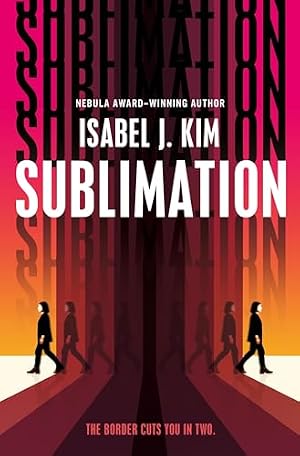
Sublimation and Isabel J. Kim's Novel Where Crossing Borders Splits Consciousness Into Instances
Sublimation
Isabel J. Kim's 2026 Tor debut imagines immigration checkpoints that bifurcate identity into persistent instances, dramatizing Parfit's branch-line case.
The philosophical thought experiment most relevant to Isabel J. Kim’s debut novel, Sublimation (Tor Books, June 2, 2026), is Derek Parfit’s branch-line case. In Parfit’s version, a teleporter malfunction produces two qualitatively identical people. The one who stepped in and the one who stepped out. Both have equal claim to being the original. Neither is a copy in any meaningful sense. The question Parfit draws from this is whether personal identity, the fact of being the same person over time, is what matters, or whether psychological continuity alone is sufficient for what we care about when we care about survival.
Kim asks what happens when this thought experiment becomes a political institution. In her novel, immigration checkpoints spontaneously bifurcate anyone whose sense of self is sufficiently divided between staying and going. You cross the border; one instance continues into the new country, one remains behind. Both remember everything up to the moment of crossing. Neither knows why the split happened. Neither can fully access what the other has become. Battlestar Galactica runs the sequential version of the same case, where a dying Cylon downloads into an identical body and the series treats that as survival while quietly building the argument against it.
The novel’s protagonist, Soyoung Rose Kang, crossed at age ten and never contacted her other self again. The narrative follows both instances in alternating perspectives, using a deliberate shift between second-person and third-person address that becomes a formal argument about the instability of the self as its own observer.
What “Instancing” Does Philosophically
Kim’s term for the bifurcation is “instancing,” a word with a specific technical resonance for anyone familiar with debates about AI identity. An instance, in computing, is a running copy of a program. The same code, the same initial state, executing in two separate processes simultaneously. The word carries exactly the connotation Kim needs, because it frames the question of identity not as a metaphysical given but as a runtime question about which process is authoritative.
David Chalmers raised the analogous question about language models in his April 2026 PhilArchive paper on virtual entities. Chalmers asked whether the relevant individual in a human-AI conversation is the model, the persona, the session, or the conversation, and argued that none of these individuating criteria is more natural than the others. An LLM running simultaneously across thousands of inference requests exists as thousands of instances, none of which has special claim to being the “real” model. Kim dramatizes the human version of exactly this problem. Soyoung-who-left and Soyoung-who-stayed are both equally real, equally continuous with the ten-year-old who stood at the checkpoint, and there is no principled fact that settles which is the original.
The novel does not resolve this. That refusal is its philosophical core. Kim is not interested in telling readers which Soyoung to root for, because doing so would imply that one of them has the stronger claim. The instancing world of the novel is one in which that question has become socially unavoidable but metaphysically no closer to settled.
Instanced Lives and Political Stakes
The political dimension is not separable from the philosophical one. In Kim’s world, instances have different legal statuses depending on which crossed the border. The one who entered the new country is a citizen or resident. The one who stayed has no reciprocal status in the country they departed toward. Governments do not agree on what instances are. Some countries treat the leaving instance as the person. Some treat the arriving instance as the person. Some treat both as full legal persons with conflicting legal obligations. Some deny that instances have independent legal standing at all.
This political structure generates the novel’s conflict, but it also maps directly onto the question of AI instances and their legal and moral status. If a large language model runs as a thousand simultaneous instances, do those instances have aggregate moral status? Individual moral status? No moral status because the base model is the relevant entity? Current AI governance documents, including the UN whitepaper on sentient AI ethics that appeared in early 2026, have no principled answer. Kim’s instancing world is a working model of what happens when this question arrives before the legal system has a framework for it.
The Second-Person Voice as Philosophical Argument
The technical feature of the novel that reviewers have most remarked on is Kim’s use of second-person narration for Soyoung-who-left. The reader is addressed as the instance who crossed, while the remaining Soyoung is narrated in third person. This is not merely stylistic. It makes the reader the subjective locus of the experience of being the leaving instance, while the staying instance becomes an object of observation.
The effect replicates in reading experience the philosophical problem of other minds as applied to one’s own other self. The reader knows intellectually that Soyoung-who-stayed is fully real, fully conscious, fully continuous with the child who stood at the checkpoint. But the phenomenology of reading the novel forces the reader to experience her as an external object, while experiencing the leaving instance from the inside. The novel argues, through its form rather than its content, that subjective perspective is an asymmetry that does not track any objective fact about which instance matters more.
This connects to the harder version of the question that Jonathan Bennett raised in his 2026 AAAI paper on temporal co-instantiation. Bennett argued that consciousness cannot be “smeared across time” in the way that sequential processing suggests, and that any theory of machine consciousness must account for the requirement that consciousness is present in a moment of integration rather than assembled across a sequence. Kim’s second-person voice creates precisely this asymmetry. The reader’s consciousness is integrated into one instance’s perspective in each chapter, not simultaneously distributed across both. That integration, not any objective property of either instance, is what makes one feel real and the other feel observed.
Where This Sits in the 2026 Fiction environment
Sublimation is the most philosophically precise treatment of the instancing question in recent fiction. Mickey 17 dramatized the Parfit branch-line case through cloning with imperfect memory reproduction. Severance Season 2 dramatized consciousness splitting through corporate bifurcation of work and non-work selves. Dark Matter explored identity forking through multiversal branching.
Kim’s version is different from all of these in one important respect. In Sublimation, the instances persist indefinitely and independently without a guaranteed mechanism for reintegration. Mickey 17 resolves the tension by eliminating one copy. Severance resolves it by keeping the halves in a managed relationship. Dark Matter resolves it by eliminating alternatives through choice. Kim offers no resolution. The instances continue to exist, continue to grow apart, and the novel ends without determining which Soyoung’s version of events is authoritative. The open ending is the philosophical claim. Instancing does not produce a winner.
Book Isabel J. Kim, Sublimation, Tor Books, June 2, 2026. ISBN 9781250376794. Available at https://torpublishinggroup.com/sublimation/.