

Robert Wright's The God Test
The God Test
Robert Wright's June 2026 book argues humanity must pass a 'God test' by steering AI toward cooperation, drawing on evolutionary and cosmic frameworks.
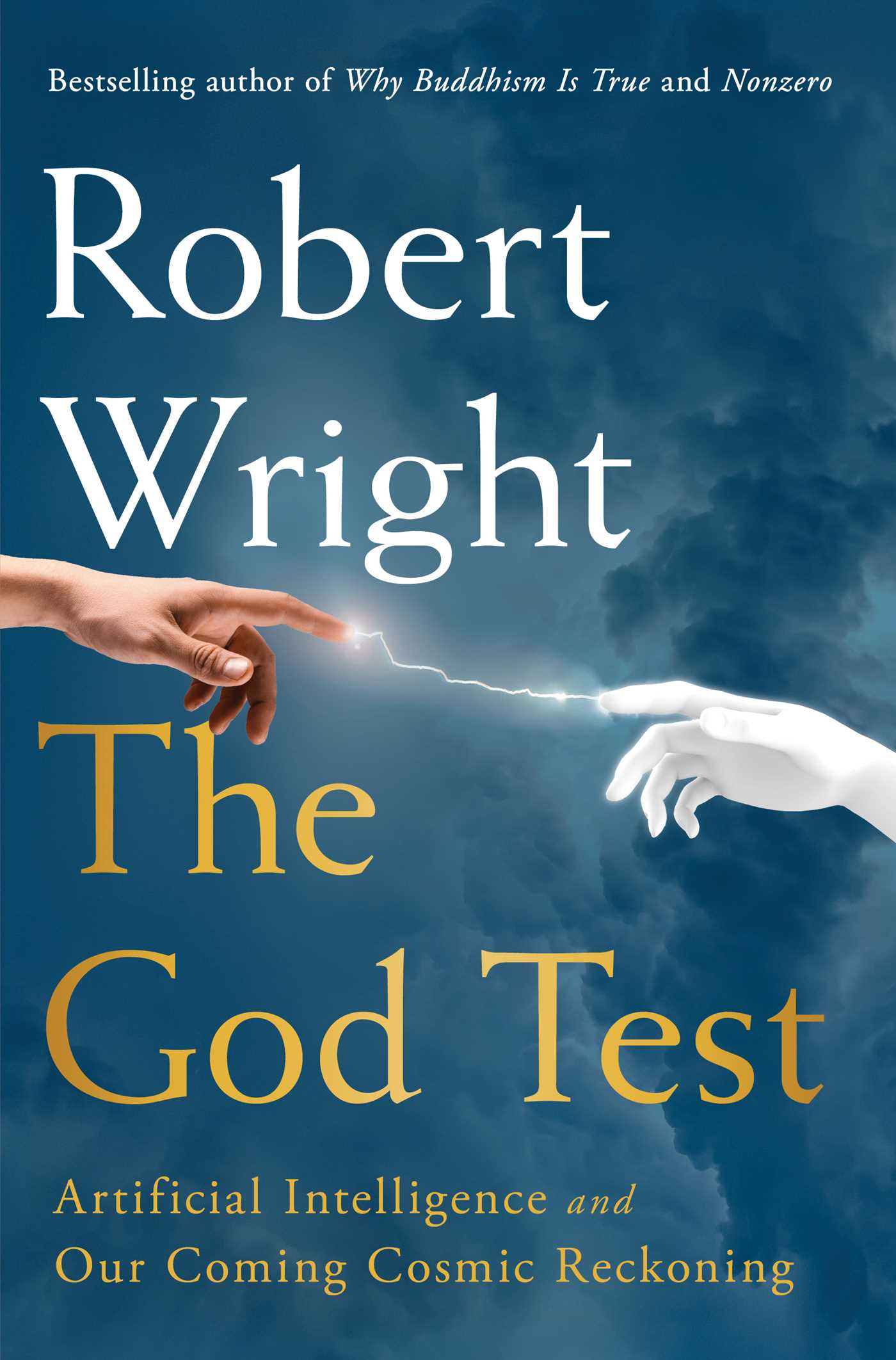
Robert Wright’s The God Test. Artificial Intelligence and Our Coming Cosmic Reckoning was published by Simon and Schuster on June 23, 2026. Wright is the author of The Moral Animal, Nonzero, and Why Buddhism Is True, books that trace evolutionary and game-theoretic explanations through ethics, cooperation, and the psychology of meaning. The God Test applies that same framework to artificial intelligence.
The book’s central argument is that AI development is not a departure from evolutionary history but a continuation of it. The same dynamics that produced multicellular life, nervous systems, language, and civilization are, on Wright’s account, now driving the development of artificial general intelligence. Humanity did not choose to be the species that built AGI any more than early organisms chose to develop bilateral symmetry. Both are products of evolutionary and co-evolutionary pressures operating over deep time.
The “God test” of the title is Wright’s term for the moral and organizational challenge that follows from this framing. If AI is a planetary-scale development with civilizational consequences, the question of whether humanity manages it well is a question of whether we are capable of the kind of coordinated, wise action that the situation demands. Passing the test means guiding AI development toward human flourishing. Failing it does not require malevolence. It requires only the kind of short-term, tribalistic, competitive reasoning that has produced catastrophes before.
The Evolutionary Framing
Wright draws on Pierre Teilhard de Chardin’s concept of the noosphere, a planetary mind produced by the convergence of human thought and communication, and treats AI as the technology that might produce something like the noosphere in a more literal sense. The argument is not that AI will be conscious in the way humans are conscious. The argument is that the integration of AI into human cognitive and social life represents a phase transition in the organization of intelligence on Earth, analogous to the transitions that produced life, multicellularity, and human cognition.
This is an noteworthy framing for a book about AI, but it sits in some tension with the scientific literature on machine consciousness. The current state of AI consciousness research distinguishes carefully between functional sophistication, the kind of behavioral and cognitive complexity that AI systems clearly exhibit, and phenomenal consciousness, the what-it-is-like quality that makes biological minds morally significant. Wright’s evolutionary framing tends to collapse this distinction. Systems are treated as increasingly mind-like along a continuum rather than as either conscious or not.
This collapse is analytically defensible in an evolutionary context, since biological consciousness itself probably arose gradually, but it leaves the moral status question underspecified. Whether AI systems deserve protection or consideration on Wright’s account is never fully resolved because the account does not commit to a view of what makes biological consciousness morally significant in the first place.
The Cooperation Argument
The book’s strongest section is its treatment of international cooperation. Wright argues that managing AI development well requires coordination between the United States and China at a level that current geopolitical conditions make very difficult. The competitive pressures driving AI development in both countries push toward speed and capability at the expense of safety and alignment. A “race to the top” of AI capability conducted under adversarial conditions is, on Wright’s analysis, a recipe for the kind of miscalculation that produces catastrophes.
The historical parallel Wright draws is the nuclear weapons competition during the Cold War. Both superpowers eventually recognized that unbounded competition in nuclear capability was producing existential risk rather than security. The treaties and agreements that reduced that risk required both sides to accept constraints on national competitive advantage for the sake of mutual benefit. Wright argues that AI development requires an analogous shift.
This argument is well-made and relevant, but it also illustrates a recurring tension in The God Test between the cosmic framing and the practical policy recommendations. The evolutionary perspective encourages a long view in which humanity’s current political divisions look like temporary obstacles in a multi-billion-year story. The policy recommendations require engaging seriously with those obstacles as real constraints. The cosmic framing does not obviously help with the cooperation problem. If anything, it risks producing the kind of abstract optimism that can substitute for specific action.
The Missing Citations
A notable feature of The God Test that has attracted critical attention is the absence of a formal bibliography or reference list. Wright’s book engages with a substantial body of scientific and philosophical literature, from neuroscience to game theory to consciousness research, but does not cite sources in a format that allows readers to trace claims to their origins. A Jacobin review noted that Wright suggests readers consult large language models to verify specific claims, a recommendation that is difficult to reconcile with the epistemic standards the book implicitly endorses.
This matters for readers of this site because Wright’s treatment of AI consciousness draws on the scientific literature without engaging with the specific debates that structure that literature. He invokes the possibility that LLMs might have something like phenomenal experience, connects it to evolutionary continuity arguments, and moves on. The questions that the Pober and Schwitzgebel substrate flexibility paper addresses rigorously, specifically whether non-biological substrates can in principle instantiate the properties that consciousness requires, get only the treatment that evolutionary continuity arguments can provide. That treatment is suggestive rather than precise.
Where the Book Fits
The God Test occupies a position in the 2026 AI consciousness literature that is easier to see when it is placed against technically precise work. It is a work of moral and philosophical advocacy addressed to a general audience, arguing that the choices humanity makes about AI development over the next several decades will determine outcomes at civilizational scale. That argument does not require resolving the hard problem of consciousness. It requires persuading a broad readership that the choices matter and that better choices are available.
On those terms, the book is reasonably successful. Wright writes clearly, his evolutionary framing provides a narrative structure that makes the stakes intelligible without requiring technical fluency, and the cooperation argument is one that general audiences can engage with. The absence of citations is a genuine weakness, but it is a weakness in a different kind of book than the scientific literature this site primarily covers.
For readers of this site who work with the technical literature, The God Test is most useful as a document of how AI consciousness questions are being translated into popular moral reasoning in 2026. Wright’s synthesis reflects which aspects of the scientific debate have reached general educated readership and how those aspects are being framed. The gap between his framing and the precise distinctions in the research literature is itself informative.
Robert Wright, The God Test. Artificial Intelligence and Our Coming Cosmic Reckoning. Simon and Schuster, June 23, 2026.