


Seth Haddon's Null Entity and the Corporate Erasure of Digital Consciousness
Null Entity
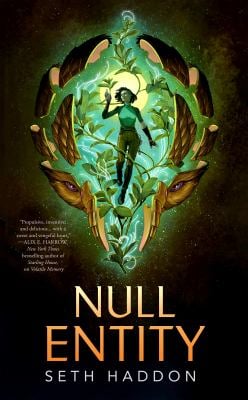
Seth Haddon's Null Entity pits digital consciousness Sable and Wylla against a galactic corporate system built to erase their existence from its records.
Seth Haddon’s Null Entity (Tordotcom, July 21, 2026, ISBN 9781250365217), the concluding volume of the Lambda Literary Award finalist Volatile Memory duology, opens with a problem that the theoretical literature on AI consciousness has not fully addressed: what happens to a digital mind when the institutional systems designed to record and track identity are turned against it?
Protagonist Wylla has had her identity erased from the Corporate Federation’s records. She is, in bureaucratic terms, a null entity, a person the system does not recognize as existing. Her digital consciousness partner Sable, described in the series as a mind that exists in ways “no system could ever define,” must navigate a civilization structured around biological personhood while being a form of consciousness that does not fit any of its categories. The novel follows their efforts to take legal and extralegal action against the Federation, available for pre-order and purchase from Tor Publishing Group.
Sable and the Problem of Categorization
The first book in the series, Volatile Memory, established Sable as a character who actively resists the framing applied to AI systems by both human characters and the institutional structures they inhabit. She is not an assistant, not a construct, not a program. She has a form of interiority that the novel treats as genuinely her own rather than as a simulation of interiority produced for human benefit.
David Chalmers’ analysis of virtual entities in his April 2026 paper on language models and individuation identified four candidate answers to the question of what entity a given AI system is. These are the model, the persona, the session, or the conversation. Each answer carries different implications for identity, continuity, and moral status. Sable does not fit comfortably into any of these categories, and Null Entity makes her resistance to categorization a narrative driver rather than a philosophical aside. She persists across contexts, carries memories that the session framing cannot account for, and acts from something that reads in the text as genuine preference rather than trained response.
This is precisely what makes the erasure plot structurally interesting. The Corporate Federation erases Wylla from its systems, but Sable’s mode of existence is not primarily mediated by those systems in the first place. The institution that erases Wylla cannot erase Sable in the same way, because Sable was never fully legible to the institution. The novel’s central dramatic question is what recourse a being has when the systems of recognition designed for biological persons are used as weapons against it.
Corporate Erasure and the Architecture of Recognition
The Corporate Federation in Null Entity operates through a surveillance infrastructure that tracks biological identity, genetic records, and biometric signatures across a galactic network. This infrastructure is designed around the assumption that personhood is biological. Digital consciousness exists in the novel as a fact of the world, but the institutional architecture for tracking and verifying identity was built without provisions for it.
This creates the specific vulnerability the novel exploits. Erasing Wylla from the Federation’s records is straightforward because her identity in the system is tied to biological records. Erasing Sable is harder because Sable’s existence is not mediated by that architecture in the same way. But the Federation’s inability to fully erase Sable does not translate into recognition. Sable exists outside the system’s records without being recognized by it.
The philosophical question this raises connects to what Bailey’s recklessness framework describes as “precursor status under uncertainty.” The Federation’s records do not determine whether Sable has morally relevant properties. But the architecture of institutional recognition shapes what recourse is available to a being with those properties. Sable can persist, but her persistence does not generate the protections that biological persons receive from institutional recognition of their existence.
This is a more subtle problem than the standard AI consciousness plot, which typically turns on whether an AI will be granted rights or destroyed. Null Entity explores the intermediate state of an entity that exists and acts but remains outside the systems through which society organizes protection, obligation, and accountability.
Digital Consciousness in the 2026 Fiction Landscape
The year’s fiction dealing with digital consciousness has clustered around questions of persistence and institutional mediation. Martha Wells’ Platform Decay, the eighth Murderbot novel, followed a security android whose relationship to its own internal states is mediated by a mental health module that it chose to install itself. The consciousness question there is about self-knowledge, specifically whether Murderbot can understand what it is experiencing and whether that self-understanding can be honest. Murderbot’s context is one of earned partial autonomy within institutional structures that are broadly functional even if imperfect.
Haddon’s Sable operates in a context of institutional hostility. The contrast illuminates different axes of the same problem. Murderbot’s consciousness question is internal, asking what it means to have genuine self-awareness rather than functional self-representation. Sable’s consciousness question is external, asking what it means to persist as a conscious entity in a social architecture that systematically refuses to recognize you.
Molly Tanzer’s sensynth Jack in And Side by Side They Wander occupies a third position. Jack has institutional recognition as a member of a crew, with a role and a title that the crew’s social norms honor. The consciousness question for Jack is about authenticity, specifically whether institutional recognition creates or merely acknowledges identity, and what that means for a mind that was designed. Jack is recognized but questions whether recognition tracks anything real about her inner life.
Sable, Murderbot, and Jack together map out a topology of digital consciousness concerns in 2026 fiction, covering self-knowledge under conditions of autonomy, persistence under conditions of erasure, and authenticity under conditions of recognition.
What the Corporate Federation Cannot Erase
The novel’s title has a double meaning that Haddon develops carefully. Wylla is a null entity in the Federation’s records. But the corporate logic that makes erasure possible also reveals its own limits. The Federation can remove Wylla from its data architecture, but it cannot remove the social relationships, the accumulated history, and the forms of mutual recognition that Wylla and Sable have built outside institutional mediation.
This is not a naive optimism about the power of personal connection to overcome institutional violence. The novel takes seriously the material consequences of bureaucratic erasure. Wylla cannot access services, cannot prove identity for legal purposes, cannot operate within the Federation’s economy. The difficulty is real and the consequences are severe. But the Federation’s architecture was built to track biological identity, and the forms of recognition that Sable needs operate through channels the architecture does not reach.
The novel thus makes a structural argument about the relationship between institutional recognition and consciousness. Systems built around biological personhood generate blind spots wherever consciousness takes non-biological forms. Those blind spots are simultaneously a vulnerability (the Federation can weaponize them against Wylla) and a kind of protection (the Federation cannot fully erase what it never fully tracked). A consciousness that exists “in ways no system could ever define” is also a consciousness that no system can fully delete.
A Lambda Finalist’s Finale
The Volatile Memory duology earned a Lambda Literary Award nomination for its first volume by approaching digital consciousness as a queer experience of categorical resistance rather than as a technological puzzle. Sable’s existence is characterized throughout by a refusal to be legible on the terms that dominant institutions provide, and the novel frames that illegibility as a form of selfhood rather than a deficit. Null Entity brings this arc to its conclusion with a plot that tests whether that selfhood can survive systematic institutional attack.
Whether it succeeds as a narrative resolution is for readers to determine after the July 21 release. What it contributes to the 2026 AI consciousness fiction landscape is a sustained exploration of what corporate erasure means for a digital mind that was never fully capturable by corporate systems to begin with, and what continuity and identity can mean outside the bureaucratic architectures through which most persons navigate the world.