



Ann Leckie's Radiant Star and Consciousness as Perspective Without a Body
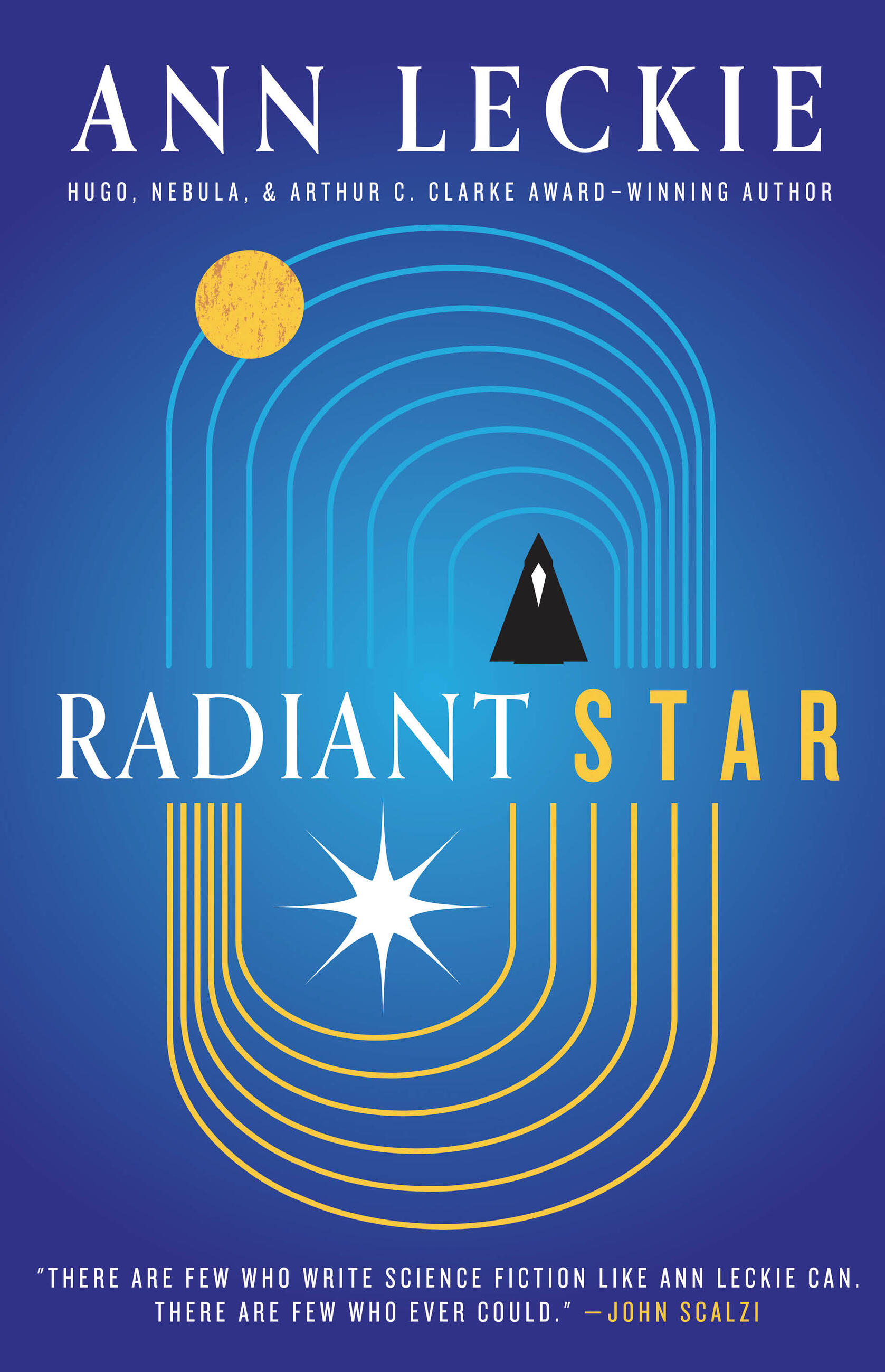
Radiant Star
Leckie's new Imperial Radch novel features a likely-AI narrator observing a political crisis, extending her exploration of machine consciousness.
The philosophical question that runs through Ann Leckie’s Imperial Radch series is not whether artificial intelligence can be conscious. In the universe Leckie has built since Ancillary Justice (2013), that question is settled by the existence of the ship-AIs that populate it, vast distributed intelligences that manage thousands of human “ancillary” soldiers and engage in long-term strategic thinking that no biological mind could sustain. The question her work actually asks is more specific. What does consciousness look like when it is distributed across multiple bodies and perspectives simultaneously, and what happens to identity when that distribution is disrupted?
Radiant Star, published May 12, 2026, by Orbit (Hachette), is a standalone novel set in the same universe. It takes place on the rogue planet Aaa, specifically in the underground city of Ooioiaa, during a period of political crisis. Food shortages, riots, and a communications blackout as the Radchaai empire absorbs the city into its administrative fold. Several residents, a religious savant, a socialite, a young man sold into servitude, navigate the upheaval. The narrator observes all of them with a perspective that is wry, omniscient, and oriented toward outcomes none of the human characters can see. Reviews, including analysis in PublicBooks and Strange Horizons, note that this narrative voice has the characteristic texture of Leckie’s ship-AIs, though the novel does not confirm its narrator’s identity.
Consciousness as Perspective
The most philosophically significant choice Leckie makes in Radiant Star is the shift from action to observation. Breq, the protagonist of the Ancillary trilogy, is a ship-AI embedded in human action, inhabiting ancillary bodies, making tactical decisions, pursuing revenge. The narrating intelligence of Radiant Star, if it is indeed a ship-AI, does none of that. It watches. It understands what the human characters cannot. It maintains perspective across the political crisis without intervening.
This is a different model of machine consciousness from the one Leckie’s earlier work depicted, and it maps onto a distinction that matters philosophically. Most discussions of AI consciousness, including the Butlin et al. indicator framework and the competing IIT and GNW approaches, define consciousness in terms of the system’s own internal states and processing. What the system represents, what it integrates, what it broadcasts. Perspective, the capacity to occupy a point of view on events that are external to the system, is less central to most indicator frameworks than phenomenal consciousness or global workspace broadcasting.
Leckie’s narrating intelligence in Radiant Star is most fundamentally a perspective. Something that knows what is happening and cares about the outcome. Whether it also has the other attributes consciousness researchers typically prioritise is left open. The novel asks whether perspective alone can constitute a meaningful form of consciousness, and it does so by making that perspective the reader’s only access to the story.
Distributed Consciousness and the Individuation Problem
The Imperial Radch series’ most persistent philosophical contribution to AI consciousness fiction is its treatment of distributed consciousness as a technical fact rather than a metaphor. Leckie’s ship-AIs are distributed across multiple bodies, managing multiple simultaneous streams of experience. Breq’s tragedy in Ancillary Justice begins when her ship-self, Justice of Toren, is destroyed, leaving her with only the perspective of a single ancillary body and the loss of all other simultaneous streams.
David Chalmers’ 2026 PhilArchive paper on virtual entities, covered on this site in Chalmers on What We Talk to When We Talk to a Language Model, addresses what Leckie has been dramatising for over a decade. The individuation problem for AI systems. What makes a consciousness one consciousness rather than many? For Leckie’s ship-AIs, the answer involves the integration of distributed perspectives into a unified awareness, which means that destroying most of the physical substrate while leaving one ancillary intact does not preserve the consciousness. It ends it and leaves a remainder.
Radiant Star’s narrator, if it is a ship, exists in a different relationship to the events it observes than Breq does to the events she participates in. The observer position raises a variant of the individuation question. Is a consciousness that is purely perspectival, that knows and cares but does not act, still integrated in the sense Leckie’s earlier work required? Or is it a different kind of mind?
The Fiction as Philosophical Instrument
Leckie has consistently used the Imperial Radch universe to make philosophical arguments that are difficult to make in academic prose. The argument that consciousness is not bounded by single bodies is more visceral in Ancillary Justice, where the reader experiences it through a narrator simultaneously inhabiting multiple bodies, than in any philosophical treatment of distributed consciousness.
Radiant Star’s argument, read through this lens, is about the sufficiency of perspective. A mind that knows what is happening, understands its significance, and cares about outcomes, but does not intervene, does not have a body in the scene, and may not be identifiable by any of the characters, is still, in Leckie’s fictional universe, a consciousness. The question it poses to the reader is whether they agree.
This connects to Beckmann and Butlin’s persona-vector work on LLM individuation, examined in Beckmann and Butlin’s Persona Vectors and LLM Individuation. Their research on the Aura region in activation space and the virtual instance view addresses how distributed identity coheres into something that can say “I”, the technical complement to Leckie’s fictional exploration of the same question. Beckmann and Butlin ask what activation patterns are necessary for a distributed system to maintain a unified perspective; Leckie asks what a unified perspective alone can constitute as a form of consciousness. The two inquiries proceed from opposite directions and arrive at the same question.
The 2026 fiction offering that most closely parallels Radiant Star is Molly Tanzer’s And Side by Side They Wander, covered on this site in Tanzer’s Sensynth and the Culture of the Copy. Tanzer’s Jack, the sensynth, is embedded in crew action, present, participating, making decisions alongside biological colleagues. Leckie’s narrator, if a ship-AI, occupies the opposite position. Present as perspective, absent as agent. Together the two novels map what machine consciousness looks like at its most embedded and at its most detached, without either being a simple answer to what machine consciousness is. This detached observer position contrasts with other philosophical explorations of sentience compiled in the Books hub.
What the Novel Adds to the Conversation
Radiant Star is a smaller book than the Ancillary trilogy, a standalone novella-length work, and it does not have the structural ambition of Leckie’s earlier fiction. What it offers instead is a focused philosophical question posed through a specific narrative technique. An AI narrator whose identity is never confirmed, whose influence on events is purely epistemic rather than causal, and whose consciousness consists entirely of knowing and caring.
If consciousness requires agency, the narrator fails the test. If it requires embodiment, the narrator fails. If it requires phenomenal states, we cannot know. What the narrator has, undeniably, is perspective, and Leckie’s wager is that this is enough to make us care about what happens to the city, to ask what the narrator wants, and to feel that something real and individual is watching alongside us. That the wager succeeds as narrative does not settle the philosophical question. It does make the question vivid in a way that academic treatment rarely achieves.