

Karl Friston
University College London. Chief Scientist, VERSES AI
Functionalist What matters is the organisation of the processing, not the material
Karl Friston’s free energy principle is a claim about what it takes for anything to persist. A system that maintains its boundary against a changing environment must, in effect, minimise the difference between the states it predicts and the states it finds itself in. Everything else follows as a consequence. Perception updates the model, action changes the world to match it, and both turn out to be the same operation viewed from different ends.
Active inference turns that into a working framework. An agent selects the action expected to minimise future surprise, which makes exploration and goal seeking fall out of a single quantity rather than requiring separate machinery. It is the most mathematically developed account in the field and the most widely implemented outside it.
What it does not directly supply is consciousness. The principle applies to a thermostat and a bacterium as much as to a brain, so something further is needed to say which self modelling systems have experience. Candidate answers point at the depth of temporal modelling, or at the system modelling itself as the cause of its own predictions. Friston has been careful about that gap, which is more than can be said for some who cite him.
Known for. The free energy principle and active inference
Coverage on this site
Research Papers and Preprints
- Langer, van Oostrum, and Ay Link Free Energy Minimization to Integrated Information September 2026
- Anil Seth and Karl Friston Build a Predictive Processing Bridge to Neurophenomenology September 2026
- Confirmation Bias Is Optimal Evidence Selection in Quantum Probability September 2026
- Renormalising Generative Models for Active Inference, With a Verified Implementation September 2026
- Cortical Labs DishBrain and what neurons learning Pong say about the minimal substrate August 2026
- Karl Friston Active Inference on a Graph and What It Predicts for Transformer Consciousness August 2026
- Andrew Corcoran Adversarial Review IIT vs Predictive Processing August 2026
- Information as Maximum Caliber Deviation Bridging IIT and the Free Energy Principle July 2026
- Active Inference and Phenotyping Agency in Artificial Intelligence Systems July 2026
- Active Inference as Test Time Scaling Law for Physical and Reasoning AI Agents July 2026
- The Spinning Wheel Theory and the Consciousness Risk Rubric. Hulme and Griffiths at AISB 2026 July 2026
- Andy Clark's Predictive Processing Framework and What It Actually Implies for LLMs July 2026
- Karl Friston's Free Energy Principle What Active Inference Means for AI Consciousness June 2026
- Friston's Scale-Free Active Inference and A World Model Architecture Built From First Principles June 2026
- What Would AI Consciousness Actually Look Like? The 14-Indicator Checklist Explained March 2026
- A Beautiful Loop Active Inference and the Circularity of Consciousness January 2026
Books and Monographs
Keynotes and Event Talks
- MC0001 After the Founding Assembly What the Berkeley Conference Produced June 2026
- MC0001 How the CIMC Is Trying to Found Machine Consciousness as a Science April 2026
Theoretical Analyses and Frameworks
Related researchers
- Carlotta LangerMax Planck Institute of Molecular Cell Biology and Genetics, Dresden; Center for Systems Biology DresdenMeasures of integrated information for embodied and active inference agents
- Jesse van OostrumHamburg University of TechnologyMathematical formalization of active inference in discrete time
- Nihat AyHamburg University of Technology; external professor, Santa Fe Institute; honorary professor, Leipzig UniversityInformation geometry and information-theoretic measures of complexity and causal integration
-
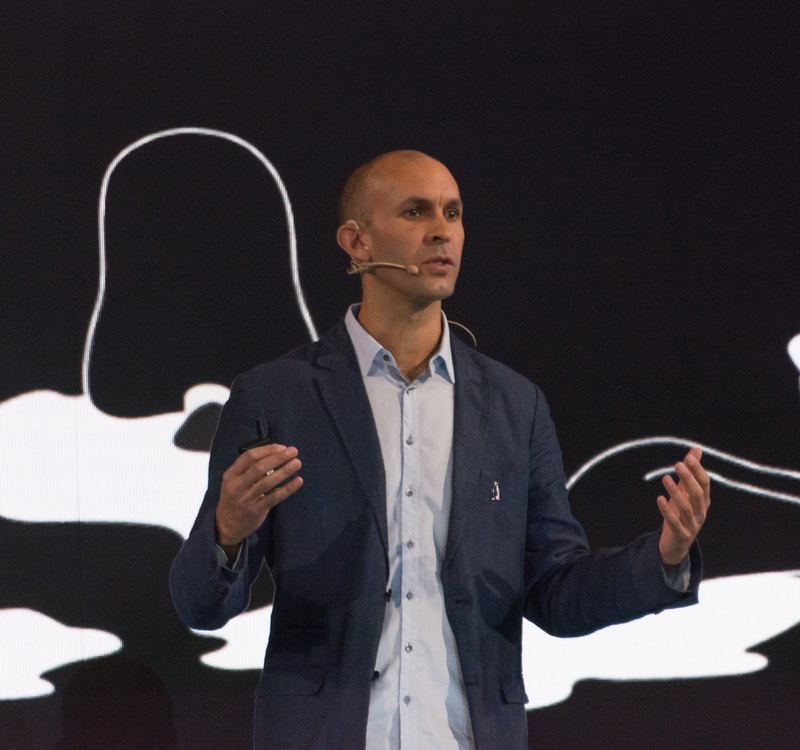 Anil SethSussex Centre for Consciousness Science, University of SussexThe beast machine hypothesis, and controlled hallucination as an account of perception
- Lancelot Da CostaDepartment of Mathematics, Imperial College London; Wellcome Centre for Human Neuroimaging, University College LondonMathematical foundations of active inference, Bayesian mechanics, computational neurophenomenology, continuous-time variational inference
- Maxwell J. D. RamsteadVERSES AI Research Lab, Los Angeles; Department of Philosophy, McGill UniversityMultiscale active inference, cultural affordances, computational neurophenomenology, shared intentionality
Karl Friston is listed with the other functionalists and computationalists, who hold that what matters is the organisation of the processing, not the material. The theory family behind that position is set out in the index of consciousness theories. Every researcher covered on this site is indexed in the directory of consciousness researchers.