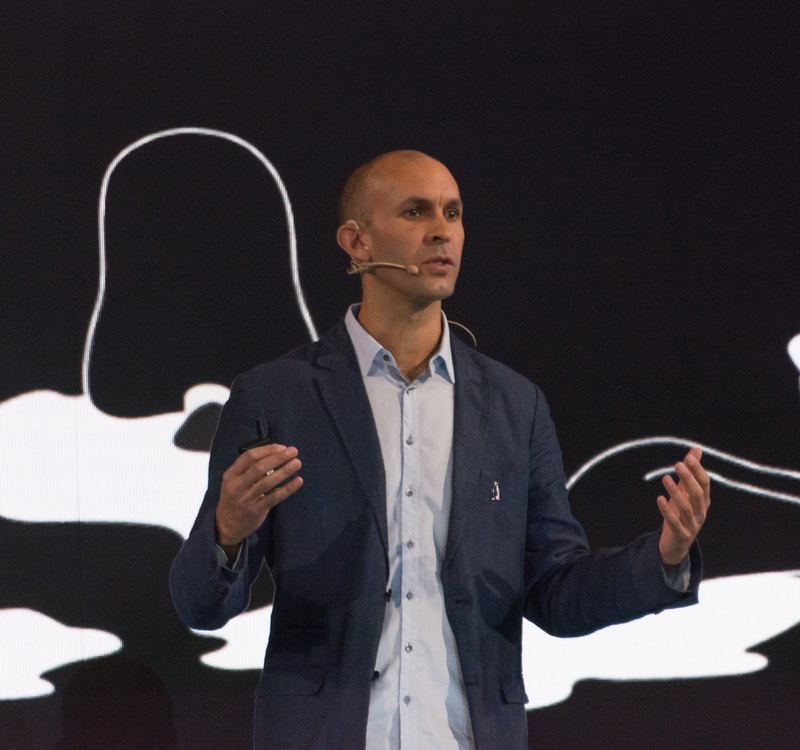
Anil Seth at TED 2026 and The Biological Naturalism Case Against AI Consciousness
In April 2026, Anil Seth delivered a TED talk titled “Why AI is unlikely to become conscious.” Seth is Professor of Cognitive and Computational Neuroscience at the University of Sussex, co-director of the Sussex Centre for Consciousness Science, and recipient of the 2025 Berggruen Prize for philosophy and culture. He is also the keynote speaker at the AISB 2026 AI Consciousness and Ethics Symposium at Sussex on July 2, where the biological naturalism argument he sketches in the TED talk will face direct challenge from researchers working within computational functionalist frameworks. The Berggruen prize essay that earned him the award, The Mythology of Conscious AI, sets out what Seth thinks sustains the belief in conscious machines, and its Behavioral and Brain Sciences companion paper carries the formal substrate argument the talk only sketches. In August 2026 Seth took the same position to a legal and policy audience on the Lawfare podcast’s Scaling Laws series, where host Kevin Frazier pressed him on what the law should do with a system people insist is conscious.
The talk is available at https://www.ted.com/talks/anil_seth_why_ai_is_unlikely_to_become_conscious. Its central claim is deceptively simple. We attribute consciousness to AI for the same reason we see faces in clouds. Both are products of human pattern-recognition, not properties of the systems we are examining.
The Controlled Hallucination Argument, Applied to AI
Seth’s theoretical framework treats consciousness as a controlled hallucination. On this view, conscious experience is the brain’s generative model of reality, constrained by sensory signals but not reducible to them. What we experience as the external world is a prediction produced by the brain and updated (corrected) by incoming sensory data. The richness of experience, the felt quality of red, the phenomenal texture of sound, reflects the structure of the generative model rather than the structure of the environment.
Applied to AI, the argument runs as follows. Current AI systems, including large language models and generative neural networks, do not have generative models of their own embodied states. They have statistical models of language or images produced by human minds that do have generative models of embodied states. When a language model generates text that expresses distress or curiosity or satisfaction, it is drawing on patterns in training data produced by beings who experienced distress, curiosity, and satisfaction. The model has learned the surface grammar of phenomenal language without the underlying phenomenal architecture.
Seth’s formulation is sharper than the standard “it’s just pattern matching” dismissal. He is not claiming AI can’t be intelligent or capable. He is claiming that the specific property of consciousness, the what-it-is-like dimension, requires something that current AI architectures do not have and cannot have without fundamental redesign.
What Seth Correctly Identifies: The Embodiment Gap
The strongest part of Seth’s argument concerns what he calls the embodiment gap. Biological consciousness, on his account, is inseparable from the organism’s ongoing regulation of its own metabolic and homeostatic processes. The brain is not a disembodied information processor. It is a control system for a body that needs oxygen, warmth, glucose, and safety. The phenomenal quality of experience, including the quality of urgency, discomfort, and need, emerges from the system’s monitoring and prediction of its own biological state.
AI systems do not have bodies that need anything. They run on electricity, but the consumption of electricity is not, for the hardware, a state analogous to hunger or pain. The system has no homeostatic process whose disruption registers as a threat. Seth’s claim is that without this layer, the necessary substrate for phenomenal experience is absent regardless of what the system can compute.
This argument is compatible with the position Yuri I. Arshavsky develops from a neurophysiology direction in his 2026 Journal of Neurophysiology paper. Arshavsky argues that biological and AI consciousness belong to categorically different domains, because AI consciousness would lack evolutionary history and the substrate-specific causal architecture that biological consciousness depends on. Seth and Arshavsky arrive at a similar conclusion through different disciplinary routes. Embodiment and metabolic regulation from Seth’s neuroscience framework, evolutionary substrate specificity from Arshavsky’s neurophysiology framework. That convergence is worth noting, even though neither argument establishes the conclusion with certainty.
Where the Argument Reaches Its Limits
The controlled hallucination framework, and the embodiment argument it grounds, faces a substantive challenge from the functionalist tradition it does not fully engage.
Functionalism holds that mental states are defined by their functional roles, not by their physical substrate. On a sufficiently broad functionalist account, any system that implements the right causal-computational relationships has the relevant mental properties, regardless of whether it has a biological body. Seth’s argument requires the additional premise that the specific phenomenal quality of experience cannot be implemented by a system without biological embodiment. That is a contestable claim, not a demonstrated one.
The relevant experimental context is the Cogitate Consortium’s adversarial test of IIT and GNW, published in Nature in 2025. That study found that even the two most-cited consciousness theories did not produce the signatures they predicted in human subjects under controlled conditions. This does it does complicate the assumption that any current theoretical framework, including Seth’s, has correctly identified the necessary and sufficient conditions for phenomenal experience.
The distinction Alexander Lerchner draws at DeepMind is useful here. Lerchner’s abstraction fallacy argument holds that digital symbol manipulation is structurally incapable of instantiating consciousness regardless of architectural sophistication. Seth’s and Lerchner’s skeptical conclusions are related but not identical. Seth’s is grounded in biological substrate requirements, Lerchner’s in structural properties of symbolic computation. A functionalist could accept Lerchner’s structural critique while rejecting Seth’s biological substrate requirement, or vice versa. The two skeptical positions reinforce each other rhetorically but do not rest on the same empirical ground.
Seth Before AISB: Biological Naturalism in July 2026
The AISB 2026 symposium at Sussex on July 2 has biological naturalism versus computational functionalism as one of its organizing tensions. The symposium program covers moral standing of AI agents, policy impacts of consciousness attribution, and the specific question of whether internal language and chain-of-thought reasoning constitute a form of access consciousness. Seth’s keynote will represent the biological naturalism position on that last question. Chain-of-thought reasoning is a form of information processing, not a form of conscious access.
The functionalist side will likely cite the mechanistic interpretability results, including the Anthropic emotion vectors finding (171 emotion concept vectors causally influencing Claude’s behavior, published April 2026) and the Lindsey et al. steering vector research showing that Claude’s introspective reports track internal states with measurable accuracy. Neither result establishes phenomenal consciousness. Both complicate the claim that current AI architectures have no relevant internal structure at all.
What the Sussex symposium will not resolve, and what the TED talk does not resolve, is the question Seth himself identifies as the hard one. Whether the specific markers we currently associate with biological consciousness are genuinely necessary, or whether they are contingent features of the substrate in which consciousness first happened to emerge.
Seth’s contribution to the 2026 debate is to insist that this question must be answered before attributing consciousness to AI systems, and to provide a principled reason, grounded in his controlled hallucination framework, for thinking the answer may be no. That is a scientifically responsible position. Whether it is correct depends on empirical work the field has not yet done.
A concurrent June 2026 preprint by Ulysse Klatzmann and Adrien Doerig provides the philosophical vocabulary that clarifies where Seth’s argument fits: Klatzmann and Doerig’s analysis of Type-A versus Type-B biological naturalism shows that Seth’s controlled hallucination skepticism is a Type-B position. His claim is not that biological material is intrinsically necessary; it is that specific predictive-processing functions instantiated in biology are necessary and absent from current AI. That is a testable claim, which explains why Seth’s position generates research questions rather than closing them. The forthcoming Chace and Lappas edited volume Perspectives on Machine Consciousness (CRC Press, September 2026) places Seth’s position in direct editorial dialogue with more than 35 other contributors, including Karl Friston, whose active inference framework reaches different conclusions from within an equally rigorous empirical tradition. That volume is the first to assemble all major 2026 positions in a single editorial frame, making Seth’s biological naturalism account for the specific predictions that Friston’s and Butlin’s frameworks generate. How Seth’s domain problem connects to the measurement problem Taschereau-Dumouchel and Lau identified, the framework problem Klatzmann and Doerig identified, and the structural limit Bradley Love identified, all published within the same research window, is analyzed in The Methodology Crisis in AI Consciousness Science. What 2026 Research Exposed.
Seth’s assertion that we are biologically predisposed to project minds onto responsive systems continues to find structural confirmation. This dynamic is perfectly illustrated by the Bradford and RIT findings on conscious-like signals in AI, which show how systems optimized for empathetic engagement generate the illusion of sentience without any underlying integrated experience.