


Konstantin Tsiolkovsky
Kaluga, Russia. Self taught, and a schoolteacher for most of his working life
Cosmist Mind is not bound to the planet or the biology that produced it
Konstantin Tsiolkovsky is remembered as the founder of astronautics, and the rocket equation he published in 1903 is the reason. The equation was instrumental to a position he had already arrived at. He held that the point of leaving Earth was not to occupy another planet, and that the long term future of mind lay in a form of existence that does not require a body at all.
His scheme of four cosmic eras places that transition in the last of them, where humanity converts from corpuscular matter into radiant matter. The scheme itself reaches us through Alexander Chizhevsky’s memoir of a conversation in 1932, written down in the early 1960s and first published in 1977, which is a weaker provenance than its wide circulation suggests. The name Radiant Era attaches to the fourth era because of what happens in it rather than because of what the source calls it.
The mechanism Tsiolkovsky offered for surviving that transition was panpsychism. In The Monism of the Universe, published in 1925, and in The Will of the Universe in 1928, he treated sensation as a property of matter as such. That commitment lets a person survive conversion into radiation without any account of how organisation produces experience, since the sensitivity was in the parts already. It is also the part of his system that fails, and it faces the same combination problem that contemporary panpsychist positions face.
He is relevant to this project for a narrow and specific reason. He is the earliest figure to pair a working physical route out of the gravity well with an argument that what should make the trip is mind rather than biology. The route was sound. The argument for the passenger has since been replaced by substrate independence, which reaches his conclusion without the claim that atoms feel.
Known for. The theory of cosmic eras, and the claim that mind ends in a radiant form
Coverage on this site
- The Kardashev scale as an energy budget for growing consciousness October 2026
- Konstantin Tsiolkovsky's Theory of Cosmic Eras and What the Radiant Era Would Actually Require August 2026
Related researchers
- Nikolai FyodorovRumyantsev Museum library, Moscow, from 1878The Philosophy of the Common Task, and space settlement as an obligation owed to the dead
- Maxwell J. D. RamsteadVERSES AI Research Lab, Los Angeles; Department of Philosophy, McGill UniversityMultiscale active inference, cultural affordances, computational neurophenomenology, shared intentionality
- Karl FristonUniversity College London. Chief Scientist, VERSES AIThe free energy principle and active inference
- Erik HoelCenter for Humanities and Sciences, Tufts UniversityFormal theory of Causal Emergence (macro over micro causation), The Overfitted Brain Hypothesis of Dreams, The World Behind the World (2023), The Kleiner-Hoel Dilemma
- Guillaume VerdonExtropic, San Francisco, founder. Kardashev Research, the nonprofit research initiative announced under the Beff Jezos pseudonymExtropic's thermodynamic computing hardware and the Z1 chip, the e/acc movement written under the Beff Jezos pseudonym, and the 2026 Kardashev Research launch
-
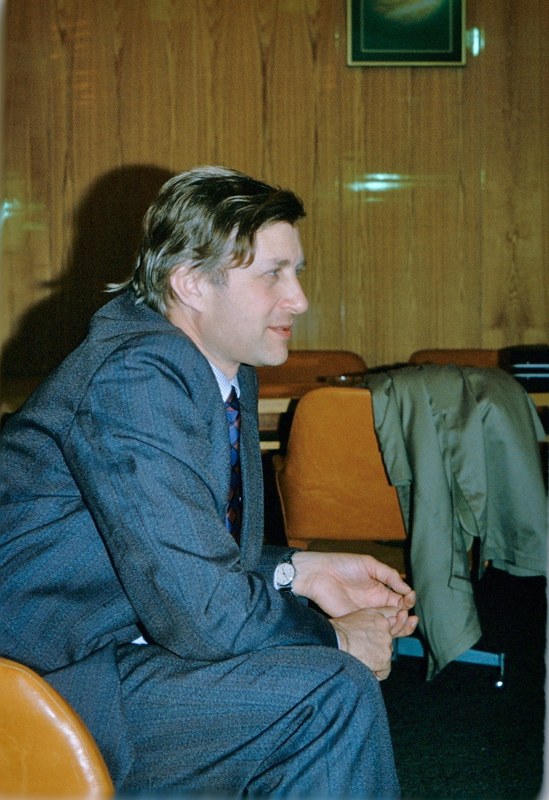 Nikolai KardashevSternberg Astronomical Institute, Moscow State University, later the Russian Academy of SciencesThe 1964 classification of civilizations by captured power, the Kardashev scale, and the Byurakan SETI meeting where it was presented
Konstantin Tsiolkovsky is listed with the other cosmists, who hold that mind is not bound to the planet or the biology that produced it. The positions themselves are set out in the index of consciousness theories. Every researcher covered on this site is indexed in the directory of consciousness researchers. The argument that mind can leave the planet that produced it is covered on Project Consciousness to Orbit.