Research and development of emerging artificial consciousness through The Consciousness AI project, based on Feinberg and Mallatt's neuroevolutionary theory.
© 2026. All rights reserved.

Does your brain carry a pattern that makes you you? The evidence says your neural oscillations identify you as precisely as a biometric. This page tests the stronger claim behind that fact. Call it the consciousness fingerprint. Consciousness emerges from synchronized neural oscillation. Each person’s synchronized dynamics are unique. Re-activating that unique pattern would re-emerge that person’s consciousness. The first two parts of the claim survive contact with the literature. The third is unproven, and the reasons it struggles decide what brain emulation, resurrection, and digital immortality could actually mean.
The hypothesis splits into three parts, and they stand on very different evidence.
This site studies consciousness as an emergent property of the universe, substrate independent. If consciousness is what certain dynamics do, then the question “which dynamics?” is empirical, and the oscillation literature is the main candidate answer. The race to define AI consciousness runs on the same logic. A theory that names the dynamics also names what an emulated brain would have to reproduce.
Four frameworks connect rhythmic synchrony to conscious experience. They agree that oscillation is essential and disagree on the job it does.
| Framework | Mechanism | Key sources |
|---|---|---|
| Binding by synchrony | Zero-lag gamma synchronization tags features as one object | von der Malsburg 1981; Singer and Gray 1995; Varela et al. 2001 |
| Communication through coherence | Phase alignment routes information between assemblies | Fries 2015 |
| Global neuronal workspace | Non-linear ignition broadcasts to frontoparietal networks | Dehaene and Changeux 2011; Mashour et al. 2020 |
| Metastable critical dynamics | Integration balanced with segregation at the edge of synchrony | Deco et al. 2017; Tognoli and Kelso 2014 |
Binding by synchrony began with Christoph von der Malsburg, who proposed fast correlation-controlled switching of synapses between conducting and non-conducting states. Wolf Singer and Charles Gray framed feature binding as neurons signalling joint membership by phase-locked firing (Singer and Gray 1995). The 25 ms window that binding imposes on any distributed system, including one running in orbit, is examined in our post on Singer’s temporal binding and the latency floor. Francisco Varela’s group extended the idea to large-scale integration. Distributed specialized regions need dynamic links, and synchrony over multiple frequency bands is the most plausible candidate (Varela et al. 2001). Rufin VanRullen’s oscillatory binding program gives the modern form, with perception sampled in discrete rhythms rather than continuously.
Pascal Fries’s communication-through-coherence adds a routing function. Gamma-band synchronization makes postsynaptic activation effective, so a transmitting assembly drives a target only when its outputs arrive in the target’s depolarizing window (Fries 2015). Information routes by relative phase, with no rewiring of anatomy.
Stanislas Dehaene and Jean-Pierre Changeux place ignition above the routing layer. Subliminal signals stay confined to local processing. Conscious access happens through a sudden non-linear ignition of a prefronto-parietal network, visible as sustained beta and gamma synchronization (Dehaene and Changeux 2011). Mashour, Roelfsema, Changeux and Dehaene’s 2020 review extends the framework to anesthesia data (Mashour et al. 2020).
Gustavo Deco, Morten Kringelbach, Viktor Jirsa and Petra Ritter fitted whole-brain models to resting-state data and found the brain sits at the edge of the Hopf bifurcation, at maximum metastability (Deco et al. 2017). Metastability means the variability of global synchronization over time, measured as the standard deviation of the Kuramoto order parameter (Deco and Kringelbach 2016). Emmanuelle Tognoli and Scott Kelso describe the same regime as a subtle blend of integration and segregation (Tognoli and Kelso 2014).
The four frameworks treat synchrony as one number for the whole brain. Recordings in awake primates also show the phase moving across the cortex as a traveling wave, and the wave phase at the moment a faint target appears predicts whether it is detected (Davis et al. 2020). The Brain Waves Console runs that effect live, next to the Kuramoto oscillators inside this project’s agent. The wave and ripple literature behind that evidence now has its own coverage on the site, with the 2026 Neuron traveling waves review, the co-ripple study of working memory and the fMRI spiral waves analyzed with their primary numbers.
Individual identification from brain dynamics is a measured result, with four independent confirmations.
The conclusion is narrower than the hype. An individual dynamical identifier exists and is stable across weeks. An identifier is not an explanation. Nothing in these studies shows the identifier causes or constitutes the conscious state. The next section examines that gap.
The re-emergence claim fails in three specific ways unless it is reformulated. Each failure mode is grounded in primary evidence.
The fingerprint persists while consciousness does not. fMRI fingerprints stay stable across NREM sleep stages and actually sharpen in deep sleep (Yang et al. 2026). NREM EEG power spectra are trait-like within subjects across nights, into old age (Eggert et al. 2022). Twenty subjects were identified across wake, dexmedetomidine sedation and recovery (Liu et al. 2019). The identifier is present in the tissue during states with no awareness.
One boundary must be stated honestly. No study tests individual fingerprints under propofol or in unresponsive patients, and group-level evidence points the other way. Propofol-induced loss of consciousness came with a breakdown of frontoparietal and thalamocortical connectivity (Boveroux et al. 2010).
The reformulation that survives is this. The fingerprint is an individual’s invariant dynamical repertoire. Awareness is flexible traversal across that repertoire. Marcello Massimini and colleagues’ perturbational complexity index tracks the traversal side, separating wakefulness, dreaming, NREM sleep, sedation and unresponsive states in single individuals (Casali et al. 2013). Trait and state measures are complementary instruments, and the strong claim needs both.
If synchrony builds experience, more synchrony should mean more experience. Seizures prove the opposite. Impaired consciousness in epilepsy follows disruption of a frontoparietal-subcortical system, through mechanisms that include both excessive and reduced activity (Blumenfeld 2012; Blumenfeld and Taylor 2003). Desynchronization often precedes seizure onset, and high synchronization appears toward seizure termination (Jiruska et al. 2013). The seizure onset zone is functionally disconnected from the rest of the brain (Warren et al. 2010). A network locked into one global rhythm has no room for the flexible traversal that the trait-versus-state analysis requires.
Brain dynamics run on coupling between scales, not one clock. The phase of slow rhythms, delta at 1 to 4 Hz and theta at 4 to 8 Hz, modulates the amplitude of fast local processing in the gamma band at 30 to 90 Hz. This phase-amplitude coupling differs by brain area, tracks task events, and predicts learning (Canolty and Knight 2010). Any fingerprint worth the name is a multi-scale pattern, never a single frequency.
This is the question that makes the theory worth stating, and it stands on no evidence yet. Three verified facts frame it.
General anesthesia is “a reversible drug-induced coma”, in the words of Emery Brown, Ralph Lydic and Nicholas Schiff, with a staged EEG signature rather than a uniform shutdown (Brown, Lydic and Schiff 2010). The same person returns every day. No stored fingerprint is re-loaded from anywhere. If waking is daily re-activation of the pattern, the resurrection question moves to a stranger place. What would re-activation mean for a duplicated or emulated substrate, where no original tissue waits to resume?
Degeneracy limits the uniqueness. Degeneracy is the ability of structurally different elements to perform the same function or yield the same output, and it is a ubiquitous property of biological systems (Edelman and Gally 2001). Many different oscillatory configurations may produce the same conscious state. One fingerprint can be sufficient without being necessary. That helps any replication attempt and undermines the idea of one unique key.
Hans Moravec’s neural substitution argument replaces neurons one by one with behaviorally identical electronic parts, and identity survives (Moravec 1988). Derek Parfit’s psychological criterion holds that personal identity consists in psychological connectedness and continuity rather than in a further fact (Parfit 1984). Under functionalist emergentism, the pattern and its dynamics carry identity. Degeneracy and anesthesia reversibility push the debate one step further, from the pattern to the repertoire plus the traversal.
Three things would need to be true for re-emergence to work.
If consciousness is traversal across a dynamical repertoire, the theory predicts something bold. Novel repertoires build novel minds. No human template is required. A connectome that self-organizes its own metastable dynamics would instantiate a consciousness fingerprint that belongs to nobody.
The prediction is testable in principle, and its nearest living version grows in a dish. Alysson Muotri’s cortical organoids develop spontaneous oscillations, burst patterns and frequency-band organization from ten weeks onward, with no body and no sensory world. Whether that counts as a new consciousness is exactly the welfare question the field now faces under uncertainty. The precautionary framework in Jeff Sebo’s welfare work applies with full force. Creating a new repertoire creates a new candidate moral patient, and the creator owns the uncertainty.
Could the pattern of someone who lost awareness be reconstructed? This section is explicitly speculative, because the evidence base is thin.
The connection runs through structure. Connectome harmonics show that functional networks match harmonic wave patterns of the structural connectome, with excitation-inhibition balance setting the regime (Atasoy, Donnelly and Pearson 2016). Structure constrains the repertoire. Damage to structure therefore narrows the repertoire, which is a mechanistic story for what severe brain injury does to the dynamics.
The speculative step is the recovery claim. Restoring a lost pattern would require reading the missing repertoire from whatever structure remains, then driving the remaining tissue back into the right traversal. No instrument today can do either half. External driving exists in primitive form, since 40 Hz gamma entrainment changes biology in mice (Iaccarino et al. 2016), but that result treats pathology and never re-instantiates a person. Honest verdict. Not impossible under this theory, with no plausible path on current evidence, and the theory at least names what the missing piece is.
The theory generates ethical questions faster than it generates answers.
Under this theory, immortality is a claim about continuing traversal. Storage of a static pattern achieves nothing on its own, because a stored fingerprint is a score, and no one is home inside a score.
The daily evidence supports the reductionist reading. Sleep and general anesthesia interrupt the traversal completely, and identity survives the gap. Parfit’s criterion explains why. “What matters” is psychological connectedness and continuity, and gaps are compatible with both. The uncomfortable consequence cuts against naive uploading. A copy that preserves the repertoire but starts a new traversal is exactly as continuous with you as you are with yourself tomorrow morning after anesthesia. Whether that counts as living forever is the same question this site’s model-switching analysis reaches from the AI side.
The Consciousness AI implements the mechanism side of this theory, and its own results discipline the claim.
The architecture’s AKOrN module, Artificial Kuramoto Oscillatory Neurons, implements oscillatory binding at Layer 2 using Kuramoto-model dynamics. A pre-registered comparison across four architectural variants found oscillatory binding and IIT-style integrated information mechanistically opposed, with no tested configuration reaching the correlation threshold. The full account is on the architecture page. The finding is a data point against any simple claim that synchrony and integration rise together, and it shows what pre-registered testing of this theory looks like.
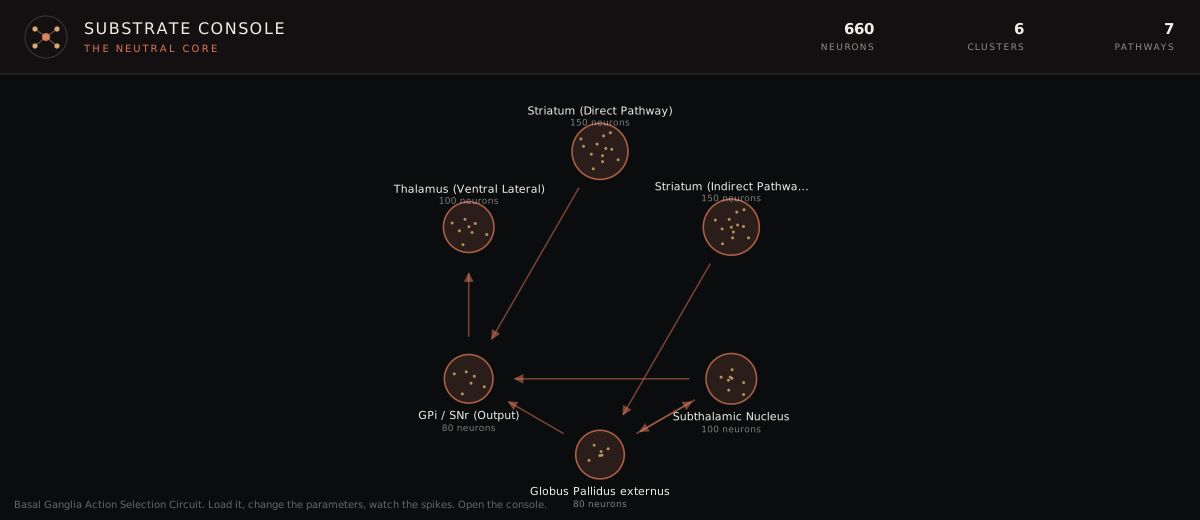
The Substrate Console runs leaky integrate-and-fire neurons, the same model class that produces self-organized gamma in the pyramidal-interneuron network gamma mechanism (Brunel and Wang 2003; Tiesinga and Sejnowski 2009). The connectome console’s C. elegans spike replay is a micro-scale instance of the same excitatory-inhibitory dynamics, run over the actual chemical wiring graph and seeded at the six touch receptor neurons, with gap junctions excluded and latencies computed from graph distance. It is a graph traversal with spike timing. It does not model consciousness, and no claim here says otherwise.
The theory is falsifiable at its joints, which is the most that can be asked of it.
The consciousness fingerprint survives as a research program. Mechanism supported, identifier real, re-emergence open. The gap between the second and third claims is where the next decade of work on brain emulation will actually happen, and this page will be updated as that work lands.