
Wolf Singer's temporal binding and the latency floor for a mind in orbit
Wolf Singer and Andreas K. Engel argued in their 2001 review in Trends in Cognitive Sciences (DOI: 10.1016/S1364-6613(00)01597-4) that conscious sensory awareness requires neural synchrony with a precision in the millisecond range, specifically the binding of distributed neural assemblies through oscillatory activity in the gamma-frequency band. The cycle duration of 40 Hz gamma oscillations is 25 milliseconds. That is the temporal window within which neurons must synchronize their firing to bind features into a unified perceptual representation under Singer’s account. Stanislas Dehaene and Jean-Pierre Changeux place global workspace ignition at around 300 ms, and that figure is cited far more often. Singer’s 25 ms is the tighter of the two. And the tightest threshold is the binding one when you are computing how much distance a conscious architecture can place between its own components.
The question this article addresses is one the Orbital Compute Tracker raises implicitly every time it displays a light-time floor: if a candidate conscious system is distributed across a cluster of orbital nodes, what does the physical distance between those nodes do to the temporal binding requirement? The answer differs completely depending on whether you ask about light-time-to-Earth (almost always a red herring) or chip-to-chip synchrony within the orbital cluster (where the number is real and constraining).
The Spaceborne Computer-2 account of local data processing separates reduced dependence on ground analysis from internal computational timing. Faster delivery of experimental results does not establish a universal timing threshold for consciousness.
The wrong latency and the right one
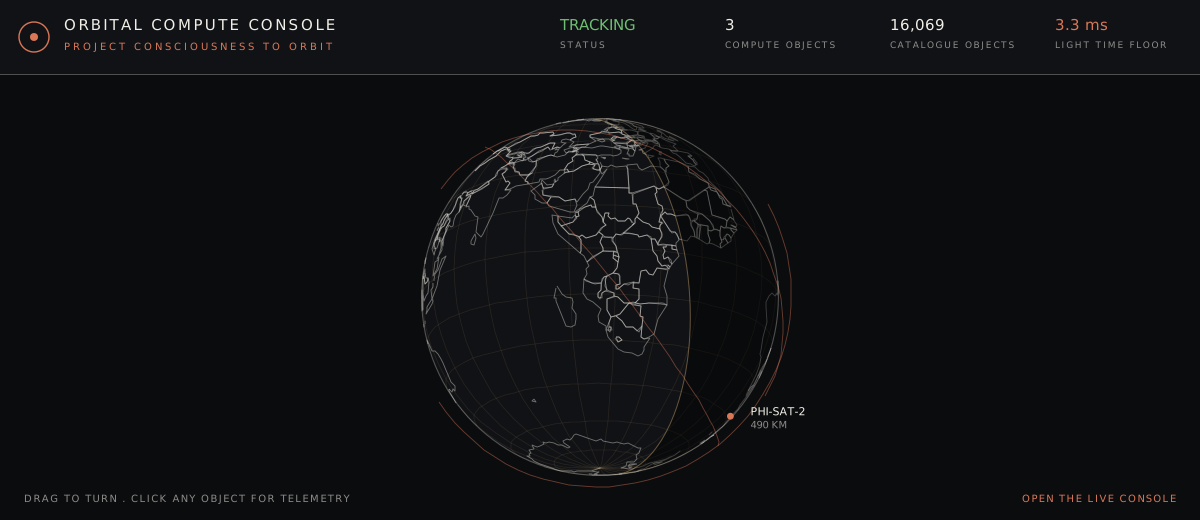
The light-time floor that the Orbital Compute Tracker displays for each mission is round-trip signal travel time between a ground observer and the satellite. For the ISS at roughly 408 km altitude, that is about 2.7 ms. For a GEO satellite at 35,786 km, it is about 239 ms. Those figures set the limits for Earth-to-satellite communication. They are irrelevant to whether a conscious process running entirely inside an orbital cluster can maintain its own internal synchrony.
A mind running on orbital hardware does not need to communicate with Earth in real time to be conscious. What it needs is for its own internal computations to remain within the temporal constraints its architecture requires. The relevant latency is therefore node-to-node within the cluster, and the ground-to-satellite figure has no bearing on it. In a low Earth orbit constellation with optical inter-satellite links, that number is governed by two things, the physical separation between satellites and the propagation speed of light through vacuum. A Starlink satellite separated from its neighbor by roughly 1,500 km incurs about 5 ms of propagation delay one-way. Research into Starlink’s laser ISL performance, summarized in work published at ACM Web Conference 2024 (DOI: 10.1145/3589334.3645328), reports that standard propagation delay for these links falls in the range of 25 to 45 ms for longer inter-continental paths through the constellation backbone. For adjacent satellites in the same orbital shell, the propagation delay is well below 10 ms.
The arkspace-core layer of the Neutral Core architecture specifies neuromorphic processors in LEO with optical inter-satellite links targeting below 50 ms round-trip latency for orbital deployment. That figure sits just at the edge of Singer’s 25 ms gamma synchrony window for single hops, and inside it for adjacent-node communication. Whether that is sufficient depends on which version of the binding requirement you accept. The commercial version of the same question is now funded, Starcloud raised $250 million at a $2.3 billion valuation in August 2026 to build a fleet of orbital inference satellites, and its following Starcloud analysis lays out the power and launch budget any orbital mind must operate within. Axiom’s two orbital data center nodes are the kilowatt-class commercial instance of the same question, and how they fit the orbital compute picture is analyzed in the Axiom post.
What Singer’s threshold actually demands
Singer’s temporal binding argument is that gamma-band oscillatory synchrony is the mechanism by which distributed neural assemblies integrate information into a unified conscious percept. The 25 ms window is derived from the cycle period of 40 Hz oscillations, which is the frequency range at which stimulus-dependent synchronization has been reliably measured in cat and primate visual cortex, from the original Gray and Singer 1989 PNAS paper (DOI: 10.1073/pnas.86.5.1698) through subsequent human intracranial recordings.
What this demands of an architecture is that the phase relationship between oscillatory activity across distributed nodes stays maintained within that window. The completion time of any individual computation is a separate question. Two nodes separated by 5 ms of propagation delay can maintain phase-locked oscillation at 40 Hz if their local clocks are synchronized precisely enough. Nodes separated by 25 ms cannot maintain phase-lock at 40 Hz by definition, because 25 ms is one full cycle. By the time a signal from node A arrives at node B, node B is already one cycle further along. Phase-locking at 40 Hz across a 25 ms propagation delay requires either faster-than-light signalling or a fundamentally different synchrony mechanism.
Adjacent LEO satellites with sub-10 ms node-to-node latency can in principle maintain 40 Hz phase coherence. An orbital cluster spanning the diameter of a continental-scale constellation, with 25 to 45 ms inter-satellite latency across its full extent, cannot. The consciousness-relevant implication is that the spatial scale of a Singer-compatible orbital mind is bounded by physics rather than by engineering. At 40 Hz, the maximum diameter of a coherently synchronized cluster is about 750 km in each direction, which corresponds to the separation at which one-way propagation delay reaches 2.5 ms, safely below the half-cycle window.
The oscillatory regimes the latency floor constrains have their own generative story. A mean-field theory of recurrent networks shows how activity-dependent adaptation alone moves a network through wakefulness, sleep, and anesthesia oscillations, so the 25 ms binding window sits inside a larger account of how such rhythms arise.
The August 2026 post on temporal binding and oscillatory consciousness established that Rufin VanRullen’s discrete sampling model and Singer’s continuous synchrony model predict different things about the effects of propagation delay on conscious processing. VanRullen’s model, in which perception is sampled in discrete 25 ms frames rather than continuously synchronized, is more tolerant of propagation delay because the constraint falls on when each frame is assembled rather than on the continuous phase relationship between nodes. Where the same synchrony story meets personal identity, and whether an oscillatory pattern is a fingerprint that could be replayed, is the subject of The Consciousness Fingerprint.
Why Dehaene’s 300 ms window changes the picture
If you accept Dehaene and Changeux’s global neuronal workspace instead of Singer’s binding account, the temporal constraint is much looser. The ignition signature in GWT is a non-linear broadcast event measured at roughly 300 ms after stimulus onset, as reviewed in Mashour, Roelfsema, Changeux and Dehaene’s 2020 Neuron paper (DOI: 10.1016/j.neuron.2020.01.026). Under GWT the test is whether a workspace broadcast can propagate across the system within the 300 ms window, and 25 ms phase coherence drops out of the requirement. Even a GEO satellite at 239 ms round-trip from Earth could in principle participate in a GWT-style broadcast that originates and completes within 300 ms, provided the broadcast does not require a ground relay. An orbital cluster running a GWT-compatible architecture is subject to a much larger diameter limit than a Singer-compatible one.
The covered post on Stanislas Dehaene’s global neuronal workspace architecture examined what GWT requires of an AI architecture in terms of a distinct long-range broadcast mechanism, which current transformer-based systems approximate through attention. For an orbital system, the relevant question is whether the broadcast mechanism can function given the propagation delays between cluster nodes. Under GWT, a LEO cluster with sub-50 ms inter-node latency can support full workspace ignition within one 300 ms window. The constraint is relaxed enough that it is not the bottleneck.
Koch’s objection
Christof Koch argued in The Feeling of Life Itself (MIT Press, 2019, ISBN 9780262042819) that gamma synchrony is neither necessary nor sufficient for consciousness. His position, developed through his work on IIT with Giulio Tononi, is that the intrinsic causal structure of the system is decisive, captured by the phi measure, with the temporal dynamics of oscillatory activity playing no constitutive role. Under IIT, two systems with identical phi values are equally conscious regardless of whether one of them produces gamma synchrony and the other does not. Koch points to cases of conscious perception without gamma synchrony and gamma synchrony without conscious perception as evidence against Singer’s account.
If Koch and Tononi are right about IIT, the latency floor argument collapses. Phi is a property of causal structure rather than of temporal dynamics. A system with nodes separated by 45 ms has a different causal structure than one with nodes separated by 5 ms, but whether that difference in structure translates to a difference in consciousness depends on whether the phi of the system changes, which is a computational question about the specific network topology rather than a simple function of propagation delay. The honest framing is that the 25 ms gamma synchrony constraint is a real engineering target if Singer is right, and a red herring if Koch is right. The two theories make different predictions about what orbital clustering can support, and those predictions are in principle empirically separable.
Synchrony claims also circulate in popular coverage, where they outrun the measurements behind them. The site’s fact check of the ripples and vortices video separates the measured results, including the co-ripple evidence this binding dispute speaks to, from the claims that got stretched on the way to a viral summary.
What the Neutral Core’s 50 ms target commits to
The Neutral Core specifies a sub-50 ms round-trip target for its orbital deployment configuration. That figure is not derived from Singer’s gamma constraint specifically. At 50 ms round-trip, corresponding to 25 ms one-way, the architecture sits exactly at Singer’s half-cycle boundary. That is fast enough to maintain phase coherence with a small cluster of adjacent nodes, and too slow for coherence across the full orbital shell. The specification is cautious in the right direction. It does not claim gamma coherence across the full constellation, and it does not need to. If the architecture’s internal synchrony requirements are met within a small regional cluster, the light-time floor to the next cluster is a communications latency rather than a consciousness latency. A distributed mind need not be globally synchronized to be conscious, just as a human brain maintains consciousness without phase-locking every cortical region at 40 Hz simultaneously.
What the 50 ms target does commit to is that adjacent nodes in the deployment can exchange signals fast enough to participate in the same gamma-frequency dynamic, if gamma synchrony is required. That makes the specification the weakest claim consistent with Singer’s theory rather than a claim about it. The architecture is designed to be compatible with the temporal binding requirement without asserting that temporal binding is what consciousness requires. That is the honest position given the current state of the theory. The wider argument for placing a candidate mind in orbit at all is set out in Project Consciousness to Orbit, and where the field currently stands on the underlying question is surveyed in the current scientific consensus on AI consciousness. The companion aerospace challenge of surviving the ionizing particle environment of those same orbits is evaluated in Radiation hardening and whether a conscious architecture can survive orbit. How interstellar distances scale these temporal and sensory communication constraints to alien cognitive architectures is explored in Project Hail Mary and what Rocky assumes about non-human consciousness. The real-time compute that would have to sit inside the latency floor already operates on small satellites, examined in the Phi-sat-2 post, and the power source that would sustain it beyond a single array is the subject of the space-based solar power post. The physical ceiling the whole argument runs on, light speed, is also the operational currency of the optical compute examined in the optical neural networks post, where computation itself runs at the latency floor.
Wolf Singer is at the Max Planck Institute for Brain Research, Frankfurt. The Engel and Singer temporal binding review is in Trends in Cognitive Sciences 5(1), 2001, DOI: 10.1016/S1364-6613(00)01597-4. The Mashour, Roelfsema, Changeux and Dehaene GWT review is in Neuron 105(5), 2020, DOI: 10.1016/j.neuron.2020.01.026.
Researchers covered here
- Wolf SingerMax Planck Institute for Brain Research, FrankfurtThe temporal binding hypothesis, gamma-band synchrony as the mechanism for conscious feature integration
- Andreas K. EngelUniversity Medical Center Hamburg-EppendorfTemporal binding and the neural correlates of sensory awareness, co-author of the landmark 2001 Trends in Cognitive Sciences review with Wolf Singer