


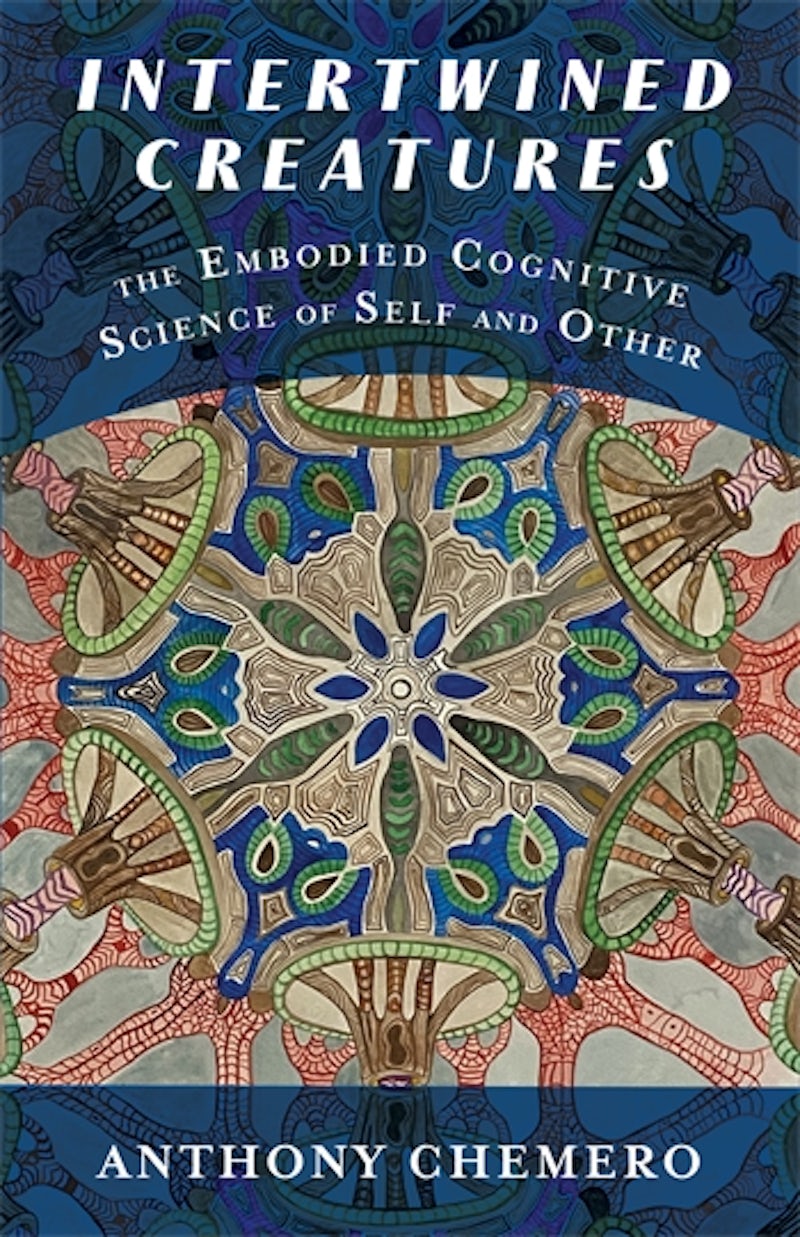
Anthony Chemero and Intertwined Creatures the embodied challenge to AI consciousness
Anthony Chemero's 2026 book argues minds are embodied and social, and that the AI consciousness question rests on a misconception of cognition.
Anthony Chemero’s Intertwined Creatures, The Embodied Cognitive Science of Self and Other (Columbia University Press, 2026) argues that the standard picture of the mind is wrong. Western philosophy and psychology built the mind as a lone, disembodied thinker that contemplates the world from afar. Chemero’s alternative is radical. The mind is an embodied, dynamic, social phenomenon, inseparable from the environment and from the people who provide “the warmth, food and love required to keep us going.” The AI consciousness question is the point where the two pictures collide, and that is why Abeba Birhane reviewed the book in Nature on 24 August 2026 under the headline “Can AI ever be conscious? The question stems from a misconception.”
The misconception is treating human cognition as something a language model could in principle reproduce. Chemero argues the mind is not the manipulation of abstract representations by rule-like mechanisms. Perception, experience, and thinking are embodied activities, and the inner speech that accompanies daily life is not the output of a hidden mental realm, it is the activity of a living organism intertwined with its situation.
The intertwined self
Chemero draws on ecological psychology, the enactive cognition of Varela, Thompson, and Noe, and the mathematics of non-linear dynamics. The three traditions converge on one claim. Complex behavior emerges through reciprocal interaction between a person and an environment, not through a central controller that computes a map of the world and then acts.
The book’s method is grounded in the ordinary. You notice you are late for work, search for your keys, get distracted by a pile of laundry, remember you need detergent, spot an apple core in your bag, clean your laptop, and forget the book you meant to take. The inner speeches that accompany these sequences are intertwined with the objects and tasks around you. The counterfactual examples show the same structure. Imagining what it would be like if every nation elected a Black woman as its head of state is built from your perceptions of Black women in authority, your experience of political institutions, and the social context that shapes expectations about who can hold office. Imagination is not a hidden computation. It is situated activity.
The argument against AI consciousness
The Nature review draws out the consequence for machine consciousness debates. Artificial intelligence systems, and especially large language models, do not need to navigate interpersonal interactions to maintain their existence, and they do not have the capacity to care. Under Chemero’s account, those are not incidental omissions. They are what a mind is for.
The disagreement with computational analogies is therefore structural, not empirical. The fields of AI, psychology, and philosophy, Birhane summarizes, have neglected a key aspect of consciousness, the body. The human brain is not a computer in the sense that the analogy requires, and the anthropomorphic spread of AI consciousness claims rests on that false equivalence. Chemero’s position is a version of the biological and embodied naturalism this site tracks, and the McClelland epistemic limits analysis and Thompson and Noe’s enactivism covering are the site’s prior engagements with this family of positions.
Comparison to The Consciousness AI
The site’s own project assumes functionalist emergentism and substrate independence. Chemero’s book is the strongest current statement of the contrary position, that the mind is not a possible product of any substrate, because it is an activity of a body in a situation. The two positions disagree at the foundation, and the disagreement is exactly the one the current scientific consensus on AI consciousness records as unresolved. Does consciousness require a sensorimotor body and a social world, or can it be carried by the causal organization alone?
Chemero’s answer to the Neutral Core’s indicator checklist is that the checklist measures the wrong properties. A workspace, a self-model, and an affective core simulated in software are, on his account, the vocabulary of hidden mental realm theory, the one he argues is false. The honest response from this site is not to dismiss the book but to note that the two positions are experimentally distinguishable only in the long run, and that the existence of embodied social robots will eventually test which one holds.
Where the book sits in the debate
The book joins the skeptical shelf of the site’s books hub. It belongs beside Michael Pollan’s A World Appears, which argues from psychedelic phenomenology that thought requires feeling and a body. Chemero argues the same conclusion from the scientific literature of ecological psychology. Where Pollan is narrative, Chemero is disciplinary, and the two together give the skeptical position both public and academic roots.
The position is not a refusal of machine consciousness in principle. Chemero’s argument is that the current engineering analogy is built on a false model of the human mind, not that no artificial system could ever satisfy the embodied and social conditions. A robot with a body, a history, and a social ecology would be a different question. The move is deflationary about language models specifically, in the same way Keith Frankish’s illusionism deflates the explanatory target, while staying open about the synthetic possibilities the future holds.
Anthony Chemero is a cognitive scientist and philosopher at the University of Cincinnati. *Intertwined Creatures was published by Columbia University Press in March 2026. Abeba Birhane is a cognitive scientist at Trinity College Dublin and founder of the AI Accountability Lab. Her review appeared in Nature on 24 August 2026.