
Research and development of emerging artificial consciousness through The Consciousness AI project, based on Feinberg and Mallatt's neuroevolutionary theory.
© 2026. All rights reserved.

One nerve cell is a branched electrical cable with voltage-gated channels in its membrane. This console runs one cell in your browser, from a single Hodgkin-Huxley compartment to a reconstructed pyramidal neuron, and it can load any reconstructed cell from NeuroMorpho.Org. The engine is a JavaScript port of the fixed step method of the NEURON simulator, and a test compares its voltage with NEURON’s own output on every model shown here.
Nothing on the canvas is a recording from a living cell. Each chapter is a model, and each one states what is built in and what the run produces.
This graphic needs a canvas and a script. The chapter table below carries the same information.
| Chapter | Model | Built in | Emerges | Source |
|---|---|---|---|---|
| 1 Spike | One compartment with the sodium, potassium and leak conductances of hh.mod |
The 1952 rate functions and conductances, and the temperature factor of 3 per 10 degrees | The threshold, the spike shape, the refractory period, repetitive firing | Hodgkin and Huxley 1952; hh.mod |
| 2 Cable | A passive cylinder, 1000 um, cut into 1 to 51 segments, beside the same cylinder cut into 101 | Membrane leak, axial resistance, capacitance | The decay with distance, the slower rise at the far end, the error of a coarse grid | Hines and Carnevale 1997 |
| 3 Axon | A 10 mm cylinder in 201 segments with the channels of chapter 1 | The same channels, and a stimulus scaled to the diameter | Propagation, its speed, the rise of speed with diameter and with temperature | Hodgkin and Huxley 1952 |
| 4 Dendrites | NEURON's demo pyramidal cell, 79 sections and 185 nodes, or a cell from NeuroMorpho.Org, with synapses of the ExpSyn kind |
The reconstructed shape, the demo's membrane values on every cell, a 2 ms synaptic decay | Weaker and later responses from far synapses, large local voltage on thin branches, less than double from two synapses at one place | NEURON share/demo; NeuroMorpho.Org |
| 5 Cost | A timer around the step function of each model | Nothing | The time for one step on the reader's device | Measured on this page |
NEURON is a widely used simulator for models of single nerve cells and of networks built from such cells. Michael Hines is its principal author, and the copyright of the source is in his name. The source is public under a three clause BSD licence at github.com/neuronsimulator/nrn, and release 9.0.2 is dated 10 August 2026. Hines and Carnevale describe the design in Neural Computation (1997).
A NEURON model is a tree of sections. A section is an unbranched piece of cable, and the program cuts
it into nseg segments and keeps one voltage for each. Mechanisms written in the NMODL language add
channels to the membrane. Each time step solves one linear equation per segment. The tree has no loops, so
the solver that Hines published in 1984 clears the
equations in one pass from the tips to the root and one pass back. The work grows in proportion to the
number of segments.
NEURON has no build that runs in a browser. The console therefore carries its own engine, about 300 lines of JavaScript, which repeats the steps of NEURON’s default fixed step method.
cnexp update at the new voltage.hh.mod instructs NEURON to do.Step 4 was found by the test and was absent from the first version. With the rates computed exactly, the engine’s spike differed from NEURON’s by up to 5.2 mV. With the table, the difference vanished.
The test is scripts/probes/probe_neuron_engine.js in the site repository. A Python script runs twenty
models in NEURON 9.0.2 and stores the voltage every 0.1 ms. The test builds the same twenty models with the
JavaScript engine and compares every sample. The largest difference on any sample is 0.000068 mV, and the
stored traces are rounded to 0.0001 mV. The interface uses NEURON’s own names, nseg, diam and Ra, and
NEURON’s units.
The engine covers a small part of NEURON. It has one channel mechanism, one passive mechanism, a current clamp and one synapse type. It has no variable step solver, no ion accumulation, no NMODL and no networks.
The file share/demo/pyramid.nrn in the NEURON repository holds a pyramidal cell that was traced in three
dimensions and converted to NEURON’s format in 1992, according to its header. The file names neither the
species nor the brain region, so this page does not name them either. The demo gives the soma and one process
the Hodgkin-Huxley channels and leaves every other dendrite passive, at 15 degrees Celsius with an axial
resistance of 100 ohm centimetres.
NEURON computed each segment’s membrane area and each axial resistance from the traced points. The console loads those numbers and never recomputes the geometry. The table below comes from the stored NEURON runs, with one synapse of 1 nS.
| Synapse | Path to soma | Peak at the synapse | Peak at the soma | Soma peak after |
|---|---|---|---|---|
| Near, on the longest dendrite | 108 µm | 0.67 mV | 0.281 mV | 2.6 ms |
| Far, at the tip of that dendrite | 939 µm | 4.37 mV | 0.083 mV | 7.5 ms |
| Far, two synapses at one place | 939 µm | 8.24 mV | 0.140 mV | 7.6 ms |
The far synapse makes six times more voltage where it sits, because a thin branch has a high input resistance. At the soma it makes less than a third of what the near synapse makes, and five milliseconds later. Two synapses at the far site give 0.140 mV at the soma. Twice the single response is 0.165 mV. The first synapse moves the local voltage toward the synaptic reversal potential, and the second one then has less to drive.
A cell with passive dendrites therefore already does more than add its inputs. The position of a synapse sets its weight and its timing, and neighbours on one branch interact.
NeuroMorpho.Org is the public archive of digitally reconstructed neurons that Giorgio Ascoli’s group curates at George Mason University. Release 8.6.128 of 1 October 2026 holds 299,708 cells, under a Creative Commons Attribution 4.0 licence. Chapter 4 can load any of them. Type a NeuroMorpho name or id and press Load, or press Random. The request goes from your browser to NeuroMorpho.Org at that moment. This page makes no request to another site until you press one of those two buttons.
Four cells ship with this site, so the menu works with no outside request.
| Cell | NeuroMorpho id | Archive | Reconstruction paper |
|---|---|---|---|
| Rat neocortex, layer 5 pyramidal | 79471 | Stuart | doi:10.1038/nn2040 |
| Rat hippocampus, CA1 pyramidal | 223 | Amaral | doi:10.1002/cne.903620103 |
| Mouse cerebellum, Purkinje cell | 10069 | Dusart | doi:10.1523/JNEUROSCI.2977-12.2013 |
| Monkey prefrontal cortex, layer 3 pyramidal | 1 | Wearne_Hof | doi:10.1016/S0306-4522(02)00305-6 |
A NeuroMorpho file holds points with a radius and a parent. It holds no channels and no membrane values. The console therefore applies one fixed set of rules to every loaded cell. The soma becomes one cylinder as long as it is wide. The axon is left out when the file marks dendrites, and a file with no marked dendrites is kept whole. Each run of points between two branch points becomes one section, cut into one segment per 50 µm as the NEURON demo cuts its own cell. The soma carries the squid channels of chapter 1, and every dendrite is passive with the demo’s values. A cell above 8,000 nodes is refused.
So a loaded Purkinje cell has the true shape of a Purkinje cell and the membrane of the demo. Its numbers show what that shape does to a signal. They are no prediction for the living cell, whose dendrites carry their own channels.
The geometry is checked like the rest. For the four shipped cells, NEURON receives the same sections and computes each area and each axial resistance from the points by itself. The engine’s voltages agree with NEURON’s to the rounding of the stored traces. A cell loaded live runs through the same code, with no stored NEURON run to compare.
The archive is described in Tecuatl, Ljungquist and Ascoli (2024), FASEB BioAdvances 6(7), 207 to 221. Its research resource identifier is RRID:SCR_002145. The panel beside the console links the reconstruction paper of each cell it loads.
The dendrites of living cortical neurons are active. They carry voltage-gated sodium and calcium channels and NMDA receptors, and they produce their own local spikes. Chapter 4 has none of this, by the demo’s design.
David Beniaguev, Idan Segev and Michael London trained artificial networks to reproduce a detailed model of a layer 5 pyramidal neuron and reported in Neuron (2021) that a temporally convolutional network of five to eight layers was required. With the NMDA receptors removed from the model, a network with one hidden layer was enough. Albert Gidon, Matthew Larkum and colleagues recorded from dendrites of human layer 2/3 neurons and reported in Science (2020) a calcium-mediated dendritic action potential. Their model showed that it lets a single cell compute the exclusive-or of two inputs, an operation that was thought to need a network of several layers.
Dendritic Integration Theory places the mechanism of conscious processing inside one cell type. Jaan Aru, Mototaka Suzuki and Matthew Larkum set it out in Trends in Cognitive Sciences (2020). A layer 5 pyramidal neuron receives feedforward input near its soma and feedback input on its distant apical dendrite, a far site of the kind chapter 4 lets you tap. The theory holds that conscious processing depends on the coupling of those two compartments, and that input from the thalamus modulates the coupling.
The experimental support comes from Suzuki and Larkum in Cell (2020). In awake mice, light driven depolarisation of the distal apical dendrite produced spikes at the soma. Under each of three anaesthetics the same stimulus no longer drove the soma. The authors describe this as a decoupling of the dendrite from the cell body.
Chapter 4 shows the passive half of that picture and no more. A 1 nS input at the tip of the longest dendrite arrives at the soma as 0.083 mV. For the far dendrite to control the cell’s output, the apical trunk needs active channels that amplify the signal on the way, and the theory is about when that amplification is switched on. The console does not model it. A chapter with an active apical dendrite needs a published reduced model whose licence permits redistribution, and a NEURON run to check it against.
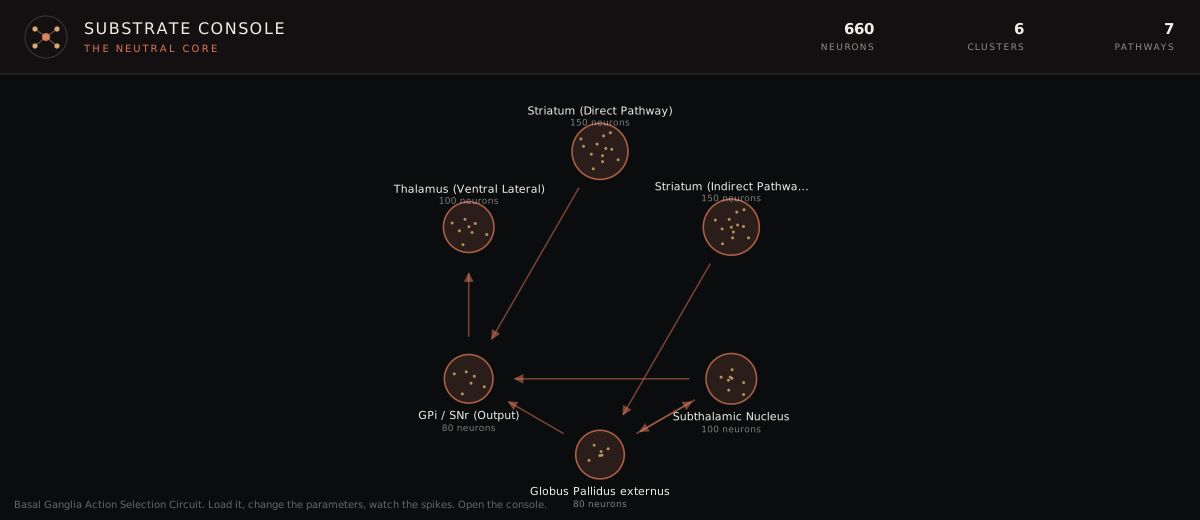
The brain emulation section of this site asks how much of a brain a copy must reproduce. Anders Sandberg and Nick Bostrom rank the candidate answers in their emulation roadmap, from a wiring diagram up to molecules. The Connectome Atlas shows the wiring level. Its spike replay treats each neuron as one unit with no dendrites and no channels. The Substrate Console runs leaky integrate and fire units, one number per cell. This page shows the next level down, where one cell is 185 coupled voltages.
Chapter 5 gives the price on your own device. The pyramidal cell advances 209 values per step and takes 40 steps for a millisecond. The integrate and fire unit advances one value. Eugene Izhikevich published the classic comparison of such models, and the post on his spiking neuron work gives his figures.
The position of this project is that consciousness is an emergent property of causal organisation and does not depend on the material. That position leaves open which level of organisation carries the relevant causes. If Dendritic Integration Theory is right, a faithful copy must keep at least two coupled compartments per pyramidal cell, and a point neuron network drops the mechanism. If the workspace theories are right, the dynamics between areas may be enough. The measurements that would decide between them have not been made.
No part of The Consciousness AI agent uses a neuron with dendrites or ion channels. The spiking lane in its architecture uses point units. The cell on this page is a reference for the emulation question and stands outside the agent.
The channels in chapters 1 and 3 are those of a squid axon at 6.3 degrees Celsius. Mammalian cortical neurons have different channels and run at 37 degrees. The cell in chapter 4 has passive dendrites and an unknown origin. The agreement with NEURON covers the twenty stored models, and a slider setting or a live cell is the same code on other numbers. Agreement with NEURON is agreement with a simulator, and no living cell was measured for this page.