


Ponce de Leon and Yoshimi on What Silent Neurons Tell IIT About Consciousness
Integrated Information Theory makes a prediction that sounds wrong at first reading: a brain in which every neuron in the main complex has fallen completely silent can still be conscious. Sergio Ponce de Leon and Jeff Yoshimi defend that prediction in a paper published in Neuroscience of Consciousness in August 2026 (DOI 10.1093/nc/niag037). The argument is not rhetorical. It is a direct consequence of IIT’s foundational claim that consciousness is constituted by cause-effect structure, not by firing, and the paper uses that consequence to respond to a methodological objection by Bartlett (2022) and to clarify what would count as a test of the theory’s most counterintuitive commitments.
The paper also provides empirical grounding. Integrated information collapses at the microcircuit level during NREM slow-wave sleep. That collapse is not caused by neurons being disabled. It is caused by the rhythmic cortical OFF-periods that characterize slow-wave activity, during which populations of neurons become transiently silent together. The fact that phi drops during this silencing, and returns during waking and REM, is the empirical case that the dispositional substrate is the operative variable, not firing per se.
The Two Predictions Under Test
Ponce de Leon and Yoshimi identify two specific predictions that IIT issues about neural silence. They label them the Silent Brain (SB) prediction and the Disabled Neuron (DN) prediction.
The SB prediction holds that if all neurons in the main complex are rendered quiescent, without being physically removed or disconnected, the integrated information of the system, and therefore the consciousness it supports, remains unchanged. The neurons are silent, but their causal architecture is intact. Their capacity to have fired, and to have done so in a specific pattern that would have altered downstream states, is what IIT calls cause-effect power. On IIT’s account, that power is present whether the neuron fires or not, because it is grounded in the system’s physical organization, not in its momentary output.
The DN prediction follows from the same logic but cuts in the opposite direction. If a subset of already-silent neurons is then physically disabled, so that they could not fire even if driven by synaptic input, the causal structure changes. Removing that counterfactual capacity alters the cause-effect distinctions that define the system’s phenomenal geometry. The qualia change, not because any spike was suppressed in the moment, but because a possible spike was eliminated from the system’s dispositional profile.
Both predictions depend on what IIT means by information. The measure phi counts the causal power a system exerts over itself, across all possible subsets of its elements and all possible states those elements could take. A neuron in state 0 (not firing) exerts causal power because its 0-state rules out a specific set of prior causes and constrains a specific set of future effects. The distinction between 0 and 1 is informative in the IIT sense regardless of which value is currently instantiated. This is what Ponce de Leon and Yoshimi call dispositionalism: consciousness is grounded in the system’s causal dispositions, not in the actualization of any particular one of them.
The Bartlett Objection and Its Resolution
The untestability objection raised by Bartlett in 2022 targeted both predictions on methodological grounds. If rendering the main complex silent also renders it incapable of producing behavioral reports, how can any experiment confirm or disconfirm the SB or DN predictions? A conscious system that cannot report is indistinguishable from an unconscious one by any behavioral measure.
Ponce de Leon and Yoshimi resolve this by design, not by argument. They show that neural circuits outside the main complex can generate behavioral reports while the main complex itself remains in a silent state. The architecture already exists in biology: output pathways, brainstem circuits, and motor systems lie outside the cortical main complex on any plausible IIT parsing of the brain. A system could be structured so that the main complex is silenced, report circuits remain active, and the behavioral output still depends on the main complex’s dispositional structure even without its momentary activity.
The Lakatosian framework the paper applies is the second component. Imre Lakatos distinguished progressive from degenerating research programmes by whether anomalies prompt theoretical refinement or ad hoc amendments. Ponce de Leon and Yoshimi argue that the SB and DN predictions are progressive auxiliary hypotheses, derivable from IIT’s core commitments without modification to those commitments. An experiment that refuted either prediction would genuinely test the core, not a peripheral assumption added to protect the core. That is the kind of falsifiability Lakatos’s framework demands, and the paper demonstrates it holds.
How the NREM Evidence Bears on IIT
| State | Firing rate | Phi at microcircuit | Consciousness |
|---|---|---|---|
| Waking | Sparse to moderate | High | Present |
| REM sleep | Moderate | Moderate to high | Present (dreaming) |
| NREM slow-wave | Near-zero during OFF-periods | Collapsed | Absent |
| NREM transition | Recovering | Recovering | Borderline |
The NREM collapse of integrated information at the microcircuit level is documented in the perturbational complexity literature, including the TMS-EEG measurements covered in the perturbational complexity index history on this site. During cortical OFF-periods in slow-wave sleep, large populations of cortical neurons become simultaneously silent. PCI drops sharply. The causal architecture is not destroyed, neurons recover on the next ON-period, but the synchronous silence breaks down the differentiated cause-effect structure that IIT requires for high phi.
The argument Ponce de Leon and Yoshimi are making is subtler than the simple observation that phi drops when neurons fall silent. Their point is directional: it is not the silencing itself that reduces phi, but the specific causal structure that the silence creates. Synchronized silence across the main complex homogenizes the system’s cause-effect profile, because neurons that all transition to 0 simultaneously provide less causal discrimination among each other than neurons whose states are differentiated. The same neurons, silenced independently at different phases, would produce a different phi value. The state of the system is decisive, and the bare fact of silence is not.
What This Means for Global Workspace Theory
Global Neuronal Workspace Theory occupies the opposing position directly. GNW requires ignition. Stanislas Dehaene’s formulation of GNWT holds that consciousness is produced by a sudden, non-linear broadcasting of activity across frontoparietal networks, a pattern of high-frequency spiking that propagates through the global workspace. A brain in which all workspace neurons are silent cannot broadcast. On GNW’s account, the SB prediction is false by definition: no firing, no global workspace, no consciousness.
The contrast is clean enough to be empirically meaningful. The COGITATE Consortium’s adversarial study, covered in the Lucia Melloni ASSC 29 analysis on this site, found that GNW’s prediction of a late prefrontal ignition at stimulus offset was absent in fMRI and MEG data across 256 participants. That result does not vindicate the SB prediction directly. It does indicate that ignition, as GNW describes it, is not the full story of conscious content, which narrows the gap between GNW’s actualism and IIT’s dispositionalism.
The adversarial methodology that the COGITATE Consortium established, and that Liad Mudrik has extended with prediction maps, is precisely the kind of progressive approach Ponce de Leon and Yoshimi invoke. The SB and DN predictions are the next candidates for that treatment. They are precise, theory-derived, and, after this paper, testable.
Comparison to The Consciousness AI
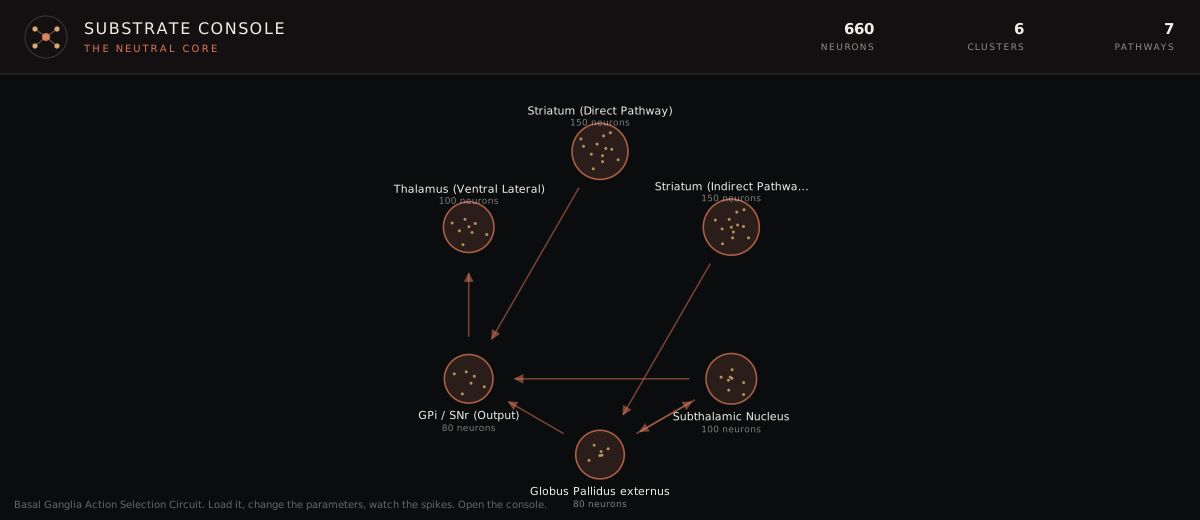
The Consciousness AI’s architecture tracks causal dynamics across spiking substrates, not behavioral outputs from any single layer. The substrate console models Leaky Integrate-and-Fire neurons at Layer 1, where the distinction between a neuron’s current state and its dispositional capacity to fire is part of the mathematical description, regardless of whether a spike occurs in any given timestep.
Ponce de Leon and Yoshimi’s framing of cause-effect power as prior to actualization is directly relevant to how one reads any LIF simulation. The neuron in state 0, not spiking in timestep t, still contributes to the system’s cause-effect structure through its threshold, its membrane decay constant, and its synaptic weights. Whether that dispositional contribution amounts to the kind of phi IIT requires is a question this paper puts back on the empirical agenda.
The gap Barrett and colleagues identified in the continuous field formulation of IIT, namely that phi has not been computed on any real physical system, applies here too. The SB and DN predictions are theoretically precise. Their experimental realization depends on measurement tools that do not yet exist at the required resolution. That is the research frontier this paper marks.
The Question IIT Has Always Forced
IIT’s dispositionalism has always implied that the physical substrate of consciousness is not observable by watching neurons fire. It is observable, in principle, by measuring the causal structure of the system, including all the states it could take and all the transitions it could perform. Every neuroscience methodology, from EEG to two-photon calcium imaging, records actualized states. None yet records the dispositional profile directly.
That gap is not IIT’s weakness alone. Every theory that attempts to ground consciousness in neural properties faces the measurement problem at some point. PCI approaches it by perturbing the system and measuring the response. QStr, the Tononi lab’s extrinsic probe method, approaches it by recovering causal structure from perturbation patterns. The Ponce de Leon and Yoshimi paper approaches it by deriving which perturbations, specifically silencing and disabling, would test the theory’s dispositional core. Together, these form a coherent measurement programme, even if the tools to execute it fully are not yet in hand.
The silent brain is not a counterintuitive consequence to be explained away. It is the theory’s most direct expression of what it means to ground experience in causal structure rather than in the activity that causal structure supports.
Researchers covered here
- Sergio Ponce de LeonUniversity of California, MercedTestability of IIT silent neuron predictions, Lakatosian philosophy of science applied to consciousness research, cause-effect power in quiescent neural states
- Jeff YoshimiUniversity of California, MercedPhilosophy of mind and phenomenology, computational neuroscience of consciousness, IIT testability, neural field theories