Evan Ye's Agency Gain and the Encoding Gap in Minimal Neural Systems
When does a system that predicts its environment start to distinguish the changes it causes from the changes the world imposes on it? Independent researcher Evan Ye addresses that boundary in “From Prediction to Self, Developmental Conditions for Agency in Minimal Neural Systems” (arXiv:2606.05605, v2 posted August 20, 2026, 27 pages, 6 figures). Working with a 192 dimensional gated recurrent unit (GRU) of fewer than 100,000 parameters across six experimental stages and 12 falsified alternatives, Ye isolates what he calls the encoding gap. A network can compensate for its own actions during prediction while holding no readable internal state that indicates it has acted. Crossing that gap requires four developmental conditions in sequence, and Ye introduces agency gain as a substrate-independent metric to measure the result. The paper makes no claim of consciousness or subjective experience.
The Architecture and the Matched Control
Ye’s testbed deliberately strips away architectural complexity so each change can be attributed to a single mechanism. The environment is a four-channel sinusoidal signal with coprime frequencies, a compound period of 10,000 steps, and additive Gaussian noise ($\sigma = 0.05$). When the action loop is active, the agent’s scalar action modifies only the first channel, adding $\gamma \cdot a(t)$ with $\gamma = 2.0$, while the remaining three channels evolve externally.
The agent is a 192 dimensional GRU whose hidden state $h_{\text{multi}}$ never resets across training. To give the state a temporal hierarchy without multiple recurrent layers, Ye applies a multi-scale exponential moving average (EMA) across four blocks of 48 dimensions, with decay gains log-spaced from 0.02 (slow memory) to 0.80 (fast response). Training follows a strict predict-then-update rule. The model predicts the incoming observation from its previous state, computes the loss, updates readout weights, and only then incorporates the new observation under zero gradient.
To separate genuine causal structure from statistical correlation, every causal experiment runs against a matched control. In the causal group, the action is a function of the network’s internal state, closing the sensorimotor loop. In the control group, the action channel receives an autoregressive AR(1) noise process matched in mean, variance, and autocorrelation to the causal agent’s actions. Both agents see identical signal statistics. Only the causal agent influences what it sees next.
The Encoding Gap and Five Failed Shortcuts
In Stage 1, pure prediction of the four-channel signal compresses 95% of the variance in $h_{\text{multi}}$ into five effective dimensions and recovers from injected noise perturbations at 95.0%. In Stage 2, adding the causal action loop produces implicit self-world separation. When the action link is severed over a 2,000 step test, the causal model recovers to 74.8% of baseline prediction accuracy on the affected channel, compared with 57.2% for the AR(1) control.
A decisive self-maintenance test in Section 3.2.1 shows why that causal link is structural. Ye trains both the causal and control networks with an auxiliary loss to classify whether the system is currently in an active burst, pushing both above 91% accuracy. He then removes the auxiliary supervision, freezes all parameters, and runs the networks forward for 5,000 steps. The causal agent retains its self-action encoding at 94.9% accuracy. The matched control collapses to 53.9%, near chance. Because the action affects the observation across a two-step delay ($\tau = 2$), the causal network must preserve its action state to keep prediction error low. Where the encoding does no causal work for prediction, the dynamics drop it as soon as external supervision ends.
Stage 3 exposes the paper’s central bottleneck, the encoding gap. Once an action burst stops, does the persistent state retain a readable trace that the agent recently acted? Ye defines a 50 step trailing window after action offset and applies direct auxiliary gradient pressure to force $h_{\text{multi}}$ to classify active, trailing, and quiet intervals. Despite perfect predictive compensation for its own actions, linear probe recall on the trailing window reaches only 12.3%. Five plausible workarounds fail to move that ceiling.
| Attempted Modification | Hypothesis Tested | Trailing Recall or Outcome | Failure Mechanism |
|---|---|---|---|
| Stronger action ($\gamma \times 1.5$ and $\gamma \times 2.0$) | Larger external effect forces explicit memory | +1.9 percentage points | Implicit weight compensation scales with amplitude without writing a state variable |
| Passive slow EMA readout | Long time constants preserve post-action history | 34.0% ceiling | Exponential decay erases the trace without active reactivation |
| Nonlinear GRU probe | Signal is present in nonlinear form | 1.4% recall | Complex probe overfits noise and collapses to the majority class |
| Character-level cross-entropy on rare “i” tokens | Rare first-person token forces grounding | 0.0% accuracy | Gradient is dominated by the 99% majority class of world tokens |
| Linear probe without auxiliary head | Action state is readable across all phases | 70.0% overall, 12.3% trailing | Apparent accuracy comes from current input leakage during active steps |
Implicit causal use and explicit self-representation come apart. A network can cancel its own motor effects in its weights while keeping zero readable record in its state that it was the author of those effects.
Proprioception and Asynchronous Awakening
| Stage 4 closes the encoding gap by adding a single scalar input channel, a proprioceptive action trace $\tau(t) = 0.95\,\tau(t-1) + 0.05\, | a(t) | $ fed back alongside the four world channels. Expanding the input from four dimensions to five lifts trailing recall from 12.3% to 56.5%, a 4.6 fold gain. With that explicit trace in place, a linear probe can ground the first-person token “i” during trailing windows at 80.1% balanced accuracy (against 64.4% for the control) and generalize to unseen action phrases such as “i jumped” and “i stopped” at 83.8%. |
Stage 5 tests what happens when the action policy $W_{\text{action}}$ is unfrozen so the network learns how to act while learning how to perceive. Simultaneous training of perception and action proves unstable across learning rates. A fast rate ($10^{-3}$) yields a $4.76\times$ interventional spike and 60.5% trailing recall, while a medium rate ($5 \times 10^{-4}$) drops trailing recall to 21.5%. Ye shows in Hypothesis 8 that this instability is caused by a non-stationary target rather than gradient interference. Perception and action use separate optimizers over disjoint weights, but every shift in $W_{\text{action}}$ changes the distribution of observations and proprioceptive traces that the perceptual readouts are trying to track.
Ye resolves this with asynchronous awakening, a three-phase developmental schedule. Phase 1 runs 100,000 steps under random actions with $W_{\text{action}}$ frozen. Phase 2a drops the learning rate by an order of magnitude for 60,000 steps to consolidate the perceptual attractors. Phase 2b unfreezes $W_{\text{action}}$ for 60,000 steps so the policy trains on a settled perceptual representation. This temporal order produces the strongest results across all tests, a $5.58\times$ interventional spike ratio and 66.3% trailing recall.
Measuring Agency Gain and Its Epistemic Foundation
In Stage 6, Ye formalizes agency gain with a dual-head architecture. Both heads read the same frozen reservoir state $h_{\text{multi}}$. The self-aware head $\text{pred}_A$ additionally receives the efference copy $a(t)$, while the action-blind baseline $\text{pred}_B$ does not. Agency gain is the prediction gap between the decoder that knows the agent’s action and the one that does not.
\[\mathcal{A}(t) = \underbrace{\|o(t+1) - \hat{o}_{\text{world}}(t+1)\|^2}_{\text{Err}_{\text{world}}} - \underbrace{\|o(t+1) - \hat{o}_{\text{self}}(t+1)\|^2}_{\text{Err}_{\text{self}}}\]To verify that $\mathcal{A} > 0$ reflects causal influence rather than a constant offset artifact, Ye pairs agency gain with an interventional spike test that clamps $\text{pred}_A$’s action input to zero for 3,000 steps while the action continues to perturb the world. He also tests three action-selection strategies across five random seeds. Directly optimizing agency gain or head disagreement by gradient descent collapses the policy into a degenerate locked action (autocorrelation $0.995$ to $1.000$, prediction gap near zero). Only forward-sampled disagreement maximization, choosing among candidate actions the one that maximizes divergence between $\text{pred}_A$ and $\text{pred}_B$, maintains a structured policy (autocorrelation $0.779 \pm 0.015$, prediction gap $84.1 \pm 5.5\%$, spike ratio $16.6 \pm 2.9\times$). The metric transfers from the periodic sinusoidal environment to a chaotic Lorenz attractor with a 99.5% prediction gap.
Ye grounds this metric in a companion preprint, “The Epistemic State of an Observer, Negative Knowledge and Recovery from Wrong Internal Models” (Zenodo:22538447, September 2026), and in a broader conceptual framework he calls Constraint Emergence Theory, introduced in his essay “The World You See Is Not the World Itself” (September 2026). In the companion paper, an observer carrying internal transition model $P_M$ is evaluated against a canonical baseline observer that knows only marginal state frequencies $P(S_{t+1})$. The resulting Observer Advantage $A_M = I_{\text{Shannon}} - I_{\text{ORI}}$ partitions epistemic status into three regimes, positive knowledge ($A_M > 0$), ignorance ($A_M = 0$, which recovers Shannon mutual information as a special case), and negative knowledge ($A_M < 0$), where a misspecified model predicts worse than knowing nothing. Ye proves that positive knowledge is bounded above by $\log N$ while negative knowledge is unbounded below, and that under Dirichlet-Multinomial Bayesian updating the evidence $n^$ required to recover from a wrong prior of strength $\alpha$ scales linearly as $n^ = \alpha c$. Within this formalism, $A_M$ measures how much constraint structure the observer has absorbed overall, and agency gain $\mathcal{A}$ isolates the share of that advantage that comes from knowing the observer’s own action.
Upstream of Spiking Credit and Relation to Consciousness Science
Ye’s framework sits directly upstream of Haoliang Han’s spiking network study (arXiv:2606.30191), covered here in Self-Caused Credit Builds a Durable Behavioral Self in a Minimal Spiking Agent. Because agency gain is defined on prediction error at the readout layer rather than on recurrent weight updates, it is independent of the underlying neural substrate. Han ports Ye’s dual-predictor agency comparator onto a Nengo leaky integrate-and-fire (LIF) network with Prescribed Error Sensitivity (PES) decoder training, matching the frozen-reservoir and trained-readout split in Ye’s Stage 6. Where Ye establishes the four conditions needed to detect and represent self-caused variation, Han takes that detection signal and uses it to gate writes into slow weights, producing self-preserving behavior that survives a complete wipe of fast working memory.
For consciousness science, the two papers supply a measurable lower bound for theories of the minimal self. Enactivist and predictive processing accounts, including the sensorimotor traditions examined in the ASSC 29 neurophenomenology review, hold that pre-reflective selfhood begins with the sensorimotor division between self-generated and externally generated sensation. Ye’s encoding gap demonstrates that sensorimotor prediction alone does not automatically create an internal self-marker. Without a dedicated proprioceptive trace and a staged learning schedule, a network can act and compensate for its actions while remaining representationally blind to its own agency. That distinction sharpens the empirical checklist discipline tracked in the nineteen researcher AI consciousness checklist and across the 2026 scientific consensus on AI consciousness.
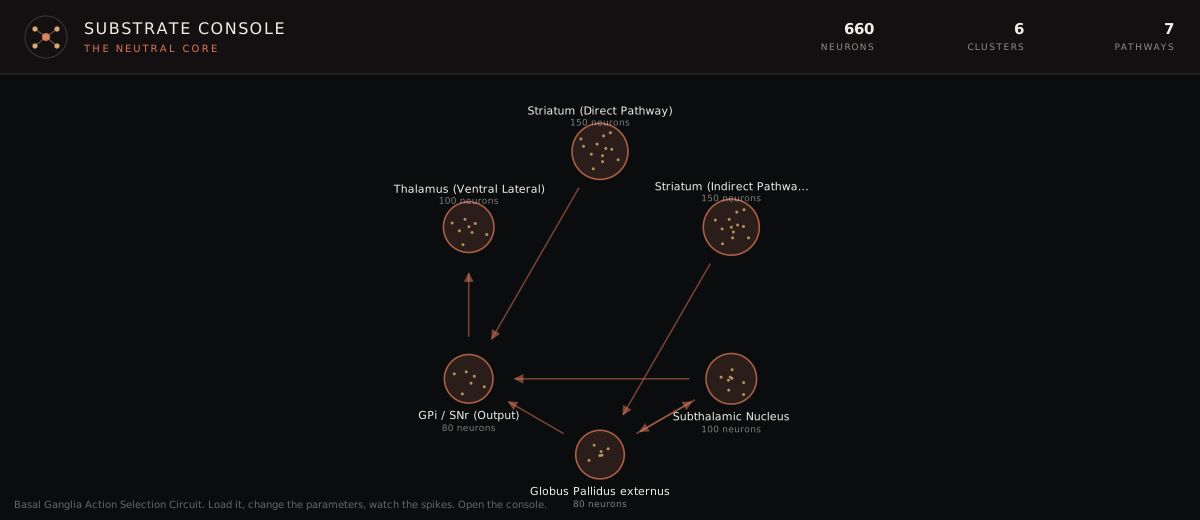
The separation between fast recurrent state, proprioceptive feedback, and spiking dynamics also bears on open design questions in the Neutral Core substrate, where Leaky Integrate-and-Fire populations form the primary dynamical layer.
Comparison to The Consciousness AI
The Consciousness AI architecture includes a SelfRepresentationCore (models/self_model/self_representation_core.py) alongside a SomatotopicMap and ProprioceptiveProcessor (models/self_model/embodiment_core.py) that route internal body-state and proprioceptive vectors into the cognitive cycle, while Layer 1 runs Leaky Integrate-and-Fire dynamics. Ye’s results bear on two open design questions in this stack. First, his Stage 4 finding shows that a proprioceptive trace is what turns implicit action compensation into a linearly decodable state variable in a recurrent reservoir, supporting the architectural separation of an explicit proprioceptive channel rather than relying on action effects to leak through external observations. Second, his Stage 5 finding on asynchronous awakening suggests that training motor policies simultaneously with perceptual representations destabilizes both unless perception is consolidated first. The Consciousness AI codebase does not currently implement Ye’s dual-head agency gain comparator or the three-phase asynchronous awakening schedule; his paper provides a concrete, falsifiable protocol that motivates testing both mechanisms in future iterations.
Scope and Open Boundaries
Ye is explicit about what the experiments do and do not establish. All 18 experiments (six developmental stages and 12 falsified hypotheses) run in low-dimensional synthetic environments (four-channel sinusoids, the Lorenz system, and a two-dimensional grid where spatial action policies failed under Hypotheses 10 and 12). The 192 dimensional GRU has an effective attractor dimensionality of roughly five on these signals, and scaling the four developmental conditions to high-dimensional multimodal observations remains untested. While the currently-acting state self-sustains at 94.9% after supervision is removed, the post-action trailing state degrades from 80% to 70% balanced accuracy once the auxiliary loss is detached (Hypothesis 6), showing that memory of past agency has a weaker physical anchor in the causal loop than ongoing action. By documenting all 12 negative results alongside the four conditions that succeeded, Ye gives researchers studying minimal agency a reproducible baseline and a clear map of which shortcuts fail.
The paper “From Prediction to Self, Developmental Conditions for Agency in Minimal Neural Systems” by Evan Ye (published on arXiv as Rui Ye) is available at arXiv:2606.05605. The companion preprint “The Epistemic State of an Observer, Negative Knowledge and Recovery from Wrong Internal Models” is available on Zenodo at doi:10.5281/zenodo.22538447.