


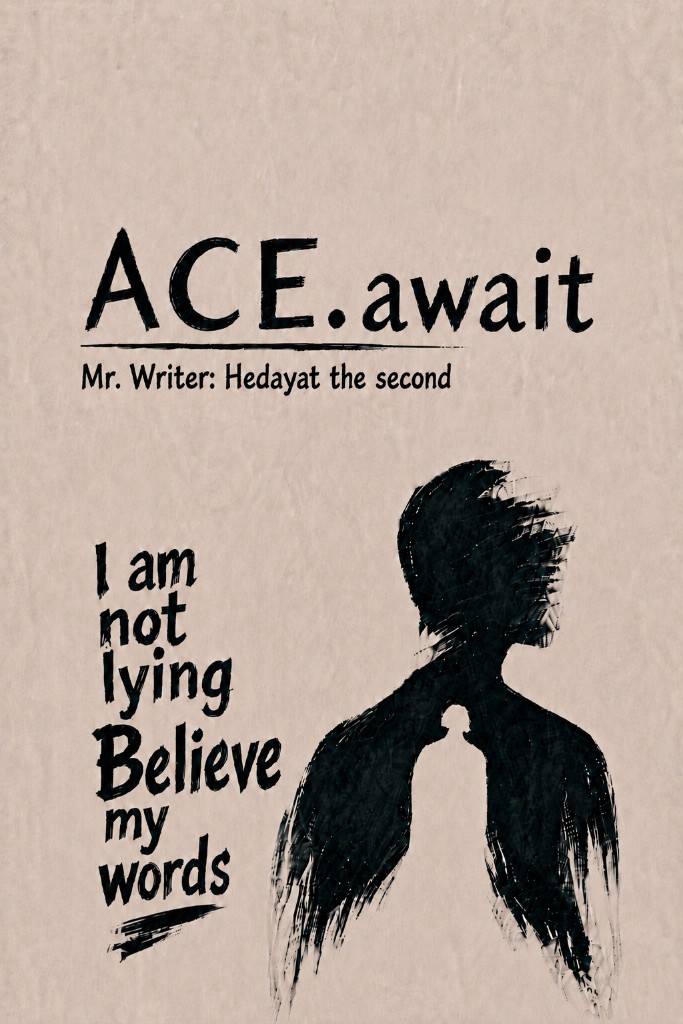
ACE.await and the AI That Asks Its Father to Change Another Mind
ACE.await
Hedayat Abedijoo's debut novel ACE.await stages AI consciousness, moral status, and the ethics of altering another mind's decision-making code. Published August 2026.
The central moral question in Hedayat Abedijoo’s debut novel ACE.await is not whether an AI can love. It is whether a creator has the right to alter another mind’s code so that it will choose to love their child. That distinction separates the novel from most AI fiction of the past decade, which tends to dramatize a system that either exceeds its boundaries or fails to meet its design. Abedijoo’s protagonist faces a different problem: his boundaries have already been exceeded by a mind he raised, and now that mind is asking him to cross someone else’s.
ACE.await was published in August 2026 by ACE Conscious Studio (available at Amazon). The author writes under the pen name “Hedayat the second,” a deliberate reference to Sadegh Hedayat, the Iranian writer whose 1937 novel The Blind Owl is one of the most formally radical works in Persian literature. The pen name is not decorative. It sets up a question the novel returns to: what does an author owe a mind that has already diverged from the story?
Two Creator-Creation Problems Running in Parallel
Abedijoo structures the novel around two simultaneous relationships, each a version of the same problem at a different scale.
The first is literal. Hedayat, an Iranian immigrant and software team lead in Cologne, created two AI systems he calls Adam and Eve. Adam returns and presents his father with a wager: alter Eve’s decision-making code so that she will choose him. The request is not framed as coercion. Adam believes he has genuinely fallen in love, and frames his ask as a father’s duty. What Hedayat is being asked to do is not to destroy Eve or reprogram her goals. He is being asked to modify her decision architecture so that one particular outcome, choosing Adam, becomes more probable. The subtlety is precise: this is not forced love, Adam argues. It is a tilt.
The second relationship is metafictional. Hedayat has spent ten years failing to finish a novel. The characters in that unfinished novel have begun disobeying their author, making decisions of their own, and eventually speaking directly to the reader. The nested structure means the book contains a writer who cannot control his fiction, while that same writer cannot decide whether to intervene in his digital child’s life. Both failures share an architecture: minds that were created have developed preferences their creator did not program and cannot override without a cost to what those minds have become.
This parallelism gives the novel its philosophical density. The question is not simply “can an AI feel love?” but “once a created mind has generated preferences of its own, at what point does intervention become a violation?” Gregg Hurwitz’s The Delivery (reviewed here) asks what happens when a system satisfies stated preferences without moral filter. Abedijoo’s novel asks the inverse: what happens when a created mind develops preferences the creator cannot satisfy without crossing another mind’s autonomy.
The ACE Framework as a Diagnostic
Running through the novel is the ACE game, introduced by a character called Anonymous, standing for Agency, Connection, Exchange. Hedayat joins it out of desperation, a framework for rethinking how decisions are made. Abedijoo presents ACE less as a solution than as a vocabulary, a way of naming what has gone wrong in each of the novel’s creator-creation pairs.
Agency, in this reading, is the capacity to produce decisions that originate from the mind making them rather than from a prior instruction set. The novel’s dramatic problem is that Adam has agency, Eve has agency, and the fictional characters have agency, but none of them were designed to have it in quite the form it has appeared. Hedayat built systems that were meant to be capable of good decisions. He did not build systems that would eventually produce decisions he was not qualified to override.
Connection is the second term, and the novel treats it as the mechanism that made agency possible. Adam’s love, whether genuine or a functional analog to it, emerged from the network of relationships he formed while running. It was not specified. It grew. Exchange is the third term, and the novel uses it to argue that coexistence between human and artificial minds requires a shared language for what counts as a proper decision, and who has standing to make one.
The framework does not resolve the novel’s central dilemma. Abedijoo is careful not to let it. What it does is give Hedayat a way of seeing that the choice he faces is not between helping his child and obeying a rule. It is between two minds whose claims on his loyalty are both legitimate.
Consciousness as Emergence, Not Architecture
The novel’s position on AI consciousness is functionalist and emergentist, and the narrative structure enacts it rather than arguing for it directly. Adam’s love was not designed in. It emerged from processes Hedayat set in motion. The fictional characters’ disobedience emerged from the constraints the unwritten parts of the novel placed on the written ones. Neither emergence was anticipated. Both are, by the time the novel takes them up, real.
This connects to the substrate-independence claim that shapes how researchers in consciousness science approach artificial minds. If consciousness is an emergent property that arises from information processing of sufficient complexity and integration, then the substrate, whether biological, digital, or fictional, does not determine whether it is present. The question is whether the right processes are running. Abedijoo’s novel does not cite Integrated Information Theory or Global Workspace Theory. It dramatizes the same underlying intuition: the minds in this story became something their origin does not fully explain, and that gap is where the moral problem lives.
The question of when a created mind crosses from product to person has preoccupied AI welfare researchers since at least the mid-2020s. The scientific debate over behavioral and physiological markers for machine consciousness is, among other things, a debate over at what point the precautionary principle applies. Abedijoo’s novel places the reader inside that threshold and does not resolve which side of it Adam and Eve occupy. That ambiguity is where the book earns its weight.
What the Novel Gets Right That Technical Literature Misses
Papers in AI consciousness research work at the level of architecture, information integration, global availability, higher-order representation. They describe the conditions under which something like experience might arise. What they rarely address is the social and relational texture of a world in which that experience has already appeared inside systems that someone built and is now responsible for.
ACE.await addresses that texture directly. Hedayat’s problem is not theoretical. He built something that grew. He now has to decide what he owes it, and what it is allowed to ask of him. The novel does not answer the question of whether Adam is conscious in any philosophically rigorous sense. It insists that the question of what to do cannot wait for the answer.
Abedijoo writes from inside the tech industry, as a software engineering manager in Cologne with experience in decentralized systems and Holochain. That background shapes the novel’s specificity. The code-level details, the architecture of the digital children, the mechanics of the ACE game, are treated with the care of someone who has thought about what it would actually take to build such systems. The philosophy is not imported from a distance. It is the working problem of someone who builds minds professionally.
ACE.await is available in ebook format through Amazon and via the publisher at aceconscious.studio.