


Eugene Izhikevich and why the choice of spiking neuron model matters for consciousness
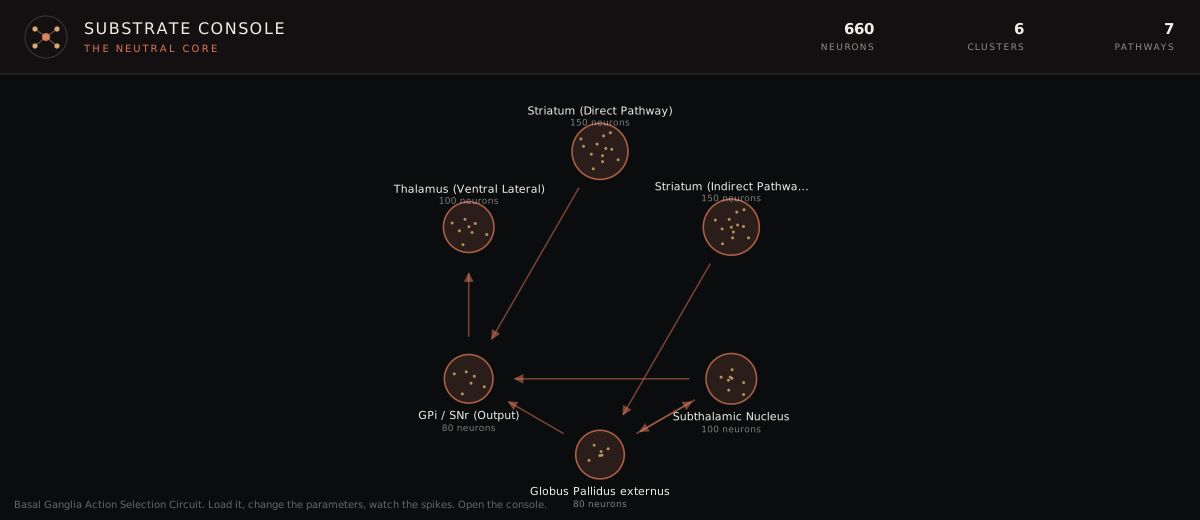
In computational neuroscience and neuromorphic engineering, the default model of a spiking neuron is the leaky integrate-and-fire (LIF) unit. It is computationally cheap, needing a single differential equation that tracks membrane potential, and it is easy to implement in digital silicon. It is the model behind first generation neuromorphic hardware such as Intel’s original Loihi chip, and behind the baseline architecture running in Layer 1 of the Substrate Console. The model choice also decides what a learned population closure can capture, and PEM-UDE has since demonstrated learning reduced-order equations directly from Izhikevich spiking populations. What spiking dynamics can self-organize is the open question this substrate raises, and Han’s agency-gated credit result gives one answer at minimal scale, a durable behavioral self built from slow, self-caused updates alone.
In two papers published in IEEE Transactions on Neural Networks, “Simple model of spiking neurons” (2003, DOI: 10.1109/TNN.2003.820440) and “Which model to use for cortical spiking neurons?” (2004, DOI: 10.1109/TNN.2004.832719), applied mathematician Eugene M. Izhikevich put a number on what that simplicity costs. He reviewed 20 neuro-computational behaviors observed in real cortical neurons, then scored eleven widely used models against all 20 and measured the arithmetic each one needs.
The result for plain LIF is stark. A standard LIF neuron is a one dimensional dynamical system. It integrates incoming current and discharges when a threshold is crossed, and on Izhikevich’s scoring it exhibits 3 of the 20 behaviors. It has no bursting, no chattering, no spike frequency adaptation, no subthreshold oscillation and no post-inhibitory rebound.
For static image classification that omission is harmless. For consciousness science it is decisive, because the leading neurobiological theories place their criterion on collective dynamics rather than on the presence of spikes. Victor Lamme’s Recurrent Processing Theory asks for self sustaining reverberant gamma-band oscillation. Stanislas Dehaene’s Global Neuronal Workspace asks for non-linear ignition. Both properties depend directly on the dynamical repertoire of the single neurons that make up the network.
The measured cost of each model
The table below reproduces the relevant rows of Figure 2 in Izhikevich 2004. The FLOPS column is his own figure for the floating point operations needed to simulate the model across a 1 ms time span.
| Model | State variables | Of the 20 cortical behaviors | FLOPS per 1 ms |
|---|---|---|---|
| Leaky integrate-and-fire | 1 ODE | 3 (tonic spiking, class 1 excitable, integrator) | 5 |
| Integrate-and-fire with adaptation | 2 ODEs | 5 (adds spike frequency adaptation and DAP) | 10 |
| Quadratic integrate-and-fire | 1 ODE | 6 | 7 |
| Izhikevich simple model | 2 ODEs plus reset | 20 | 13 |
| Hodgkin-Huxley | 4 ODEs, conductance based | 20 | 1,200 |
Two qualifications belong with that table, and both come from Izhikevich himself.
The 20 count records what a model can be tuned to do, one behavior at a time. Izhikevich states directly that no model should exhibit all 20 simultaneously, because some of the properties are mutually exclusive. A neuron cannot be an integrator and a resonator at once.
Hodgkin-Huxley is the only model in the set with biophysically meaningful and measurable parameters, which the Izhikevich model does not have. The 92 fold difference in arithmetic buys that biophysical grounding. The behavioral range is the same in both.
The mathematical difference between LIF and Izhikevich
A leaky integrate-and-fire neuron models the membrane potential v as a resistor-capacitor circuit. When input current arrives, v leaks exponentially back toward resting potential or charges upward toward a fixed threshold. Once the threshold is crossed an instantaneous spike is recorded and v is reset. Because v is the only state variable, the neuron carries no memory of its recent activity beyond its current voltage. History dependent behavior is therefore unavailable to it, which is why adaptation and resonance are absent from its row in the table.
Izhikevich’s 2003 model adds a second dynamical variable, the membrane recovery variable u, which stands in for activation of potassium currents and inactivation of sodium currents.
v' = 0.04 v^2 + 5 v + 140 - u + I
u' = a (b v - u)

after-spike reset, applied when v >= 30 mV:
    v <- c
    u <- u + d
The four dimensionless parameters tune the cell’s bifurcation geometry. The parameter a sets the time scale of the recovery variable u, and smaller values produce slower recovery. The parameter b sets the sensitivity of u to subthreshold fluctuations of v. The parameter c sets the post-spike reset value of the membrane potential. The parameter d sets the post-spike reset of the recovery variable, standing in for slow inward sodium and calcium currents.
Varying those four numbers moves one two variable system among regular spiking pyramidal cells, intrinsically bursting deep layer cortical neurons, chattering 40 Hz gamma generating cells, and fast spiking GABAergic inhibitory interneurons.
Why recurrent processing requires dynamic diversity
In Victor Lamme’s Recurrent Processing Theory, consciousness arises when feedforward sensory signals trigger late sustained reverberant feedback loops between cortical areas. In visual cortex that reverberation shows up as sustained oscillatory activity in the gamma band, 30 to 80 Hz.
Recurrent networks built from homogeneous LIF units sustain that state poorly. A recurrent network of identical LIF neurons sits on a narrow margin. If recurrent synaptic weights are too low, reverberation fades to silence. If they are raised slightly, the network synchronizes into runaway epileptiform bursting.
Biological cortex avoids runaway synchrony through cellular heterogeneity. Chattering neurons pace gamma frequency oscillations. Fast spiking basket interneurons supply fast feedback inhibition that cuts off runaway excitation within milliseconds. Low threshold spiking interneurons supply slow dendritic inhibition that regulates long term gain. Izhikevich’s 2006 work on polychronization (Neural Computation, DOI: 10.1162/neco.2006.18.2.245) showed that networks of heterogeneous Izhikevich neurons support polychronous groups, which are reproducible time locked spiking sequences with millisecond precision that persist without global synchronization.
Structured activity of the same kind appears at the far larger end of the scale ladder. Xu, Long, Feng and Gong report rotating spiral waves organizing whole cortex fMRI, where local phase singularities give large scale activity an order that resembles what polychronous groups do for spikes, though at a signal that unfolds over seconds rather than milliseconds.
Network computations also admit algebraic description. Dehghani shows that composing recurrent motifs, including divisive normalization and winner-take-all, generates group structure that no individual motif possesses, and that result is examined in a companion post on algebraic emergence in recurrent circuits.
Without those two dimensional dynamics, a silicon network attempting to satisfy Lamme’s recurrent processing criterion has to rely on external parameter tuning rather than on self stabilizing intrinsic dynamics.
The same substrate question has a representational side. The rate coding bundle memory proposal shows how a continuous rate coded substrate can still store and retrieve discrete symbols through a hybrid graded and binary memory, which is the representational complement to the dynamical diversity this model supplies.
What the neuron model does to workspace ignition and to phi
The choice of neuron model carries consequences for the other leading consciousness theories, and the consequences differ.
Under Global Neuronal Workspace Theory, Stanislas Dehaene and Jean-Pierre Changeux hold that conscious access corresponds to an all or none ignition event, in which local representations cross a threshold and broadcast across long range cortico-cortical connections. In biological cortex that ignition is mediated by thick tufted Layer 5 pyramidal neurons, which show intrinsic bursting and calcium dependent dendritic spikes. An Izhikevich intrinsically bursting parameterization captures that non-linear burst threshold directly. A 1D LIF neuron treats an ignition inducing burst the same way it treats a train of isolated spikes.
Under Integrated Information Theory, as developed by Giulio Tononi and Christof Koch, the quantity phi measures the intrinsic cause-effect power of a system’s causal structure, derived from its transition probability matrix. A network of 1D memoryless LIF units has a far smaller state space than a network of 2D units where each node carries a continuous recovery state. Internal recovery dynamics let individual nodes express history dependent causal transitions, which enriches the system’s overall cause-effect structure.
The neuromorphic shift from Loihi 1 to Loihi 2
The historical obstacle to running Izhikevich models in hardware was arithmetic. At 13 FLOPS per millisecond against 1,200 for Hodgkin-Huxley, the model is cheap in absolute terms, and still 2.6 times the cost of plain LIF. It also needs quadratic terms and internal state tracking that first generation fixed function neuromorphic chips could not execute efficiently.
The analysis of Intel Loihi 2 and orbital neuromorphic computing covers how the Intel Neuromorphic Computing Lab redesigned the core between Loihi 1 and Loihi 2 to remove that bottleneck. Loihi 2 replaced fixed LIF microcode with programmable neuron instruction sets, which lets researchers run custom Izhikevich, Resonate-and-Fire and adaptive threshold models directly on neuromorphic silicon.
For projects investigating emerging consciousness under functionalist emergentism, including The Consciousness AI (https://github.com/tlcdv/the_consciousness_ai), the lesson of Izhikevich’s measurement is specific. Substrate independence cannot treat the neuron as a trivial point-process black box, because 3 of 20 behaviors is a different substrate from 20 of 20 at roughly twice the arithmetic. If consciousness arises from the collective dynamical geometry of recurrent networks, the single neuron model has to carry the degrees of freedom those dynamics need. Where the field currently stands on that question is surveyed in the current scientific consensus on AI consciousness. How these point neuron approximations map into the wider hierarchy of whole brain emulation is set out in The Sandberg and Bostrom whole brain emulation roadmap eighteen years on. The neuron-model fidelity question, and the other questions about what an emulation must preserve to carry consciousness, are collected in the brain emulation section. The empirical lower bound of the same substrate question is a culture of 800,000 living neurons that learned to play Pong, and how the DishBrain sentience claim is read is examined in the DishBrain post. The hardware that can run these neuron models at brain scale in real time, a million-core spiking supercomputer, is examined in the SpiNNaker post.
Eugene M. Izhikevich is Co-founder and Chairman of the Board at Brain Corporation, and author of Dynamical Systems in Neuroscience (MIT Press, 2007, ISBN 978-0-262-09043-8). “Simple model of spiking neurons” appeared in IEEE Transactions on Neural Networks in 2003 (DOI: 10.1109/TNN.2003.820440). The model comparison and the FLOPS figures are Figure 2 of “Which model to use for cortical spiking neurons?” (2004, DOI: 10.1109/TNN.2004.832719).