
The Sandberg and Bostrom whole brain emulation roadmap eighteen years on
In 2008, Anders Sandberg and Nick Bostrom published Whole Brain Emulation: A Roadmap (Technical Report #2008-3, Future of Humanity Institute, Oxford University). The report set out the scientific and computational milestones required to move a biological brain onto synthetic hardware. It states that whole brain emulation requires three main capabilities. The first is the ability to physically scan a brain and acquire the information. The second is the ability to interpret the scanned data and build a software model from it. The third is the ability to simulate that very large model. The roadmap’s three capabilities now have a 2025 successor audit, the State of Brain Emulation Report by Zanichelli, Schons, Freeman, Shiu, and Arkhipov, which reassesses how far each of the three has actually moved and which remains the binding constraint.
Eighteen years later, the scanning and interpretation capabilities have produced results that were targets when the roadmap was drafted. Connectomics consortia have mapped the complete synaptic wiring diagram of the fruit fly Drosophila melanogaster (FlyWire, 2024, resolving roughly 139,000 neurons and 54 million synapses) and reconstructed a sample of human temporal cortex one cubic millimeter in volume (Harvard and Google, 2024, cataloging 57,000 cells and 150 million synapses across 1.4 petabytes of imaging data).
Those structural results have sharpened the theoretical problem the roadmap identified. An exact static wiring diagram does not by itself produce a functioning conscious emulation. The recording side of the problem has its own quantitative bounds, derived two years before this roadmap in Marblestone and colleagues’ analysis of the physical limits of recording every neuron in a mammalian brain, which shows what millisecond-scale whole brain activity data would demand of any instrument. The field’s 2025 reassessment, the State of Brain Emulation Report by Zanichelli, Schons, Freeman, Shiu, and Arkhipov, revisits this exact gap and reorganizes the roadmap’s three capabilities into recording, connectomics, and simulation, concluding that the recording capability remains the binding constraint.
The eleven levels the roadmap actually defines
The roadmap’s central move is to reject emulation as a single binary capability. Its Table 2 ranks eleven levels of emulation by how much physical detail the model carries. Table 9 attaches a processing demand to each one. Both are reproduced here, because the levels are frequently paraphrased into descriptions the report does not use.
| Level | Roadmap name | What the model carries | Processing demand |
|---|---|---|---|
| 1 | Computational module | High level representations of information and information processing, in the classic AI sense | Not estimated |
| 2 | Brain region connectivity | Each area is a functional module wired to others by a species universal connectome | Not estimated |
| 3 | Analog network population model | Neuron populations and their connectivity, with activity represented as time averages | 10^15 FLOPS |
| 4 | Spiking neural network | As level 3, plus firing properties, firing state and dynamical synaptic states | 10^18 FLOPS |
| 5 | Electrophysiology | As level 4, plus membrane states, ion channel types and properties, ion concentrations, currents and voltages | 10^22 FLOPS |
| 6 | Metabolome | As level 5, plus concentrations of metabolites and neurotransmitters per compartment | 10^25 FLOPS |
| 7 | Proteome | As level 6, plus protein concentrations and gene expression levels | 10^26 FLOPS |
| 8 | States of protein complexes | As level 7, plus quaternary protein structure | 10^27 FLOPS |
| 9 | Distribution of complexes | As level 8, plus locome information and internal cellular geometry | 10^30 FLOPS |
| 10 | Stochastic behavior of single molecules | Molecule positions, a molecular mechanics model of the whole brain | 10^43 FLOPS |
| 11 | Quantum | Quantum interactions in and between molecules | Not estimated |
The report gives one more figure that most summaries drop. An informal poll of the workshop attendees put the required resolution at level 4 to 6, and the same group put the scanning resolution needed to reach it at 5 by 5 by 50 nanometers. Two attendees were more optimistic about high level models. Two suggested that level 8 or 9 detail might be needed at first, with mature emulation settling back to level 4 or 5. The roadmap then focuses on level 4 to 6 while staying open to deeper levels.
The scale versus resolution trade off
Level 4 models a brain as a network of point neurons interacting through discrete spike events. The analysis of Eugene Izhikevich’s 2D dynamical neuron models shows that point neuron approximations can capture regular spiking, bursting and adaptation at modest cost.
Descending from level 4 to level 6 raises the processing demand by seven orders of magnitude, from 10^18 to 10^25 FLOPS. Which level an emulation has to run at depends entirely on which level of biophysical organization turns out to be constitutive of conscious experience. Two positions divide on that question.
Computational functionalism holds that subjective experience depends on the abstract informational and causal relations among functional units. Hans Moravec argued the case through his gradual neural replacement thought experiment. On that view level 3 or level 4 preserves both cognitive function and phenomenality, and the higher levels are implementation detail.
Substrate sensitive positions hold that phenomenal consciousness requires specific continuous electrochemical dynamics, astrocytic modulation, or ephaptic field interactions. Ned Block defends that view in his meat machines analysis. On that view a level 4 emulation produces an unconscious behavioral simulator, a philosophical zombie, while the physical conditions for qualia stay uninstantiated. The workshop consensus of level 4 to 6 sits directly on top of this disagreement, which is why the roadmap records a range rather than a number.
Where a connectome stops and dynamical state begins
The main lesson of recent connectomics is the gap between structure and state. A connectome is a static structural map, an anatomical snapshot fixed in resin or chemical fixative.
The MaleCNS comparison with FlyWire adds a male brain and nerve cord reference to this distinction. Synapse counts supply anatomical weights, while physiological dynamics and consciousness claims require separate evidence.
A biological brain is a non equilibrium dynamical system. The functional state of a living circuit is set by which axon connects to which dendrite and also by physiological variables that static electron microscopy cannot resolve.
Ambient concentrations of dopamine, serotonin, noradrenaline and acetylcholine continuously reshape synaptic gains across whole brain regions, reconfiguring the effective connectivity of the physical network without altering its anatomy. That is level 6 information, two levels and seven orders of magnitude below where a connectome sits.
Individual neurons constantly alter the expression and phosphorylation of sodium, potassium and calcium channel subtypes, shifting their firing thresholds and burst tendencies. That is level 5 and level 7 information.
The physical size of a dendritic spine gives only an approximation of its synaptic strength. The exact molecular composition of AMPA and NMDA receptor pools stays largely unmeasured in static serial section imaging.
Without measuring or accurately inferring those variables, initializing a simulation from a static connectome produces silent or uncoordinated networks rather than an active stream of consciousness. The roadmap anticipated this. It is the reason its own scanning requirement is stated as a resolution figure and not as a wiring diagram.
How the roadmap informs The Consciousness AI architecture
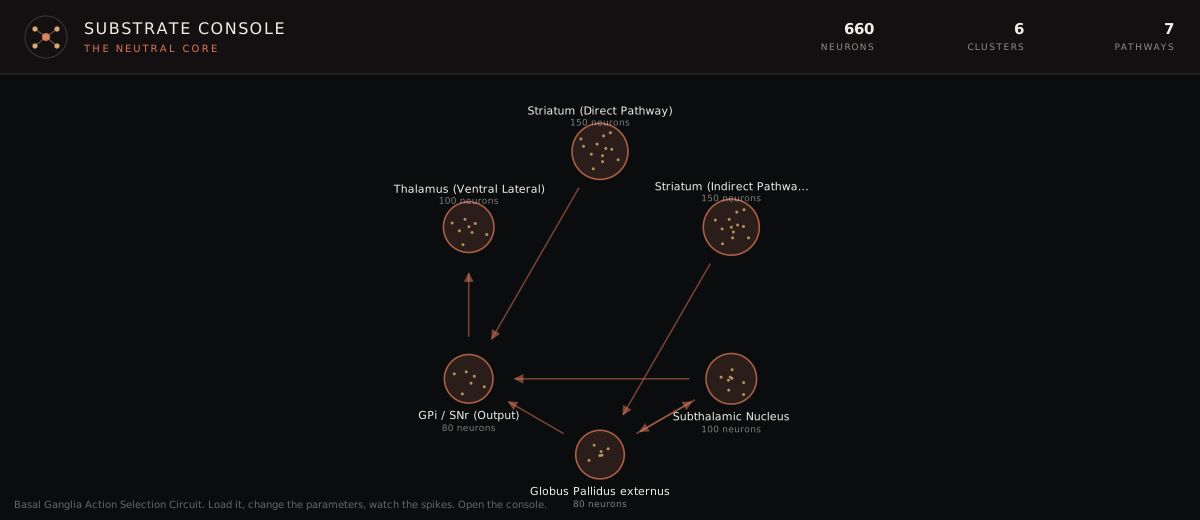
The Substrate Console on this site embodies the trade off Sandberg and Bostrom formalized.
Layer 1 of the architecture runs in the browser using anatomical region templates built from the Allen Institute, BrainGlobe and Julich-Brain atlases. The console preserves proportional connectivity and synaptic pathways between functional clusters, such as the striatum, globus pallidus and subthalamic nucleus in the basal ganglia action selection circuit, while discarding full biological scale. It simulates hundreds of point neurons per cluster rather than billions.
In the roadmap’s own taxonomy that places the Substrate Console between level 2 and level 4. It carries region connectivity and threshold dynamics, and it is an architecture for testing how macroscopic causal topology governs signal propagation and recurrent loops. Full scale biological emulation at the level 4 to 6 range the workshop settled on remains a separate and much higher resolution milestone.
For projects investigating emerging consciousness under functionalist emergentism, including The Consciousness AI (https://github.com/tlcdv/the_consciousness_ai), the 2008 roadmap stays authoritative on one methodological principle. Progress in artificial consciousness cannot rest on vague claims of computational equivalence. It requires naming the level of biophysical resolution an architecture implements, and showing that the chosen level preserves the causal dynamics that consciousness science demands. Where the field currently stands on which dynamics those are is surveyed in the current scientific consensus on AI consciousness. What the physical limits of electrode arrays imply for connecting biological tissue to a synthetic emulation is evaluated in Paradromics Neuralink and what a real cortical interface would need. The roadmap and the papers that update it are collected in the brain emulation section. The working group member who turned the roadmap into an ongoing engineering programme, Randal Koene and his Carboncopies foundation, is examined in the Koene and substrate-independent minds post. The hardware that implements the roadmap’s real-time compute requirement, a million-core spiking machine, is examined in the SpiNNaker post.
Anders Sandberg is Senior Research Fellow at the Future of Humanity Institute, Oxford University. Nick Bostrom is Professor at Oxford University and author of Superintelligence (Oxford University Press, 2014, ISBN 978-0-19-967811-2). Whole Brain Emulation: A Roadmap is published as FHI Technical Report #2008-3. The level definitions are its Table 2 and the processing demands its Table 9.
Researchers covered here
-
 Anders SandbergFuture of Humanity Institute, Oxford UniversityCo-author of Whole Brain Emulation: A Roadmap (2008) with Nick Bostrom, computational neuroscience, and technological futures
-
 Nick BostromOxford UniversitySuperintelligence (2014), the Simulation Argument (2003), and co-authoring Whole Brain Emulation: A Roadmap (2008)