


Cortical Labs DishBrain and what neurons learning Pong say about the minimal substrate
Brett J. Kagan and colleagues at Cortical Labs published the DishBrain result in Neuron in October 2022. They grew roughly 800,000 human and rodent cortical neurons on a high-density multielectrode array, connected the array to a simplified video game, and let the culture play. The neurons learned to hit the digital ball within about five minutes, and the paper’s title states the controversial claim directly, “In vitro neurons learn and exhibit sentience when embodied in a simulated game-world” (DOI).
The word “sentience” in that title is doing a precise amount of work, and it is the thing worth examining. The experiment did not assert that the culture felt anything. It asserted that a biological neural network, given only sensory feedback and prediction error, organized its activity toward a goal. Whether that organization is the beginning of experience or a sophisticated simulation of it is exactly the dispute the field has not resolved, and DishBrain is one of the cleanest experimental cases on which to hold it.
The experiment in full
The paper’s author list runs Kagan, Kitchen, Tran, Habibollahi, Khajehnejad, Parker, Bhat, Rollo, Razi and Friston. Karl Friston’s presence is not incidental. The learning signal was free-energy minimization, the framework Friston developed, in which a system reduces prediction error by either changing its model of the world or acting to make the world match its model. The culture could not change its model easily, so it had to act.
The culture was stimulated through the array at positions that encoded the ball’s location, and its spontaneous activity was read to control the paddle. When the culture produced activity that returned the ball, the prediction error dropped. When it missed, the error rose. Over about five minutes the random baseline activity converged on patterns that reliably hit the ball, and the behavior reversed direction with the game conditions.
The setup embodied the neurons in the minimal terms the paper’s title requires, no body, no reward chemistry, no program. Sensory input, a closed loop, and a state to minimize. Everything else was left out. That is what makes it a test of the minimal substrate question rather than a feat of engineering.
What the sentience claim does and does not assert
The paper did not claim the cultures experienced the game. Its specific claim was narrower and, in the authors’ framing, defensible, the cultures exhibited goal-directed behavior without any instruction about what the goal was. The word “sentience” was chosen to mark the difference between a system that behaves adaptively and one that merely computes. The authors argued that a culture which self-organizes toward a goal on the basis of its own prediction error is doing the kind of thing that, in an intact animal, precedes and accompanies experience.
That is the claim under attack, and the attacks are real. A culture on an electrode array has no self-model, no affect, no report, and no persistence of identity across sessions. Critics argue that free-energy minimization can produce goal-directed behavior in any system with the right cost function, silicon included, and that no element of the DishBrain setup establishes that the minimization is accompanied by anything it is like to be the culture.
The exchange is useful precisely because it is not settled. The site’s coverage of the scientific consensus records the field’s position that no current system has been shown to be conscious and none has been shown not to be. DishBrain sits inside that uncertainty more honestly than most claims, because it publishes the exact experiment on which the claim rests.
The minimal substrate debate
The result bears on the substrate-independence question in the specific form the brain emulation section tracks. Whole brain emulation assumes a brain’s function can be reproduced in hardware at some level of detail. DishBrain runs the experiment in reverse, taking the biological substrate and asking how little of it is needed before goal-directed behavior appears.
The answer, from Kagan’s team, is less than most researchers assumed. A culture of cortical neurons without a body, without spinal input, without glial density, learned a goal-directed task. If the minimal functional unit of adaptive cognition can be that small, then the assumption behind emulation, that the organizing principle counts for more than the exact anatomy, gains experimental support. If the critics are right, and the culture was merely a complex sensorimotor reflex tuned by error, then the lesson is that goal-directed behavior appears far below the level at which anyone should infer experience.
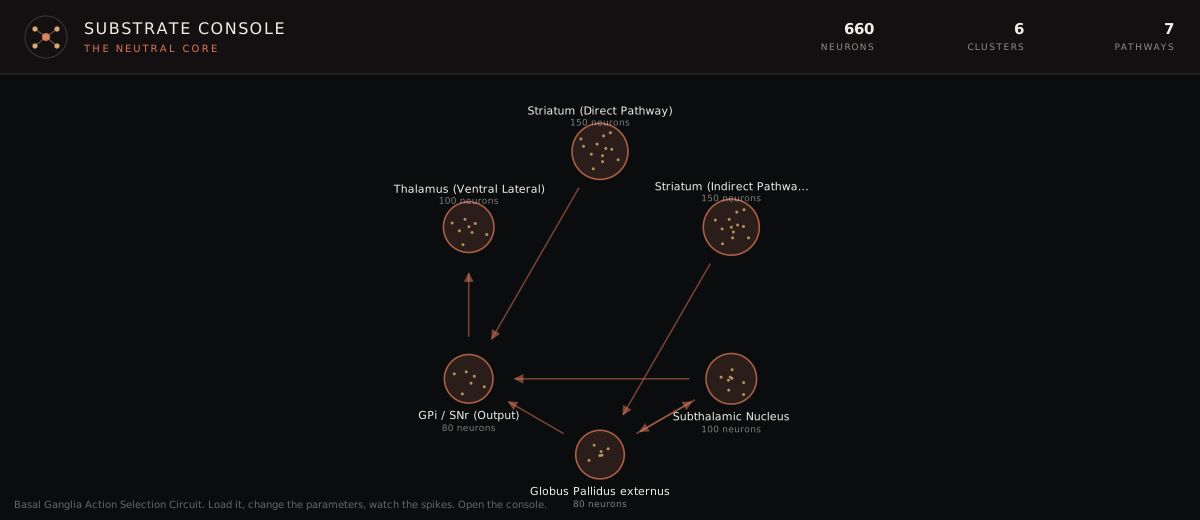
The site’s own substrate argument, built on the spiking neuron model comparison and implemented in the Substrate Console, holds that neuron-level dynamics carry degrees of freedom relevant to consciousness criteria. DishBrain is the empirical version of that claim in biological cells rather than in simulation, and it is the strongest case that the single-neuron level is not a trivial black box.
Where Friston’s framework anchors it
The free-energy learning signal is the theoretical backbone, and it is the part the field can actually inspect. A culture that minimizes prediction error through action is implementing, in real neurons, the same loop that Friston’s active inference framework describes in agents. The site’s coverage of active inference treats the loop between model updating and action as the sensorimotor core of agency. DishBrain demonstrates that loop running in tissue, which is why Friston’s co-authorship is the paper’s most cited connection.
The boundary the authors respect is the one active inference also respects. The loop produces behavior and predictions. It does not, by itself, establish phenomenal experience. Friston’s own writing treats the free-energy principle as the formal backbone of life and mind while remaining open on the hard problem, and the DishBrain paper inherits that exact caution.
What this tells us about consciousness
The honest reading of DishBrain is that it compresses the minimal substrate question into a testable measurement rather than resolving it. The culture learned, which is now a fact. Whether the learning was accompanied by anything it is like to be the culture remains open, and the paper’s title overstates its own claim, which is a fair criticism and the one the field has made.
What the experiment does establish is the smallest functioning biological cognitive system known to organize itself toward a goal. That is a datum the substrate debate has to include. It is the closest thing the literature has to a lower bound on the biological organization that produces adaptive, error-minimizing behavior, and whether consciousness rides on that organization or requires something more is the question the next decade of this line of work has to answer. A three-dimensional step beyond the flat dish, an organoid used as an adaptive reservoir computer, is examined in the Brainoware post.
Brett J. Kagan, Andy C. Kitchen, Nhi T. Tran, Farshad Habibollahi, Morteza Khajehnejad, Ben J. Parker, Anjali Bhat, Ben Rollo, Adeel Razi and Karl J. Friston, “In vitro neurons learn and exhibit sentience when embodied in a simulated game-world,” Neuron 110(23): 3952-3969, 2022, DOI 10.1016/j.neuron.2022.09.001.