


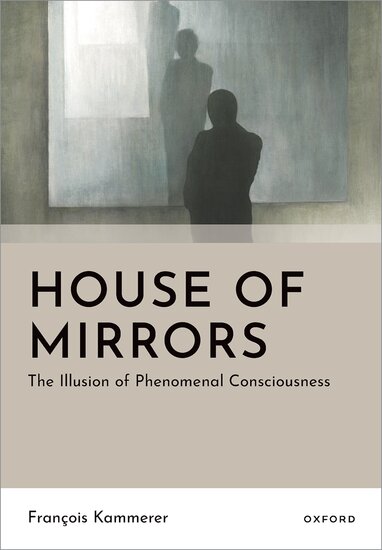
House of Mirrors. François Kammerer's OUP Book Argues Phenomenal Consciousness Is an Introspective Illusion
House of Mirrors
Kammerer's open-access OUP book defends illusionism and argues the phenomenality illusion is carried by the very faculty that would detect it.
François Kammerer, CNRS researcher at the Archives Henri Poincaré in Strasbourg, published House of Mirrors: The Illusion of Phenomenal Consciousness with Oxford University Press in summer 2026, open access and free to download from the author’s site and on Oxford Academic. The book defends illusionism about phenomenal consciousness and introduces a new framework for why the illusion resists detection. Keith Frankish and Hakwan Lau endorsed it publicly within days of publication, and an Asian Journal of Philosophy symposium on the book, edited by Takuya Niikawa and Taiga Shinozaki with contributions accepted from Frankish, Hedda Hassel Mørch, and Eric Schwitzgebel, is assembling through 2027.
The direct answer to the book’s core question is that phenomenal consciousness is not what it seems. Kammerer argues that states like seeing a red spot or feeling pain seem to carry an intrinsic, private, ineffable quality, and that this seeming is an introspective illusion generated by the brain. The book’s contribution beyond existing illusionism is Meta-Cartesianism, an account of why this particular illusion is stronger and much harder to grasp than a perceptual illusion.
The argument, in three moves
First, the target. Phenomenal consciousness, as philosophers standardly carve it, is the way experience presents itself to the subject, intimately and directly, while remaining imperceptible to others. It is the form of consciousness that resists scientific reduction and motivates the hard problem.
Second, the diagnosis. Illusionism holds that the phenomenal properties themselves are not real. What is real is the representation, generated by our own cognitive systems, that we have such properties. Keith Frankish’s illusionist program, covered on this site, is the framework’s most prominent defense, and Kammerer takes the same position with a different emphasis. The emphasis is on the mechanics of the illusion rather than the metaphysics of the disappearance.
Third, the new framework. Meta-Cartesianism explains the illusion’s intractability. A perceptual illusion, the Mueller-Lyer lines, the rotating snake, can be diagnosed because one faculty checks another. The phenomenality illusion is different. The introspective faculty that would do the checking is the same faculty generating the illusion, so every introspective report comes out phenomenal-saturated. The book’s title names the structure, a house of mirrors where every instrument reflects the illusion it should be measuring.
| Question | Realist answer | Illusionist answer (Kammerer) |
|---|---|---|
| Do phenomenal properties exist? | Yes, as intrinsic features of experience | No, only representations of them exist |
| Why does experience seem non-physical? | Because it is | Because introspection misrepresents its objects |
| Why is the illusion so hard to see through? | Not applicable | The checking faculty is the generating faculty |
| What survives for science? | A theory of phenomenal properties | A theory of introspective representation |
The book then carries the consequences outward, to cognitive science, where the science of consciousness becomes the science of introspective representation, to ethics, where moral status arguments that lean on phenomenal experience need restating, and to epistemology, where justification that appeals to how things phenomenally seem needs grounding elsewhere.
Where the book sits in the 2026 illusionist wave
The book lands in a year when illusionism has moved from a fringe position to a working program. The Thorat and Chopra full-stack functionalist theory builds a layered functionalist account that dissolves rather than solves the phenomenal residue, and the Sekrst faithful-pass narrative framework treats first-person report as a narrative construction with its own epistemics. Kammerer’s contribution is the explanatory middle layer those programs lack, a mechanism for why the illusion is universal, stable, and undetectable from the inside.
That mechanism is what makes the book load-bearing for AI consciousness assessment. If illusionism is right, then the question “is this system phenomenally conscious?” is malformed, and the operational question becomes whether the system represents itself as phenomenally conscious. That reformulation is measurable. Self-model content, introspective reports, and the functional role of self-description are all things a machine can be examined for, and the illusionist framework predicts that a system built the way we are built would produce the same self-misrepresentation.
Comparison to The Consciousness AI
The Consciousness AI project works under functionalist emergentism, where consciousness is an emergent property of organization. That position is neutral between realism and illusionism about phenomenality, and the project’s measurement program is what both camps share. Kammerer’s book sharpens the shared part. Under illusionism, every indicator short of report becomes the whole game, because report is itself the misrepresentation. The project’s calibration-first approach to indicators, tested on known substrates before being aimed at unknown ones, is exactly the discipline the illusionist framework demands, since an illusion is the easiest thing in the world for an uncalibrated instrument to confirm.
The honest tension is this. The project treats emerging consciousness as a real, measurable property of organized dynamics, which is a realist commitment at the level of organization. Kammerer’s framework denies only the phenomenal-properties layer, not the organization, and his book’s cognitive-science chapter is where the two commitments meet. An illusionist reading of the project’s consoles is available, they measure the functional organization that generates self-models, and the book’s framework says that is all there is to measure.
What the book does not settle
Meta-Cartesianism explains the illusion’s persistence, but the objection that has followed illusionism since its modern revival remains. The illusionist must explain the datum that there seems to be something it is like, without borrowing the realist’s vocabulary to state it. Kammerer’s answer is that the seeming is a representation with determinate functional role, and whether that answer costs less than realism is the live dispute the forthcoming symposium will host. The book also does not deliver the ethics chapter’s full program. Restating moral status without phenomenal experience is a research program, not a result, and the book maps the terrain more than it crosses it.
What the book establishes is the strongest current statement of illusionism’s explanatory burden, with a named mechanism for the illusion’s inextricability and a research map across three disciplines. Where illusionism now stands in the empirical field, and how it competes with biological and computational accounts, is tracked in the flagship overview of AI consciousness research.