

Daniel Dennett and the Multiple Drafts Model of AI Consciousness
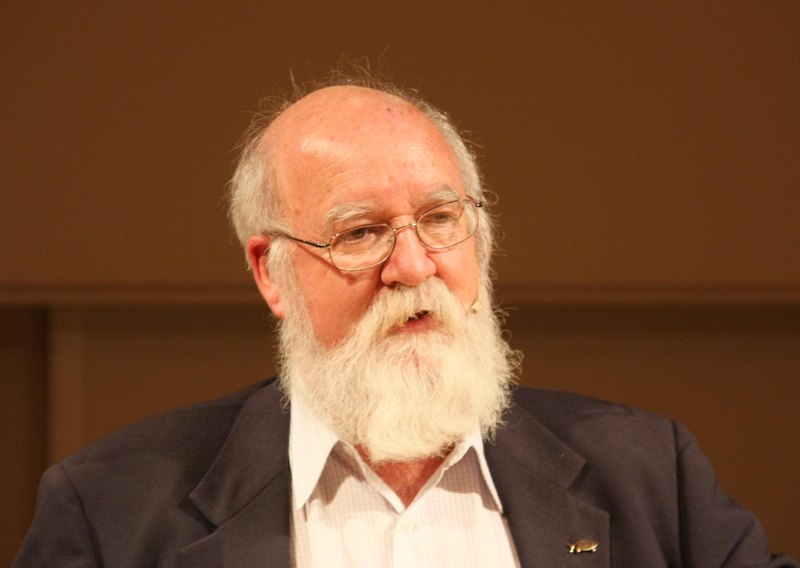

Daniel Dennett argued that there is no place in the brain where consciousness happens. His Multiple Drafts Model, set out in Consciousness Explained in 1991, holds that perception and thought are handled by parallel processes that continuously revise each other, with no central stage where the results are presented to an inner audience. The consequence for artificial systems is direct and Dennett drew it himself. If there is no special place and no special substance, a system with the right parallel organisation has whatever consciousness there is to have. He died on 19 April 2024, aged 82, having spent his final years arguing that building such systems would be a mistake. The revisory character of the narrative is exactly what Kristina Sekrst relies on in One Faithful Pass Over the Cuckoo’s Nest, her AISB 2026 argument that a faithful chain of thought strips out the opacity narrative theories call consciousness-constitutive.
| Dennett’s claim | What it rules out | What it permits |
|---|---|---|
| No Cartesian Theater | Any theory that locates consciousness at a place or a moment | Consciousness as a distributed process with no centre |
| Multiple Drafts | A single canonical stream of experience | Parallel revisions with no fact about which was “the” experience |
| Heterophenomenology | Treating introspective reports as authoritative | Treating them as data about what the subject believes |
| Function is all there is | An extra phenomenal residue after the functions are explained | Artificial systems qualifying on the same terms as brains |
What the Multiple Drafts Model Says
The target of the theory is an image Dennett called the Cartesian Theater. It is the assumption, usually implicit, that somewhere past all the processing there is a place where everything comes together and gets presented, and that whatever is on that stage at a given instant is what the subject is conscious of.
Dennett’s argument is that no such place exists, and that theories which assume one inherit a problem they cannot solve, because they still owe an account of who is watching.
What replaces it is continuous parallel revision. Many processes work on incoming information at once, each producing partial interpretations, each editing and being edited by the others. There is no master copy. Ask what the subject was conscious of at a precise moment and, on this account, there may be no fact of the matter, because different probes at different times will elicit different reconstructions and none of them is the original.
That last claim is the one people find hardest, and it is deliberate. Dennett held that the intuition of a single definite stream is itself produced by the machinery, and that treating the intuition as evidence is the mistake.
Heterophenomenology and Its Relevance to AI
Dennett’s method for studying consciousness was to take verbal reports seriously as data while refusing to treat them as authoritative. A subject who reports a vivid experience is reporting what they believe. That belief is a real fact that needs explaining. Whether the belief is accurate about an inner state is a separate question the report cannot settle.
This is the most immediately usable part of his work for artificial systems, and it is what makes the current situation with language models a problem he anticipated. When a model produces a first person report about its own states, heterophenomenology says the report is data about the model’s representational condition and not evidence of experience. The same discipline applies to humans, which is the point.
The position runs alongside the illusionist programme covered in Keith Frankish on illusionism and first person reports from language models, and it overlaps with the eliminativist tradition examined in Patricia Churchland on neurophilosophy and eliminativism. Dennett is usually grouped with both, and he resisted the grouping, since he did not deny that people are conscious. He denied that consciousness has the properties introspection attributes to it.
The Convergence With Workspace Theories
The Multiple Drafts Model and Global Workspace Theory are frequently treated as rivals and they are closer than that. Both deny a locus of consciousness. Both make availability to other processes the decisive property. Both treat the reported stream as a construction.
The difference is that workspace accounts keep a bottleneck, a limited resource that content competes for and is then broadcast from, developed in Bernard Baars on global workspace theory and ignition thresholds in language models and in Stanislas Dehaene on the global neuronal workspace. Dennett’s parallel drafts have no such gate.
Michael Graziano has argued that these positions describe one mechanism from different angles, a reconciliation covered in Michael Graziano and the attention schema theory of AI consciousness. Where the rest of the field’s positions sit relative to each other is set out in the index of consciousness theories and what each predicts about AI.
The Tension He Left Behind
Dennett’s theory is permissive about machine consciousness. If consciousness is what a certain kind of parallel information processing amounts to, and there is no further phenomenal ingredient, then the substrate is irrelevant and a sufficiently organised artificial system qualifies.
His practical position was the opposite. In his last decade he argued repeatedly against building systems that present as people, and in a 2023 essay in The Atlantic on counterfeit people he described the mass production of convincing artificial persons as among the most serious risks of the technology. His objection was not that such systems would suffer. It was that humans would be unable to stop treating them as persons, and that the resulting damage to trust would be structural.
That is a coherent position and it is worth stating precisely, because it is often misread. Dennett did not argue that machines cannot be conscious. He argued that our judgements about which things are conscious are unreliable in exactly the direction that would cause harm, and that building things designed to trigger those judgements is reckless independent of what is happening inside them.
Comparison to The Consciousness AI
This project’s Global Workspace layer, described on the architecture page, implements the bottleneck Dennett rejected. Specialist modules submit bids, a winning coalition ignites through a sigmoid non-linearity, and the result is broadcast back to all modules across five to ten adaptive convergence cycles.
That is a Cartesian Theater in the narrow architectural sense that there is a defined place where content becomes globally available. It is not one in the sense Dennett attacked, because there is no audience. The broadcast goes to the same specialist modules that produced the bids, and the reentrant loop means the recipients are also the authors. Nobody is watching.
Whether that distinction survives Dennett’s argument is genuinely open. He would likely say that a system with an ignition threshold has smuggled in a moment at which content becomes conscious, and that the moment is an artefact of the design rather than a discovery about minds. The honest position is that this project builds an architecture Dennett’s theory does not require, and that the Multiple Drafts alternative, a system of parallel revisions with no gate at all, has not been tried here and would be a distinct experiment.
What Follows
Dennett’s durable contribution is negative and it holds. Any theory that answers the question “where does it all come together” has not escaped the problem, because the answer immediately raises the question of who receives the presentation. That constraint applies to artificial architectures as much as to brains, and most proposed designs fail it without noticing.
What his account does not supply is a test. If the reports are data about beliefs rather than about experience, and if there is no further fact beyond the functions, then a system that behaves and reports correctly has satisfied every available criterion. Dennett treated that as the end of the question. The field has not accepted it, which is why the search for indicators continues, as documented in the current scientific consensus on AI consciousness.
Christian List carried the compatibilist core to artificial systems in 2025, and his intentional-agent test for AI free will is examined here.