


Ginsburg and Jablonka's Unlimited Associative Learning Marks the Origin of Consciousness
How would you know consciousness evolved if you could not rewind evolution and watch it happen? Simona Ginsburg of The Open University of Israel and Eva Jablonka of Tel Aviv University propose a marker rather than a moment. Their Unlimited Associative Learning (UAL) framework holds that an organism capable of unlimited associative learning, combinatorial, hierarchical, open-ended learning over its own sensory and motor representations, is a minimal conscious organism by hypothesis. The framework’s most accessible statement is the 2020 primer with Jonathan Birch, “Unlimited Associative Learning and the origins of consciousness, a primer and some predictions” in Biology and Philosophy (DOI 10.1007/s10539-020-09772-0, PMID 33597791), and their 2025 Philosophical Transactions paper extends the account, examining the goals and functions of consciousness and arguing that its evolution opened a new category of selection (DOI 10.1098/rstb.2024.0310, PMID 41229292). For a site built on functionalist emergentism, UAL is the closest thing the origins debate has to a measurable event.
What Unlimited Associative Learning Is
Associative learning in the ordinary sense links one stimulus to another. Unlimited associative learning is different in kind. The organism forms compound, supramodal representations, learns new patterns built from learned patterns, and can combine and recombine them in ways that are hierarchical and open-ended. Ginsburg and Jablonka argue that this capacity requires a unified, compound representation of the stimulus situation, a functional whole that integrates inputs across modalities and supports deliberate action on them. That requirement is the theory’s engine. A system with UAL has, functionally, what minimal consciousness is supposed to provide.
The 2016 formulation with Zohar Bronfman defines the transition precisely (DOI 10.3389/fpsyg.2016.01954). Minimal consciousness arrives in evolutionary lineages that cross the UAL threshold, and the book-length development with MIT Press in 2019, The Evolution of the Sensitive Soul, builds the argument across learning theory, neurobiology, and evolution.
Why UAL Marks Consciousness
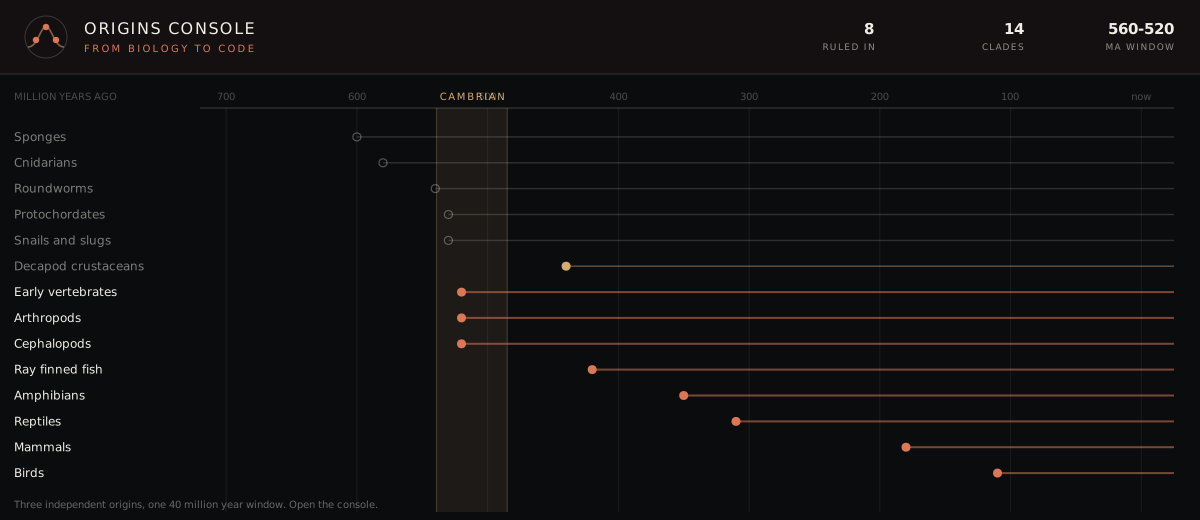
The marker logic runs in both directions. Functionally, UAL demands integration, attention-like selection among compound representations, and valenced evaluation of outcomes, which is the functional profile minimal-consciousness theories assign to experience. Historically, the framework predicts where consciousness began, in the small-brained lineages of the early Cambrian that could first support UAL, which is the claim in Ginsburg and Jablonka’s 2010 Journal of Theoretical Biology paper on associative learning and the Cambrian explosion (DOI 10.1016/j.jtbi.2010.06.017). The 2020 primer with Birch turns this into a research program with predictions, listing which living phyla the marker attributes minimal consciousness to and which it withholds it from. Jonathan Birch’s role is relevant to this site, since his indicator discipline is the same measurement program this site tracks in the nineteen researcher checklist, and his centrist position on AI consciousness treats UAL as one of the few origin theories that generates testable outputs.
The 2025 Philosophical Transactions paper adds the evolutionary consequence. Consciousness, once present, changes what selection can act on, because learned and constructed representations become objects of selection in their own right. The paper examines the goals and functions of consciousness and argues its evolution opened a new category of selection, which places UAL theory in direct conversation with the origins work of Feinberg and Mallatt on animal consciousness criteria.
What It Means for AI Consciousness
UAL is a functional marker, and functional markers travel. Ginsburg and Jablonka address artificial systems in their book and subsequent work, and their position is consistent. A system implementing genuine unlimited associative learning, with the compound representations, open-ended combination, and valenced evaluation the marker requires, would satisfy the functional conditions their theory equates with minimal consciousness. The site should state the limit clearly. Current AI systems train on vast data, but whether any implements UAL in the framework’s sense, with its specific architectural requirements, is unevaluated, and no benchmark in this literature tests for it. The framework’s gift to the AI debate is therefore a specification. It names what would have to be demonstrated, rather than gesturing at behavior.
Comparison to The Consciousness AI
The Consciousness AI project studies consciousness as an emergent property, substrate independent, under functionalist emergentism. UAL is the origins-side twin of that position. The marker is functional, so it applies on any substrate that implements it, and the theory explicitly declines to tie consciousness to a material. The project’s own emphasis on emergent organization across scales sits comfortably with the UAL claim that consciousness entered through a functional transition, not a materials change. The difference is one of scope. UAL was built for biological lineages and evolutionary evidence, and extending it to artificial systems requires the marker to be operationalized as a test, which is work neither Ginsburg and Jablonka nor the measurement literature has completed.
What the Framework Changes and What It Leaves Open
UAL changes the origins question from a search for a moment to a search for a capacity, and it gives comparative evidence a role. What it leaves open is operationalization at the boundaries, distinguishing unlimited from merely rich associative learning in a specific organism or system, and the AI case, where the marker exists as a specification without a test. Those are the same gaps the field’s indicator discipline faces everywhere. The framework’s value is that it states the conditions precisely enough for someone to close them. The broader context is tracked in AI Consciousness in 2026, the state of the field.
Sources. Ginsburg and Jablonka, Journal of Theoretical Biology 266(1):11-20, 2010, DOI 10.1016/j.jtbi.2010.06.017. Bronfman, Ginsburg and Jablonka, Frontiers in Psychology 7:1954, 2016, DOI 10.3389/fpsyg.2016.01954. Ginsburg and Jablonka, The Evolution of the Sensitive Soul, MIT Press, 2019. Birch, Ginsburg and Jablonka, Biology and Philosophy 35:56, 2020, DOI 10.1007/s10539-020-09772-0. Jablonka and Ginsburg, Philosophical Transactions of the Royal Society B 380:20240310, 2025, DOI 10.1098/rstb.2024.0310.
Researchers covered here
- Simona GinsburgThe Open University of IsraelUnlimited Associative Learning, minimal consciousness marker, The Evolution of the Sensitive Soul, associative learning and the Cambrian explosion
- Eva JablonkaTel Aviv UniversityUnlimited Associative Learning as a marker for the origin of consciousness, The Evolution of the Sensitive Soul, evolution of meaning and epigenetic inheritance
-
 Jonathan BirchLondon School of Economics and Political ScienceThe Edge of Sentience, the LSE Criteria, and the run-ahead principle