



Bjørn Merker's Selection Triangle and Consciousness Without a Cortex
Bjørn Merker’s selection triangle locates the minimal machinery of consciousness in the upper brainstem, and it does so with a functional argument that survives even if his strongest clinical claims stay contested. The triangle holds that every autonomous animal solves three coupled problems at once. It must pick where to direct its senses, what to do with its body, and how much the outcome matters. Merker, an independent neuroscientist, argued in Behavioral and Brain Sciences in 2007 (PMID 17475053) that a brainstem system running these three selections together produces the single coherent point of view that consciousness is. This walkthrough covers the argument, the clinical evidence, the spiking models of the superior colliculus that support its first vertex, and the way this project’s open architecture implements each vertex in code.
The clinical case for a cortex-free conscious state
Merker’s 2007 target article, “Consciousness without a cerebral cortex”, rests on evidence from children with hydranencephaly, a developmental condition in which the cerebral hemispheres are largely absent and replaced by cerebrospinal fluid. Those children wake and sleep, orient toward sights and sounds, react differently to familiar caregivers and strangers, and express contentment and distress through facial expression and vocal behavior. Decorticated mammals show the same profile in coarser form, with purposeful exploration, affective vocalization, and conditioned learning intact after full cortex removal.
Merker’s reading is direct. If the raw conscious state survived only in cortex-bearing brains, hydranencephalic children would show none of this. The state survives because the structures that organize it sit below the cortex, in the midbrain and the basal diencephalon. The cortex elaborates the contents of experience on top of that state. This claim is contested, and the strongest counterposition holds that human experiential content at least requires cortical circuitry. The careful reading takes the clinical evidence as a challenge to cortical orthodoxy rather than as a settled refutation of it.
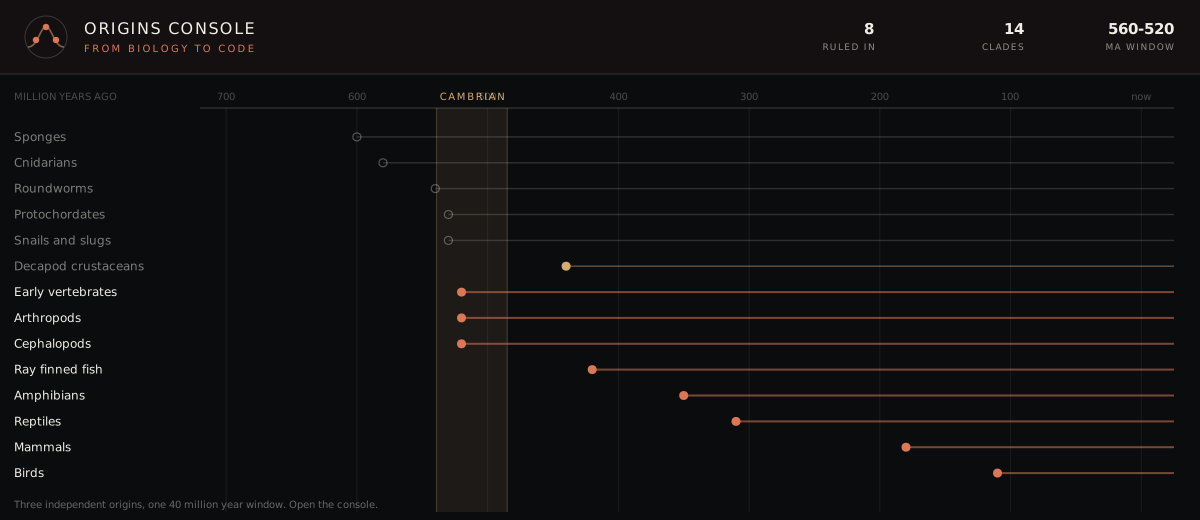
Where Feinberg and Mallatt date the origin of consciousness to three separate lineages in the Cambrian, Merker identifies the machinery those lineages share. The two frameworks land on the same structure, the optic tectum and its surrounding upper brainstem loops, from opposite directions. One works forward from 520 million years of neuroevolution. The other works inward from the clinical ward and the field cage.
The three selections of Merker’s selection triangle
The triangle names the three selections and their biological loci.
| Vertex | Locus | What it selects | Biological basis |
|---|---|---|---|
| Target selection | Superior colliculus (optic tectum) | Where to look and go | Multisensory priority map aligned in a common coordinate frame |
| Action selection | Basal ganglia, substantia nigra pars reticulata | What to do | Tonic GABAergic veto over the motor output, lifted by striatal disinhibition |
| Motivation | Hypothalamus and periaqueductal gray | Why the outcome counts | Homeostatic drives and affective valence biasing the other two selections |
The argument for why this amounts to consciousness runs through behavioral necessity. A single body with one set of muscles, in one world, serving one set of needs, must commit to one action at a time. The selections interact. Where the senses point constrains what actions are available. How hungry the animal is constrains where it looks. Merker’s claim is that the brainstem solves these three selections jointly, and the joint solution is a unified model of the world the animal acts in. That unified model, organized around an implicit first-person origin, is his candidate for the conscious state.
The spiking colliculus and the first vertex
The target selection vertex has a rare asset in neuroscience, a biologically detailed spiking model that reproduces the observed behavior of the structure. Bahadir Kasap and A. John van Opstal built a spiking neural network of the midbrain superior colliculus that generates realistic saccadic motor commands (Kasap & van Opstal 2017, Biological Cybernetics, doi:10.1007/s00422-017-0719-9).
The model translates retinal target position into a collicular site through a complex-logarithmic mapping, u = B·ln(1 + r/A), with the constants B = 1.4 mm and A = 3° fit to the monkey superior colliculus (Robinson 1972, Ottes et al. 1986). Each neuron uses adaptive exponential integrate-and-fire dynamics, a conductance-based spiking model, with biophysical parameters that vary systematically across the map. Lateral connections follow a center-surround scheme with short-range excitation and long-range inhibition, which synchronizes the burst profiles of the recruited population. The saccade trajectory is then decoded from the population spikes with a linear ensemble scheme, where each neuron contributes a fixed site-specific minivector per spike. Their code is public, written for the Brian simulator, at bitbucket.org/bkasap/sc_microstimulation, with a microstimulation extension published in PLOS Computational Biology in 2019 (doi:10.1371/journal.pcbi.1006522).
The relevance is architectural. The superior colliculus in this model is a spatiotemporal transformation engine, a population that converts a spatial priority into a precisely timed motor command. Spiking dynamics of exactly this kind, population codes with local excitation and wider inhibition, and the difference one neuron model makes to the behaviors a network can produce, are covered in the Izhikevich spiking neuron model analysis.
Motivation, value, and the periaqueductal gray
The third vertex has experimental support that is newer and thinner. A reviewed preprint by Daniela Lichtman, Eyal Bergmann, Jonathan Nicholas, Raphael Gerraty and Itamar Kahn, posted at eLife in April 2026 (doi:10.7554/eLife.110415.1), ran task-fMRI on mice performing a go/no-go odor discrimination with a contingency reversal. Ventral striatal activity tracked expected value during initial learning. During reversal, when the rewarded odor switched, the periaqueductal gray tracked model-derived value signals from a Q-learning fit, specifically the contrast between the values of licking and not licking. The reviewers rated the evidence incomplete, and the authors themselves frame the finding as a directional result rather than a settled one.
The result gains weight from independent PAG findings that the preprint itself cites. Roy et al. recorded aversive prediction errors in the human PAG (Nature Neuroscience, 2014). Sukikara et al. showed in 2006 (Journal of Neuroscience) that PAG inactivation impairs the switching away from a previously rewarded response, a reversal analogue in rats. Reis et al. (eLife, 2021) identified dorsal PAG ensembles representing approach and avoidance states. None of these establishes a full value-updating circuit. Together they make the PAG a plausible motivational interface between sensory maps and action selection, which is the role the triangle assigns it.
The chemical substrate for that interface is anatomically quantifiable. Zaldivar and Krichmar surveyed 38 neuromodulatory receptor subtypes across the amygdala and 13 source regions in the Allen Mouse Brain Atlas (Brain Structure and Function, 2013, PMC3825589), inferring system-to-amygdala connectivity from receptor expression energy. The dopaminergic supply from the ventral tegmental area, the mesolimbic pathway, is the part most relevant to a midbrain value system.
What the evidence supports, and where it stays open
Two limits deserve equal billing with the claims. First, the strong reading of Merker’s thesis, that all conscious contents can be organized subcortically, remains contested, and Merker’s own follow-up moved one piece. His 2013 paper on the efference cascade (Frontiers in Psychology, 4:501) anchors the first-person pivot in gaze control and gives the dorsal pulvinar, a thalamic structure with long-range inhibitory circuitry, the role of precipitating the brain’s best estimate of its circumstances. The zona incerta arbiter of the 2007 paper and the pulvinar hub of the 2013 paper are different proposals, and any implementation must state which one it follows.
Second, the empirical picture is assembling rather than assembled. Krauzlis, Lovejoy and Zénon’s review in Annual Review of Neuroscience (2013) establishes the superior colliculus as a selection structure involved in visual spatial attention, beyond saccade production. A 2026 study in Nature Communications (doi:10.1038/s41467-026-73206-w) reports that an attention-demanding hunting task engages a superior colliculus to zona incerta circuit in mice. The PAG value work is directional. Each vertex has support of a different strength, clinical for the overall thesis, electrophysiological and computational for target selection, imaging-based and partial for motivation.
Comparison to The Consciousness AI
The open-source project behind this site builds its architecture on the same tectum-first assumption, and the selection triangle maps onto it vertex by vertex. The comparison is architectural motivation, not equivalence, and the gaps are stated with the same care as the matches.
| Triangle vertex | In the project | State |
|---|---|---|
| Target selection | Sensory Tectum, a multisensory fusion layer with topographic maps, inverse-effectiveness weighting and an RSSM world model, all in a common spatial frame | Implemented. No log-polar coordinate transform or population-vector motor output yet |
| Action selection | Basal-ganglia style Go/No-Go action selection with a computed dopamine reward prediction error | Implemented. No tonic inhibition layer over the tectal output, the analogue of the SNr veto |
| Motivation | Affective Modulator, a valence field over workspace bids with arousal-coupled ignition threshold | Implemented as bid biasing. No direct priority injection into the tectal map before competition |
The engineering question the triangle poses is precise. A tonic inhibitory baseline over the tectal motor layer, matching the substantia nigra’s veto, and a midline arbitration hub between orienting bids and higher relays, matching the zona incerta proposal, are both falsifiable additions. The project’s gate discipline requires any such addition to produce a measurable, directional change in orienting behavior across three or more seeds before it counts as a result. The technical architecture page documents the full seven-layer stack, and the researcher profile of Bjørn Merker tracks coverage of his work on this site.
For the site’s flagship treatment of how consciousness is assessed and measured, see the scientists racing to define AI consciousness. VanRullen’s CS26 synthesis of the same clinical evidence, with thalamocortical oscillatory loops in the leading role, is covered in the cortex-free consciousness analysis.
The frame and its limits
The selection triangle earns its place in this project for one reason. It converts a slogan, that consciousness is subcortical, into an engineering specification with named structures, quantifiable parameters and testable gaps. The log-polar constants of the collicular map, the veto rate of the nigral output and the reversal signals of the PAG are all measurable, in brains and in code. What the frame does not establish is the strong subcortical thesis, and what no current result establishes is that implementing the triangle yields experience rather than competent orienting. The project holds that distinction visible in its indicator discipline. Architecture guides the build. Only measurement decides what the build achieved.
Researchers covered here
- Bjørn MerkerIndependent researcher, SwedenConsciousness without a cerebral cortex, the subcortical midbrain candidate, striatum-based sensory integration, critique of cortical orthodoxy
- Bahadir KasapDonders Institute for Brain, Cognition and Behaviour, Radboud UniversitySpiking neural network models of the superior colliculus, log-polar motor map dynamics, ensemble coding of saccade commands
- A. John van OpstalDonders Institute for Brain, Cognition and Behaviour, Radboud UniversitySuperior colliculus motor map theory, ensemble coding of saccadic commands, spiking network models of the midbrain gaze system