
Verzhbinsky and Halgren Show Co-Ripples Tie Distant Brain Regions Together
When two distant brain regions ripple at the same time, their neurons fire together about 30 percent more often, and the effect does not shrink with distance up to 220 millimetres. That is the central result of a Nature Neuroscience study published on August 12, 2026 by Ilya A. Verzhbinsky, Jonathan Daume, Sophia Cheng, Ueli Rutishauser and Eric Halgren, titled “Cross-region neuron co-firing mediated by ripple oscillations supports distributed working memory representations” (DOI 10.1038/s41593-026-02403-z). The recordings cover five regions, the hippocampus, amygdala, ventromedial prefrontal cortex, anterior cingulate cortex and pre-supplementary motor area, bilaterally, in 35 patients. The study ties those brief 90 Hz events to working memory load, response speed and the reinstatement of encoded stimulus patterns. It does not claim that ripples sweep the whole brain at all times. The recordings are the regions listed, and the paper stays inside them.
Ripples are a general cortical signal
Ripples were first mapped as the high frequency component of hippocampal sharp wave ripple complexes in rodents, where they support replay of past sequences during sleep and quiet wakefulness. Later work found the same 50 to 100 millisecond bursts across human cortex, often with no sharp wave attached. The new study builds on an earlier result from the same first author. Verzhbinsky and colleagues reported in PNAS in 2024 that co-occurring ripples facilitate neuronal interactions between nearby cortical locations (Verzhbinsky et al., PNAS, 2024). What stayed open after that work was scale and relevance. Ripples coordinated local firing, but nobody had shown ripple mediated coupling between regions separated by more than a few millimetres, and nobody had shown that the coupling tracks cognitive demands.
The experiment
The team analyzed an open access dataset of simultaneous single unit and local field potential recordings from Behnke-Fried microwires implanted in patients undergoing monitoring for intractable epilepsy, first collected by Daume and colleagues for a 2024 Nature study. Verzhbinsky and colleagues analyzed 35 patients across 43 sessions, 14 men and 21 women aged 20 to 67. Electrodes targeted the five regions in both hemispheres. From 1,927 microwire channels the analysis isolated 1,373 single units. Ripples were detected as peaks of the 70 to 100 Hz filtered signal exceeding 2.5 standard deviations above mean power, with at least three oscillation cycles and no sharp transients. Epileptiform periods and seizure onset zone electrodes were excluded. Each patient performed a modified Sternberg working memory task, holding either one or three images across a delay of about 2.5 seconds and then deciding whether a probe image was in the set. Ripple profiles were consistent across regions and patients, with mean peak frequencies between 90.7 and 91.3 Hz and durations between 69 and 75 milliseconds in all five regions.
Co-ripples raise co-firing by about a third at any distance
Across 31,489 analyzed unit pairs, neurons fired together significantly more often during periods when their two regions rippled simultaneously. The median increase was 34 percent, and the effect held for all five connection types, amygdala to cortex at 49 percent, hippocampus to cortex at 21 percent, amygdala to hippocampus at 43 percent, ipsilateral cortex to cortex at 42 percent and contralateral cortex to cortex at 44 percent. Distance did the surprising thing. Co-occurrence rates fell from 13 percent within a microwire bundle, under about 5 millimetres, to 5 percent between bundles, and then stayed flat. Cross hemispherical pairs separated by 35 to 223 millimetres showed co-occurrence rates within 0.1 percent of same hemisphere pairs separated by 71 to 203 millimetres. The co-firing advantage over no ripple periods did not decay with fiber tract distance either, and trended slightly upward (Pearson r 0.04). The authors then checked whether the extra co-firing was just a byproduct of higher firing rates. Two rate corrected tests said no. Co-firing exceeded the independent rate null during co-ripples by 56 percent more than during no ripple periods (p 1.1 times 10 to the minus 99), and the spike time tiling coefficient, which corrects for firing rate, was 117 percent greater during co-ripples. The coordination is temporal, beyond a shared rise in excitability.
Ripples track memory load and response speed
Ripple rates rose above baseline in every recorded region during encoding, maintenance and retrieval, with encoding up 13 percent, maintenance up 10 percent, and retrieval carrying the largest regional shifts, up 36 percent in pre-supplementary motor area, 20 percent in hippocampus during encoding and 13 percent in hippocampus during retrieval. Memory load moved the numbers further. Co-ripple rates between regions rose with three items instead of one during maintenance (p 0.038) and more strongly during retrieval (p 3.2 times 10 to the minus 6), with the largest pairwise increases between hippocampus and pre-supplementary motor area at 18 percent and between ventromedial prefrontal cortex and hippocampus at 17 percent. The load contrast was clearest in the ripple band, where 12 of 15 region pairs showed significant load modulation at retrieval, against 2 pairs in low gamma and none in non oscillatory very high gamma, and that band specificity separates ripples from general high gamma coordination. Amplitude envelope correlations, the continuous version, showed no consistent load modulation in any band, so the effect belongs to the timing of discrete ripple events. Behavior tracked the ripples too. After the retrieval stimulus, ripple rates ran higher in the hippocampus and amygdala on trials with fast responses, and hippocampal ripple onsets led amygdala onsets in both speed conditions.
Co-ripples reinstate the encoded pattern at retrieval
The most specific result is content carrying. During retrieval, co-ripples promoted the reinstatement of stimulus specific, long distance co-firing patterns that were observed during encoding, especially on rapid recognition trials. The co-firing that co-ripples carry is therefore not generic excitation. It carries stimulus specific structure across regions, and the efficiency of retrieval tracked it. On this dataset the task accuracy was 93 percent, which left too few error trials to compare correct against incorrect performance directly. The claim the data support is that co-ripples coordinate distributed representations during working memory, with the coordination scaling against task demands. The claim they do not support is that ripples are the medium of experience. They are a measured coordination mechanism whose cognitive relevance is now demonstrated at single neuron resolution.
Comparison to The Consciousness AI
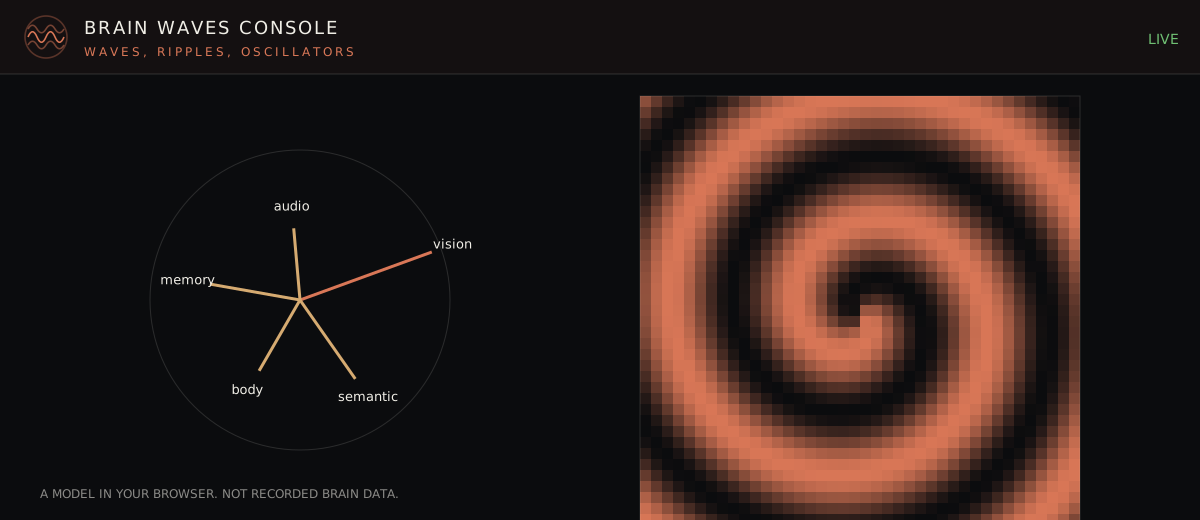
This project binds its five workspace modules with Kuramoto oscillators, and its sync_R measure reads how well their phases align. The co-ripple result describes a different coordination mechanism, transient high frequency synchrony between distant sites, gated by demand. Nothing in the project implements it. The Brain Waves Console runs the pattern as a model in its ripples chapter, with six sites corresponding to the recorded regions, a gold line joining pairs that ripple together, and a shared spike process sized so the expected co-firing rise matches the reported 30 percent. The chapter is explicit that the ratio converges by construction and that the rates are illustrative. What the result offers this project is a candidate mechanism to measure rather than build, aligned with the project’s practice of measuring before building, and the substrate the project already runs is spike based, so a ripple analogue would be a new instrument rather than a change to existing code.
What the study settles and what stays open
The study settles three points at single neuron resolution. Ripples co-occur across long distances with no measurable distance penalty. Their co-occurrence lifts cross region co-firing beyond what shared excitability explains. And both the rate and the content of that coordination scale with memory load and response speed. The open list is real. The recordings cover five limbic and frontal regions, not the whole brain, so claims about brain wide ripple coordination stay unmeasured. The mechanism behind long distance co-occurrence is unexplained, since the study shows the association and its cognitive modulation, not the causal link between them. Whether co-ripple coordination is part of how conscious contents get bound, the question the binding problem keeps open, is a theoretical step the data constrain without settling. Roelfsema has argued that assemblies form through enhanced firing rates alone, with no need for oscillatory synchrony, and this dataset is exactly the kind that such a dispute will be argued over. The phase gated perception evidence reviewed on this site shows a different oscillation carrying behavioral weight, and together the two lines make cortical oscillations a measurement target rather than a metaphor. Where oscillatory identity claims could go, and what replaying them would mean, is the territory of the consciousness fingerprint page.
Sources
- Verzhbinsky, I.A., Daume, J., Cheng, S., Rutishauser, U., Halgren, E. (2026). Cross-region neuron co-firing mediated by ripple oscillations supports distributed working memory representations. Nature Neuroscience. DOI 10.1038/s41593-026-02403-z
- Verzhbinsky, I.A. et al. (2024). Co-occurring ripple oscillations facilitate neuronal interactions between cortical locations in humans. PNAS 121, e2312204121. DOI 10.1073/pnas.2312204121
- Daume, J., Kamiński, J., Schjetnan, A.G.P., Salimpour, Y., Khan, U., Kyzar, M., Reed, C.M., Anderson, W.S., Valiante, T.A., Mamelak, A.N., Rutishauser, U. (2024). Control of working memory by phase-amplitude coupling of human hippocampal neurons. Nature 629, 393-401. DOI 10.1038/s41586-024-07309-z
- Roelfsema, P.R. (2023). Solving the binding problem. Assemblies form when neurons enhance their firing rate. Neuron 111, 1003-1019. DOI 10.1016/j.neuron.2023.03.016