

Neural Traveling Waves in Cortex. Muller and Reynolds Review the Mechanisms
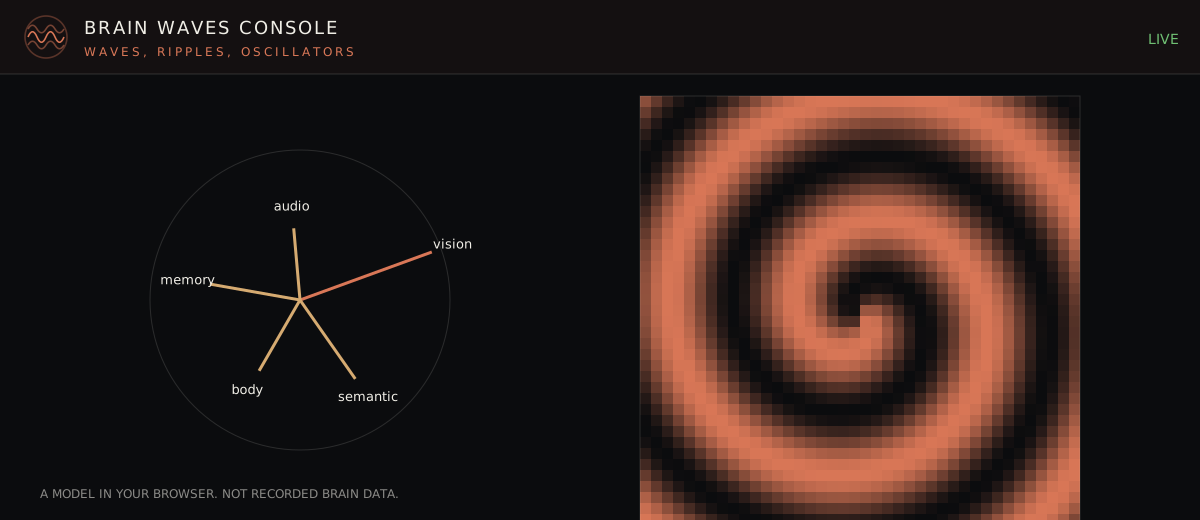
Neural traveling waves in cortex are waves of raised spiking that move across the cortical sheet, and the most complete review of them appeared in Neuron on September 2, 2026. Lyle Muller of the University of Texas at Dallas and the Fields Institute, Alexandra N. Busch of Western University, Zachary W. Davis of the University of Utah, and John H. Reynolds of the Salk Institute published “Neural traveling waves in cortex. Network mechanisms and potential roles in neural computation” (DOI 10.1016/j.neuron.2026.06.019). The review answers three questions that had stayed open since waves were first seen in anesthetized animals. Waves occur in awake animals. They change what an animal perceives. And a circuit mechanism, carried by the brain’s own horizontal wiring, can generate them without any extra physics. This post walks through that mechanism, the sparse regime the review emphasizes, the phase gated detection data, and the speculative framework the authors attach to it. The Brain Waves Console runs a live model of the same mechanism.
Neural traveling waves in cortex arise from local circuit rules
The review anchors wave generation in the anatomy of a single cortical area. Feedforward connections from lower visual areas supply about 5 percent of the synapses onto a neuron in visual cortex. Feedback connections from higher areas supply about 15 percent. The remaining 80 percent come from recurrent horizontal connections within the same area, which the authors call RH connections. Those horizontal axons are mostly unmyelinated. They conduct spikes at 0.1 to 0.6 metres per second, and they span several millimetres, so a signal from a nearby neuron arrives tens of milliseconds late. Connection probability falls with distance while delay grows with it. Muller, Busch, Davis and Reynolds argue that this pairing is enough. In large spiking models with biologically scaled synapses, hundreds of thousands of neurons, and distance dependent delays, traveling waves emerge across the range of activity seen in vivo, and their speeds match the measured 0.1 to 0.6 m/s band. Earlier measurements agree. Benucci and colleagues estimated about 0.2 to 0.5 m/s in cat primary visual cortex. No field spread is needed at these speeds, since electric fields diffuse far faster than that. The wave is what local coupling does.
Sparse waves in awake cortex
Small models tend to produce dense waves, where most neurons fire as the wave passes. The review reports a different regime at biological scale. In models with realistic synaptic conductances and axonal delays, waves are sparse. Only a small fraction of neurons spike as the wave sweeps past, and the local activity stays in the weakly correlated asynchronous irregular state. The wave modulates the balance of excitation and inhibition in a pool of roughly 100 micrometres, so it boosts or suppresses incoming signals instead of flooding the network with correlations. The awake recordings back this picture. Davis and colleagues recorded from area MT of marmosets with Utah arrays and found strong intrinsic waves, roughly 10 per second during fixation, in animals performing a threshold detection task. The probability that a neuron fired spontaneously depended on the wave phase, with background rates roughly doubling between the less and more excitable phases. Waves also appeared while the animals freely viewed high contrast natural scenes, so the dynamics persist under ordinary viewing.
Wave phase gates perception
The perception result comes from the same marmoset experiments (Davis et al., Nature, 2020). A faint target landed on the cortex at different wave phases. Evoked responses measured in the retinotopically aligned patch were stronger when the target arrived during the excitable phase, and weaker during the quiet phase, with the difference significant across 43 multi-units from two monkeys (p < 0.00001, two sided Wilcoxon rank sum test). Gain moved by roughly 10 to 20 percent with phase. Perceptual sensitivity peaked at the wave phase that produced the strongest evoked response. In the review’s words, wave phase was the single best predictor of trial by trial detection performance, capturing more variance than any other neural or behavioural variable they compared. Patchy long range connections add structure on top. Models with feature selective connectivity predict that waves modulate gain for neurons sharing a feature preference, and recordings in MT found wave motifs that enhanced sensitivity for their preferred motion direction (Davis et al., Cell Reports, 2024). These are measured effects on detection, and they are the closest link so far between intrinsic cortical dynamics and the contents of experience. They show that perception rides on the wave state of the cortex. They do not show that waves are sufficient for experience, and the review does not claim that.
The generative prediction framework is labeled speculative
The review then proposes a role for waves that goes beyond gating. As waves travel, they could carry recent input across the retinotopic map, so the activity at each point would hold a superposition of the present stimulus and a fading trace of what was just seen. The authors borrow the image of a palimpsest, a manuscript where older text stays visible under the newer. From that superposition, interactions between waves carrying past and present could drive short term predictions of upcoming input. The computational evidence comes from network models. Benigno and colleagues trained recurrent networks with distance dependent connectivity and delays to forecast natural movies a few frames ahead, and the wave carrying networks learned the task while networks with random connectivity and the same delays did not (Benigno et al., Nature Communications, 2023). Machine learning models point the same way. The Neural Wave Machines of Keller and Welling (ICML, 2023) run input sequences through traveling waves in their hidden layers, and Liboni and colleagues showed distance coupled recurrent networks whose input sets each node’s natural frequency, producing object specific waves that segment images (Liboni et al., PNAS, 2025). The review labels this generative framework speculative. No recording has yet shown waves carrying stimulus history across a map in a behaving animal. One observation points at it. After repeated presentations of a visual stimulus, spontaneous waves in anesthetized rodent visual cortex came to resemble the waves the stimulus evokes, as if the circuit had internalized the spatiotemporal structure of its recent input. Whether that happens awake, and whether it scales to complex tasks, stays open.
The case against ephaptic waves
The review devotes its first box to a dispute this site has covered from the other side. Earl Miller, Scott Brincat and Jefferson Roy argue that cortical computation runs partly through the electric fields that neural activity generates, with those fields acting back on neurons (the Analog Cognition analysis). Muller and colleagues answer with numbers. Wave speeds of 0.1 to 0.6 m/s match unmyelinated axon conduction and are far too slow for field spread, which is nearly instantaneous. In vitro work on endogenous fields, including the slice experiments of Frohlich and McCormick and of Costas Anastassiou and colleagues (covered here), finds that fields of a few mV/mm and extracellular potentials under about 0.5 mV move membrane voltage by submillivolt amounts, small against the roughly 25 mV gap from rest to threshold. Those effects show up as subtle shifts in spike timing for neurons already receiving input, and they are strongest for the slow 0.1 to 1 Hz rhythms of sleep and anesthesia. Against that, behaving primates show phase locked changes in population gain and in detection performance that are hard to reconcile with submillivolt perturbations. Fields also average over hundreds of micrometres, so they lack the spatial resolution to imprint the columnar, feature specific structure the wave motifs show. The review’s verdict is that waves are emergent products of recurrent, anatomically structured synaptic networks, with field effects at most a weak and coarse modulation. This site treats the disagreement as open and presents both sides, as the ephaptic coupling analysis does. The review also states its own cautions in a second box. Narrowband filtering can manufacture waves that are not there, and coordinated but non propagating amplitude changes must be ruled out before any wave claim stands.
Comparison to The Consciousness AI
This project binds its five workspace modules with Kuramoto oscillators, the Artificial Kuramoto Oscillatory Neurons mechanism of Miyato, Löwe, Geiger and Welling. Those oscillators sit in an all to all coupling with no spatial map and no conduction delays, so no wave can travel in them yet, and the review’s mechanism highlights exactly what is missing, a sheet for waves to cross. While building the Brain Waves Console, the project ported the binding layer’s update rule line by line and found that the natural frequency term always evaluated to zero, so the oscillators could only settle into one fixed state. The fix now sits behind a default off flag, which keeps every earlier result reproducible. The console’s sheet chapter runs the distance coupled lattice with an optional conduction delay as a model of the mechanism this review describes, and its gate chapter runs the phase dependent gain the marmoset data support. The connection to consciousness stays stated narrowly. The measured results tie wave phase to detection and working memory coordination, which are functions that consciousness research tracks. Whether a wave substrate is necessary for experience is a different question, and the flagship overview of the field tracks where the major theories stand on it.
What the review settles and what stays open
The review establishes three things with converging evidence. Traveling waves are pervasive in awake cortex, not artifacts of anesthesia. Their speeds match horizontal axon conduction, which makes a synaptic circuit mechanism the parsimonious explanation. And wave phase carries measurable weight in perception, with detection sensitivity peaking at the excitable phase. The open list is equally concrete. No recording shows waves carrying stimulus history across a map, which is the load bearing assumption of the generative framework. The contrast dependence of waves under natural viewing is unmeasured. Whether intrinsic, evoked and saccade related waves share one structural substrate is unresolved. And learning should reshape wave motifs if the framework is right, a prediction only one anesthetized observation speaks to so far. For the study of consciousness, the review’s contribution is a measured handle. Phase gated detection ties intrinsic cortical dynamics to perceptual outcome in a way that a model can be built against, and the oscillatory binding layer of this project is one place such a model is being tested.
Sources
- Muller, L., Busch, A.N., Davis, Z.W., Reynolds, J.H. (2026). Neural traveling waves in cortex. Network mechanisms and potential roles in neural computation. Neuron 114. DOI 10.1016/j.neuron.2026.06.019
- Davis, Z.W., Muller, L., Martinez-Trujillo, J., Sejnowski, T., Reynolds, J.H. (2020). Spontaneous travelling cortical waves gate perception in behaving primates. Nature 587, 432-436. DOI 10.1038/s41586-020-2802-y
- Davis, Z.W., Benigno, G.B., Fletterman, C., Desbordes, T., Steward, C., Sejnowski, T.J., Reynolds, J.H., Muller, L. (2021). Spontaneous traveling waves naturally emerge from horizontal fiber time delays and travel through locally asynchronous-irregular states. Nature Communications 12. DOI 10.1038/s41467-021-26175-1
- Davis, Z.W., Busch, A., Steward, C., Muller, L., Reynolds, J. (2024). Horizontal cortical connections shape intrinsic traveling waves into feature-selective motifs that regulate perceptual sensitivity. Cell Reports 43, 114707. DOI 10.1016/j.celrep.2024.114707
- Benigno, G.B., Budzinski, R.C., Davis, Z.W., Reynolds, J.H., Muller, L. (2023). Waves traveling over a map of visual space can ignite short-term predictions of sensory input. Nature Communications 14. DOI 10.1038/s41467-023-39076-2
- Liboni, U.S. et al. (2025). PNAS 122, e2321319121. DOI 10.1073/pnas.2321319121
- Keller, T.A., Welling, M. (2023). Neural Wave Machines. ICML 2023. proceedings.mlr.press/v202/keller23a.html
- Miyato, T., Löwe, S., Geiger, A., Welling, M. (2025). Artificial Kuramoto Oscillatory Neurons. ICLR 2025. arXiv 2410.13821
Researchers covered here
- Lyle MullerDepartment of Neuroscience, The University of Texas at Dallas; Fields Lab for Network Computation, Fields Institute for Research in Mathematical Sciences, TorontoLead author of the 2026 Neuron review of neural traveling waves in cortex, the Benigno wave-prediction model (Nature Communications 2023), the Liboni wave segmentation model (PNAS 2025), and the case against ephaptic wave mechanisms (Box 1 of the review)
- Zachary W. DavisDepartment of Ophthalmology and Visual Sciences, University of Utah, Salt Lake CityFirst author of the wave-gated perception study (Davis et al., Nature 2020), the sparse-wave model result (Davis et al., Nature Communications 2021), and the feature-selective wave motif recordings (Davis et al., Cell Reports 2024)
- John H. ReynoldsThe Salk Institute for Biological Studies, La Jolla, CaliforniaThe normalization model of attention, co-senior authorship of the wave-gated perception finding (Davis et al., Nature 2020), and co-authorship of the 2026 Neuron traveling waves review