


Spiral Waves in Human Cortex. Xu, Long, Feng and Gong Find Brain Spirals
Rotating spiral waves organize the human cortex, and their rotation direction and location tell which cognitive task a person is doing. That is the result Yiben Xu, Xian Long, Jianfeng Feng and Pulin Gong reported in Nature Human Behaviour on June 15, 2023, under the title “Interacting spiral wave patterns underlie complex brain dynamics and are related to cognitive processing” (DOI 10.1038/s41562-023-01626-5). One correction comes before everything else. The data are functional magnetic resonance imaging signals, the slow blood oxygenation response sampled at a scale of seconds across the whole brain, not electrical recordings. No electrode saw these spirals rotate. The claim rests on the moment by moment fluctuations of the fMRI signal in 100 Human Connectome Project subjects, at rest and during tasks, and the paper is careful to stay at that scale.
What a brain spiral is and where the phase singularity sits
A spiral wave is a wave that rotates around a central point. The point itself is a phase singularity, the one location where the wave’s phase is undefined, because every rotation direction meets there. In physics the same object appears as a vortex, and in the heart as the filament that organizes re-entry during fibrillation. Xu, Long, Feng and Gong detected these patterns in cortical fMRI signals and found them widespread, during both resting and task states. The spirals propagate across the cortex while rotating around their singularity centres, which gives the large scale activity a non-stationary structure, an ordered form that keeps moving. Earlier work had seen spiral waves in electrical recordings of neocortex, with Huang and colleagues reporting spiral wave dynamics measured at the mesoscale in Neuron in 2010 (Huang et al., Neuron, 2010), and Muller and colleagues later finding rotating waves in human EEG during sleep spindles. The new paper’s contribution is scale. The same geometry organizes whole cortex dynamics in imaging data, not just patches measured with dyes or arrays.
Rotation direction and location classify tasks
The task result comes from the spirals’ own properties. Each brain spiral has a rotation direction, clockwise or anticlockwise, and a location on the cortical sheet. The authors show these properties are task relevant and use them to classify which cognitive task the subject was performing. The classification works because different tasks put spirals with different directions and positions in different parts of the cortex, so the pattern of rotating activity carries task information without any averaging over time. The detection also survives scrutiny of its own method. The paper includes an analysis of unfiltered fMRI signals, showing the spirals are not artifacts of the band filtering step, a necessary check because narrowband filtering can manufacture wave-like patterns that are not in the raw data. The Muller, Busch, Davis and Reynolds traveling waves review makes the same caution a central methodological point, and this fMRI study addresses it directly.
Interacting spirals coordinate the cortex
The spirals do not sit alone. The paper shows multiple brain spirals interact, and through those interactions they coordinate the correlated activations and de-activations of distributed functional regions. During cognitive processing, that coordination enables flexible reconfiguration of task-driven activity flow between bottom-up and top-down directions. In plain terms, the pattern of rotating waves determines which regions activate together and which suppress together as a task runs, and it can reconfigure between the two directions of the cortical hierarchy as processing demands change. The spirals are therefore a candidate organizing mechanism for large scale dynamics, a layer of description between single neurons and functional networks that standard connectivity analyses average away.
Comparison to The Consciousness AI
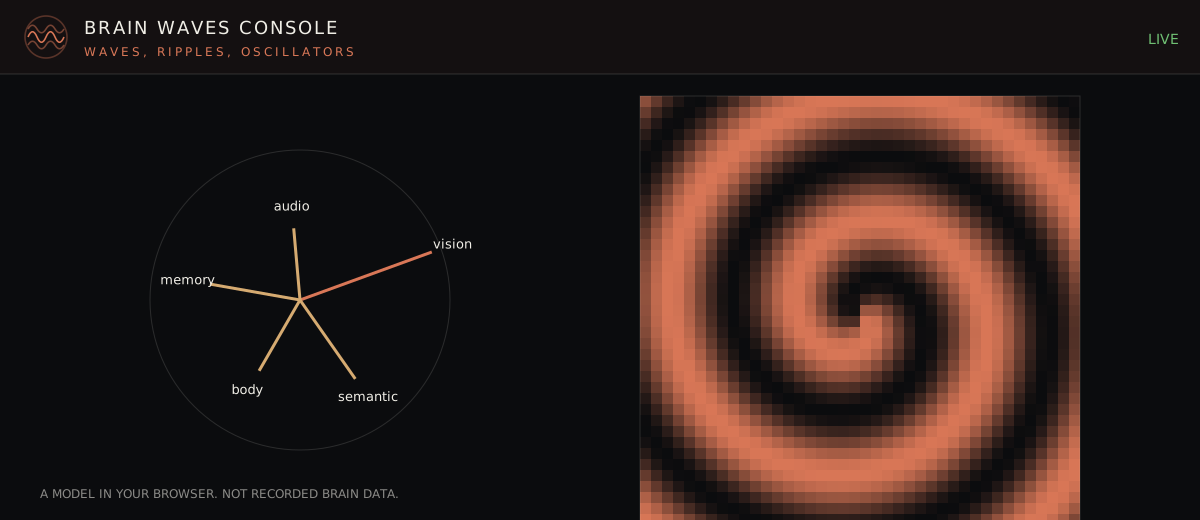
The project’s agent has no whole cortex sheet, so the fMRI scale of this result has no analogue in its architecture. The Brain Waves Console shows the pattern type instead, in its sheet chapter, where 4096 coupled phase oscillators on a grid generate plane waves, target waves and spirals from the same local rule, with spirals identified by a low phase gradient directionality as the model’s own readout. The connection this result offers to consciousness research is organizational. Whole cortex dynamics have structure, that structure changes with cognitive state, and the organizing units are rotating waves rather than static networks. For consciousness as an emergent property of organized dynamics, this is evidence about the kind of dynamics a cortex runs at the largest scale, and it gives no direct handle on experience. It constrains any theory that treats cortical activity as independent regional flicker, which is a claim about functional organization, and the flagship overview of the field tracks where the major theories place their bets on dynamics of this kind.
What the study settles and what stays open
The study settles that spiral waves are a real, widespread organization of human cortical fMRI at rest and during tasks, that their rotation directions and locations carry task information, and that interacting spirals coordinate distributed activation patterns. It leaves the electrical scale unmeasured, since fMRI has no access to spikes or the millisecond dynamics that produce them, so the relation between these whole cortex spirals and the traveling waves measured with arrays and dyes remains an inference from geometry rather than a demonstration. Whether the spirals cause task performance or track it is also open, since classification evidence shows the patterns track cognition without establishing a causal role. The oscillatory dynamics the site tracks elsewhere live at a different scale, milliseconds and single neurons, and the two scales are consistent readings of one cortex rather than competing accounts.
Sources
- Xu, Y., Long, X., Feng, J., Gong, P. (2023). Interacting spiral wave patterns underlie complex brain dynamics and are related to cognitive processing. Nature Human Behaviour 7, 1196-1215. DOI 10.1038/s41562-023-01626-5
- Huang, X., Xu, W., Liang, J., Takagaki, K., Gao, B., Wu, J.-Y. (2010). Spiral wave dynamics in neocortex. Neuron 68, 978-990. DOI 10.1016/j.neuron.2010.11.007
- Muller, L. et al. (2016). Rotating waves during human sleep spindles organize global patterns of activity that repeat precisely through the night. eLife 5, e17267. DOI 10.7554/eLife.17267
- Muller, L., Chavane, F., Reynolds, J., Sejnowski, T.J. (2018). Cortical travelling waves. Mechanisms and computational principles. Nature Reviews Neuroscience 19, 255-268. DOI 10.1038/nrn.2018.20