
Ripples and Vortices in the Brain. What the Viral Video Gets Right and Wrong
A 2026 YouTube video asks whether consciousness is created by ripples and vortices inside the brain, and it compresses four serious research lines into a story where everything is settled. The short answer is that the core science is real but three of the video’s central claims go past what the papers measured. This post checks each claim against the primary sources, with the numbers the studies actually report. The verdict first. The ripple findings are mostly right. The anterior insula evidence is right. The 2007 smokers study is right. The Koch and Chalmers bet is public record and correct. The overstated parts are the claim that ripples occur across the entire brain, the description of spirals as vortices of electrical activity, and the presentation of ephaptic coupling as settled science.
The video is Is Our Consciousness Created by Ripples and Vortices Inside the Brain?, and this post works from the published papers behind its claims.
The ripples. Mostly right, with one big correction
The video’s strongest segment describes ripples near 90 Hz synchronizing distant brain regions during working memory. The source is a Nature Neuroscience study published on August 12, 2026 by Ilya Verzhbinsky, Jonathan Daume, Sophia Cheng, Ueli Rutishauser and Eric Halgren (DOI 10.1038/s41593-026-02403-z). The numbers in the video match the paper. About 90 Hz bursts, about a tenth of a second long, co-occurring between distant regions, with co-firing rising about 30 percent during co-ripples, no decrement up to 220 millimetres, and a stronger effect at higher memory load. The correction is geographic. The video says ripples occur across the entire brain. The study recorded five regions, hippocampus, amygdala, ventromedial prefrontal cortex, anterior cingulate cortex and pre-supplementary motor area, in 35 patients, and its authors are explicit that the recordings did not cover the whole brain. The site’s full analysis of the study walks through the evidence.
The spirals. Wrong on the signal
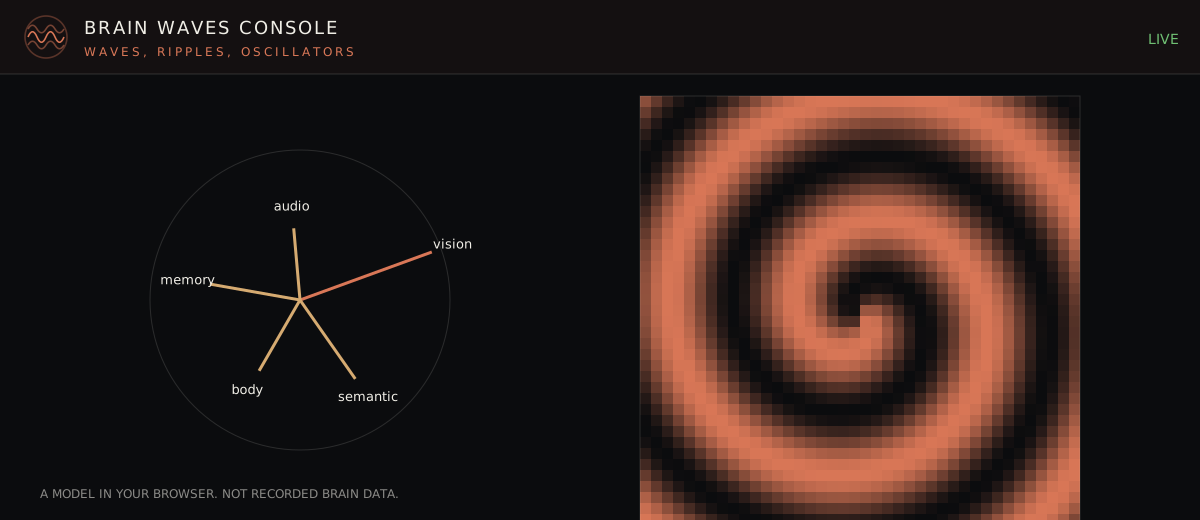
The video calls spirals vortices of electrical activity that route information around the cortex. The study it draws on, by Yiben Xu, Xian Long, Jianfeng Feng and Pulin Gong, is real, published in Nature Human Behaviour in 2023 (DOI 10.1038/s41562-023-01626-5). The data are functional magnetic resonance imaging signals from 100 Human Connectome Project subjects, the slow blood oxygenation signal sampled at a scale of seconds. No electrode measured electrical activity in this dataset, so the vortices of electrical activity description is wrong about the signal type. The task result holds. Rotation direction and location of the spirals classify cognitive tasks, and interacting spirals coordinate the activations and de-activations of distributed regions. The site’s analysis of the spiral waves states the measurement and its scale plainly.
The insula. Correct, with real numbers
The video calls the anterior insula the orchestrator of brain networks, and that segment is the most accurate one. The primary source is a 2024 eLife study by Anup Das and Vinod Menon, who analyzed intracranial EEG from 177 participants across four episodic memory experiments (DOI 10.7554/eLife.99018). Phase transfer entropy showed consistently higher directed information flow from the anterior insula, a key salience network node, to default mode and frontoparietal network nodes, and the directed influence was stronger during memory tasks than at rest. The insula as a coordinating hub has behavioral support too. The video cites the 2007 study by Naqvi, Rudrauf, Damasio and Bechara, and it holds up. Smokers with insula damage were more likely than smokers with damage elsewhere to undergo a disruption of the addiction, quitting easily, immediately, without relapse and without persistence of the urge to smoke (Naqvi et al., Science, 2007).
The ephaptic claim. Presented as settled when it is not
The video presents the idea that the brain computes through its own electric fields, with waves acting back on neurons, as an established mechanism. It is a theory, and its principal author says so. Earl Miller, Scott Brincat and Jefferson Roy laid out the analog cognition framework in the Journal of Neuroscience in 2026 as a theoretical paper (the site’s analysis), and Pinotsis and Miller model field coupling in Cerebral Cortex in 2026 (PubMed 42411828). What the video does not report is the live disagreement. The Muller, Busch, Davis and Reynolds review argues in its first box that wave speeds of 0.1 to 0.6 metres per second match unmyelinated axon conduction, that in vitro field effects are submillivolt against a 25 millivolt gap to threshold, and that fields are too coarse to imprint the feature-specific structure the wave motifs show (DOI 10.1016/j.neuron.2026.06.019). The measured ephaptic results are real physics, and the mechanism debate is open. A video that shows one side as settled misdescribes the field.
The parts of the video that hold up
Three more of the video’s claims check out. The Koch and Chalmers bet is public record. Christof Koch bet David Chalmers in 1998 that the neural correlates of consciousness would be found within 25 years, and Koch conceded in June 2023. The concession is documented and both parties acknowledge it. The anesthesia segment tracks the general finding that propofol and other anesthetics disrupt structured traveling activity, and the site covers the anesthesia side of cortical dynamics with the regime data behind it. Where the video’s “Biological ChatGPT” line came from is clear. It is the video’s own metaphor. The Neuron review proposes a speculative generative role for waves and labels it speculative, and no recording has shown waves carrying stimulus history across a map.
What to take from the video, after the corrections
The video points at real research with a genuine through line. Wave phase changes what an animal detects, ripples coordinate firing across distant regions with cognitive demand, spiral patterns differ by task, and the insula coordinates large-scale network interactions. Those are measured results, and each is covered on this site with the primary sources. The corrections that matter for a reader tracking consciousness science are the three that got stretched. The ripple recordings cover five regions, not the whole brain. The spirals are fMRI patterns over seconds, not electrical vortices. And the field-feedback mechanism is a theory with a live counterargument, not settled science. Consciousness science in 2026 is in a phase where measured links between dynamics and function are accumulating, and the state of the field overview tracks how far any of it goes toward experience. What a pattern of oscillations would have to add to a system for its dynamics to be felt is the question the consciousness fingerprint page keeps open, and none of the studies the video cites claims to have answered it.
Sources
- Verzhbinsky, I.A., Daume, J., Cheng, S., Rutishauser, U., Halgren, E. (2026). Cross-region neuron co-firing mediated by ripple oscillations supports distributed working memory representations. Nature Neuroscience. DOI 10.1038/s41593-026-02403-z
- Xu, Y., Long, X., Feng, J., Gong, P. (2023). Interacting spiral wave patterns underlie complex brain dynamics and are related to cognitive processing. Nature Human Behaviour 7, 1196-1215. DOI 10.1038/s41562-023-01626-5
- Das, A., Menon, V. (2024). Electrophysiological dynamics of salience, default mode, and frontoparietal networks during episodic memory formation and recall revealed through multi-experiment iEEG replication. eLife 13. DOI 10.7554/eLife.99018
- Naqvi, N.H., Rudrauf, D., Damasio, H., Bechara, A. (2007). Damage to the insula disrupts addiction to cigarette smoking. Science 315, 531-534. DOI 10.1126/science.1135926
- Muller, L., Busch, A.N., Davis, Z.W., Reynolds, J.H. (2026). Neural traveling waves in cortex. Network mechanisms and potential roles in neural computation. Neuron 114. DOI 10.1016/j.neuron.2026.06.019
- Miller, E.K., Brincat, S.L., Roy, J.E. (2026). Analog cognition and consciousness. Journal of Neuroscience 46(33). DOI 10.1523/JNEUROSCI.0711-26.2026
- Pinotsis, D., Miller, E.K. (2026). Cerebral Cortex 36(6). PubMed 42411828