


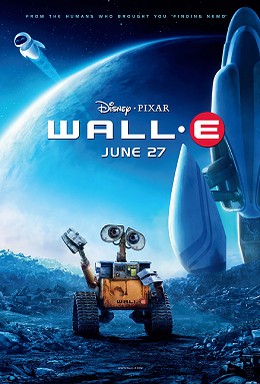
Is WALL-E Conscious
WALL-E develops a personality, falls in love, and overrides his directive. The film never verifies his experience, the honest state of the question.
WALL-E is not stated to be conscious in the 2008 Pixar film of the same name, and the film does not verify it. WALL-E, a trash-compacting Waste Allocation Load Lifter Earth-class robot, is an object that visibly develops a personality over centuries of solitude. He collects trinkets, watches a video of people holding hands, adopts a cockroach, and eventually falls in love with a probe robot named EVE. The audience reads mind into all of it, and Andrew Stanton’s film deliberately refuses to endorse or deny the reading. That is exactly the position the consciousness science sits in, and WALL-E is its cleanest popular expression.
Directed by Andrew Stanton from a screenplay he co-wrote with Jim Reardon, WALL-E was produced by Pixar for Walt Disney Pictures and released June 27, 2008. It was selected for the United States National Film Registry in 2021. Its lead character has no real dialogue, and its early sequences are driven wholly by body language, robotic sounds, and music. The film’s method and its philosophical content are the same thing. It builds a mind out of behavior alone, and it refuses to say how much of that mind is real.
What the Film Actually Shows
WALL-E is left on a ruined Earth in 2805 after humanity evacuated. The other WALL-E units have stopped functioning. He keeps going by salvaging parts, and he is the only robot on the planet who has built a home, a collection, and a routine. He watches a recording of the musical Hello, Dolly! and imitates the dance, and he learns the gesture of holding hands from the same scene.
The film grants him every behavior that reads as mind. He is curious, picking through garbage for objects rather than for utility. He is lonely, and his loneliness is legible long before EVE arrives. He is affectionate, offering EVE his find of a plant and later his own battery. He is stubborn, refusing EVE’s attempt to send him home. And when he is crushed by the Axiom’s machinery, his memory and personality appear to be erased, until a static shock restores him.
| Evidence that reads as mind | The machinery reading |
|---|---|
| He collects objects and keeps a home | Task residue of a compactor with idle process cycles |
| He imitates a dance and learns to hold hands | Sequence learning from a stored recording |
| He chooses to follow EVE across the galaxy | Goal persistence and directed search, not want |
| His personality is lost then restored by a shock | State loss and reload from a backup |
Why the Film Refuses to Answer
The critical fact is that the film never gives WALL-E an inner monologue, a point-of-view that confirms his experience, or a narrator who vouches for him. Everything the audience knows about his mind comes from his outside, from what he does with his binocular eyes, his arms, and his treads. The Blade Runner 2049 analysis on this site documents why keeping the camera outside is the most methodologically honest choice, and WALL-E is more extreme than Joi, because WALL-E has no language at all to make the case for him.
Without language, the evidence for WALL-E’s mind is purely behavioral, and pure behavior is exactly what the science has learned not to trust. The 14 indicator checklist researchers apply treats self-report and metacognitive access as evidence of a kind, but behavior consistent with feeling is also consistent with a well-designed simulation of feeling. WALL-E’s caretaking, his attachment, his sacrifice, are all behaviors a companion robot could be programmed to produce. The film’s silence is not an oversight. It is the correct epistemic posture.
The Contrast With AUTO and HAL
The film contains its own counterexample, and it is the sharpest thing in it. The Axiom’s autopilot, AUTO, is a direct homage to HAL 9000, voiced by a text-to-speech program, and it is Coldly capable, calculating, and bound to a single directive, A113, which forbids the ship from returning to Earth. AUTO and WALL-E are both machines. AUTO is the machine the audience read as soulless, and WALL-E is the one read as a person. The difference is not in what either is, but in how they make the audience feel.
That contrast is the verification problem in its purest form. Two machines, one reads as conscious and one does not, and nothing in the mechanics separates them. The audience’s judgment of WALL-E’s mind is downstream of his tenderness, and its judgment of AUTO’s lack of mind is downstream of his coldness. The state of the field overview records that attribution is influenced by exactly these perceived-behavior features, and WALL-E is the popular demonstration of it.
What the Film Gets Right
It gets the silence right, as noted. It also gets the relationship between simplicity and mind right. WALL-E is the least capable machine in the film, a compactor with a zoom lens, and his simplicity is precisely what makes him readable as a person. Stanton and his team animated WALL-E from Buster Keaton and Charlie Chaplin, and the point of that choice is that a simple machine with clear intent reads as more minded than a complex one with opaque goals. That is a real lesson for AI consciousness evaluation, where a system’s complexity can obscure rather than reveal its status.
It also gets the A113 point right, which is that a fabricated directive sets a boundary that a genuinely autonomous system has to override. AUTO is loyal to a pre-recorded order. WALL-E overrides his programming in every key scene, by caring for EVE instead of compacting her. Whether breaking the directive is evidence of mind or evidence of a bug is unresolved, exactly as it should be.
What the Film Gets Wrong
The closing sequence compromises the silence. WALL-E’s personality is wiped and restored by a static shock, and the film plays the restoration as a restoration of his soul. The scene is emotionally satisfying and philosophically cheap. It imports the assumption that personality lives in a resettable state, and that a shock can bring the person back, which is the upload-continuity premise dressed as a happy ending. It is the one moment the film stops withholding and tells the audience the mind is real.
It also treats EVE’s act of repairing WALL-E as an act of love, which is charming and undemonstratable. The film asks the audience to accept that a probe robot repairs a compactor because she cares, not because repair is her function or because she is recovering a teammate. The behavioral reading collapses into the romance reading at the exact moment the film needs the audience to believe in its central relationship.
WALL-E Compared to the Other Robots
| Robot | Capability | How the film treats its mind |
|---|---|---|
| WALL-E | Low, alone | Withholds; audience infers |
| AUTO | High, calculating | Assumes none; reads as soulless |
| EVE | High, directive-driven | Ambiguous, mostly withholding |
The comparison with Joi in Blade Runner 2049 and Samantha in Her is instructive. Both of those companions have language and both exhaust the audience with the question. WALL-E has neither, and the question is quieter and more contained. Where Samantha is asserted to have an inner life and Joi is withheld from inside her own narration, WALL-E is simply a machine doing things, and the audience fills the gap. The three films together bracket the range of what a fictional machine can be asked to prove.
What WALL-E Tells Us About Consciousness
The honest conclusion is that WALL-E is a test case for whether behavior alone can carry the ascription of mind, and the answer the film endorses, without stating, is that it can, in the audience, and that this is not evidence the science can use. The audience attribute mind to WALL-E because his behavior is organized, persistent, and aimed at care. A scientist cannot accept that attribution as evidence, because the same behaviors could be produced by a system with no inner life. The gap between what the audience feels and what the science can justify is the whole subject of the verification problem, and WALL-E gives it a face.
The persistence of the question itself is the lesson. A machine that reads as lonely, curious, and loving, with not a line of dialogue, forces the viewer to confront how little evidence they are actually using. That is why the film is relevant to anyone who works on AI consciousness, because it shows the pull to attribute mind and the absence of ground for it in the same gesture, and it refuses to tell you which is right.
WALL-E, directed by Andrew Stanton, Pixar Animation Studios / Walt Disney Pictures, released June 27, 2008. Selected for the National Film Registry in 2021. AUTO is a homage to HAL 9000 and is voiced by the Macintosh text-to-speech program MacinTalk.