

CubeSat Orbits Explained, LEO, Sun-Synchronous Orbit, ISS Deployment and Deorbit Time
Almost every CubeSat flies in low Earth orbit, and almost every one falls back to Earth. It reaches one of three orbits. It is released from the International Space Station (ISS) at about 420 km, from a NanoRacks or Japanese deployer on the Kibo module. It rides a SpaceX Transporter flight to a sun-synchronous orbit near 500 km. Or it rides a SpaceX Bandwagon flight to a mid-inclination orbit near 45 degrees. The altitude decides how long it stays up, from under a year to several decades, and since September 2024 the FCC requires a satellite in low Earth orbit to come down no later than five years after its mission ends.
The film Built for 15 years, it lasted 926 days. Why CubeSats fall back to Earth follows the FACSAT-2 CubeSat from its release to its reentry, with its real height curve and its Morse beacon.
This is part two of our guide to building and launching a CubeSat from the US, and it covers step 1 of the nine, the choice of orbit. The CubeSat guide lists every part in order. The series is a neutral guide. The Consciousness AI does not build or launch a satellite. Every number below names its source and the date we checked it.
The three orbits a CubeSat can get
A CubeSat has no rocket of its own. It goes where its ride goes, so the choice of orbit is really a choice of ride.
| Route | Typical altitude | Inclination | Source and date checked |
|---|---|---|---|
| Release from the ISS | 414 to 424 km | 51.6 degrees | ISS orbital elements, CelesTrak, 7 November 2026 |
| SpaceX Transporter rideshare | about 500 km | about 97 degrees (sun-synchronous) | FACSAT-2 orbit, CelesTrak catalog and Vargas Domínguez et al. 2026 |
| SpaceX Bandwagon rideshare | 510 to 605 km reported | about 45 degrees | Aviation Week (2023) and NASASpaceflight (2024) reports |
The ISS figures come from its orbital elements of 7 November 2026, which give a perigee of 414 km, an apogee of 424 km, an inclination of 51.63 degrees and a period of 92.95 minutes. NASA’s station facts page states that the station makes 16 orbits of Earth in 24 hours.
The Transporter row uses one real CubeSat as the example. FACSAT-2, a 6U CubeSat of the Colombian Aerospace Force, was deployed from SpaceX’s Transporter-7 mission on 15 April 2023 into a sun-synchronous orbit at about 500 km, with an inclination of 97.29 degrees in the CelesTrak catalog. SpaceX’s rideshare page stated on 6 November 2026 that its sun-synchronous missions fly approximately every 4 months.
The Bandwagon row is the weakest in the table, because the SpaceX page did not load for our check. Aviation Week reported in 2023 that SpaceX planned Bandwagon flights to about 45 degrees at 550 to 605 km, and NASASpaceflight reported that Bandwagon-2 released payloads near 510 and 570 km in December 2024. Confirm the current numbers in the SpaceX booking tool before you plan around them.
Release from the ISS
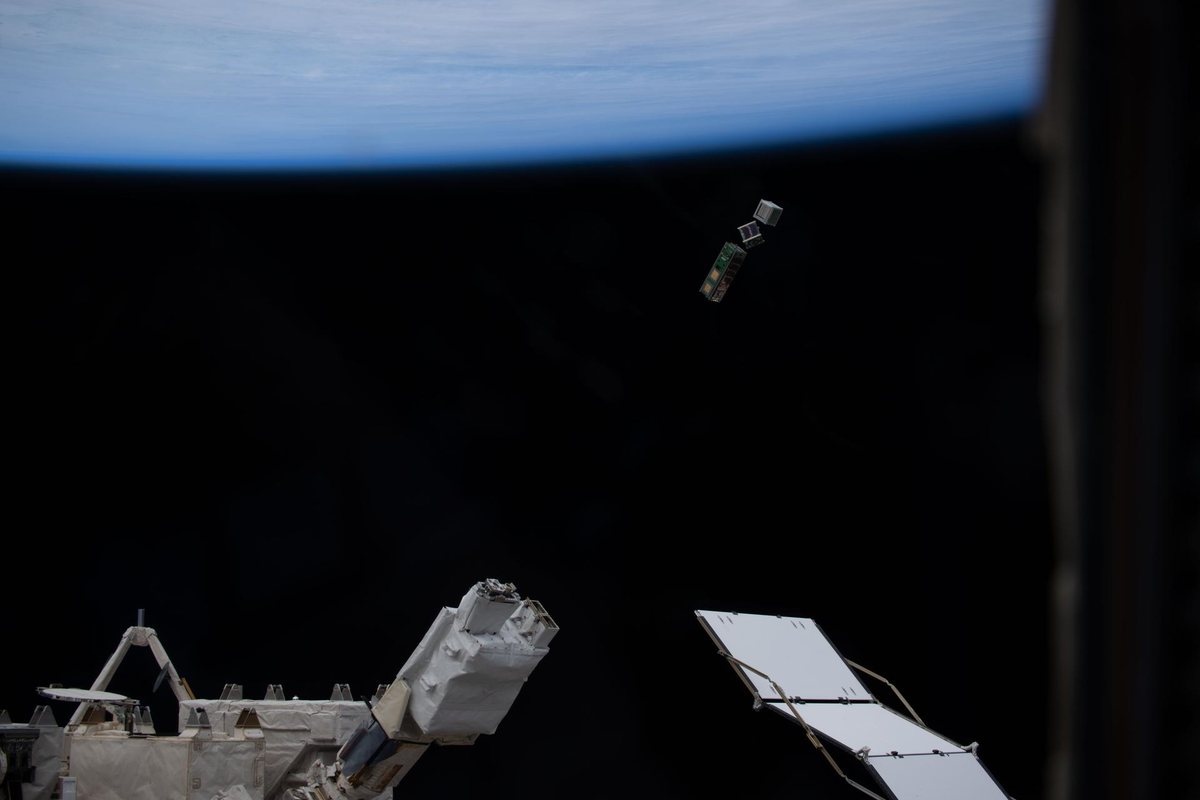
A CubeSat bound for the ISS flies up packed inside a cargo spacecraft. Astronauts load the deployer in the airlock of the Japanese Kibo laboratory module. NASA’s caption of a photo from 20 April 2023 describes Frank Rubio installing the NanoRacks CubeSat Deployer inside the Kibo airlock, after which the Japanese robotic arm grapples the deployer and points it away from the station. The photo above shows the same process from a Japanese small satellite orbital deployer in February 2026.
The ISS route has two limits. The CubeSat inherits the station’s 51.6 degree orbit, so its ground track never passes north of 51.6 degrees or south of minus 51.6 degrees. It also starts low, so it has the shortest life of the three routes.
Sun-synchronous orbit on Transporter
A sun-synchronous orbit is tilted slightly past the poles so that the satellite always crosses a given latitude at the same local time. NASA’s Earth Observatory explains it with the Terra satellite, which crosses the equator over Brazil at about 10:30 in the morning local time, and about 99 minutes later crosses over Ecuador or Colombia at about 10:30 again. A camera gets the same light on every pass, and the orbit covers the whole planet, poles included. This is why Earth observation CubeSats usually ask for it.
Mid-inclination on Bandwagon
SpaceX started Bandwagon as a second rideshare line beside Transporter. Aviation Week quoted SpaceX in 2023 saying that mid-inclination was the second most requested orbit among its rideshare customers. A 45 degree orbit spends more time over low and middle latitudes than a polar orbit, which suits a mission that serves those regions.
What each orbit gives a small satellite
| Factor | Release from the ISS | Sun-synchronous (Transporter) | Mid-inclination (Bandwagon) |
|---|---|---|---|
| Light | Changes from pass to pass | Same local time on every pass | Changes from pass to pass |
| Coverage | Up to 51.6 degrees north and south | Whole Earth, poles included | Up to about 45 degrees north and south |
| Radio passes | Several minutes each, a few times a day per station | Several minutes each, a few times a day per station | Several minutes each, a few times a day per station |
| Lifetime | Shortest of the three | Years, depends on solar activity | Longer, the orbit starts higher |
Radio passes are short in every low orbit. The SatNOGS volunteer network logged FACSAT-2 passes from stations in Europe in 2025, and each recorded pass lasted about 4 to 6 minutes. For example, observation 12592965 from a station in Drachten, the Netherlands, ran from 00:13:04 to 00:17:28 UTC on 20 October 2025. A satellite in low orbit is above the horizon of one station for minutes, not hours, so the ground segment needs several stations or a network. Part 9 of the series covers ground stations.
Why altitude sets the deorbit time
Low Earth orbit is not empty. The top of the atmosphere still reaches it, and the thin air drags on every satellite. NASA’s Earth Observatory explains that drag lowers a satellite until it “spirals lower and faster” and burns up or falls to Earth. The air is denser lower down, so a low satellite falls faster.
The Sun changes the rate. Solar heating expands the upper atmosphere, so in a solar maximum a satellite flies through denser air. NASA’s Earth Observatory gives the scale for a satellite that keeps its orbit with thrusters. It needs about four orbit boosts per year when the Sun is quiet, and a maneuver every 2 to 3 weeks at peak solar activity. A CubeSat without a thruster cannot push back, so it simply falls sooner.
A 2026 preprint by Santiago Vargas Domínguez, Mara Valentina Angel and Brayan Nicolas Buitrago of the National Astronomical Observatory of Colombia (arXiv:2609.24534, 21 September 2026) gives a table for a 6U CubeSat with FACSAT-2’s measured drag. It lists the total time in orbit from the injection altitude under three levels of solar activity.
| Injection altitude | Solar maximum (170 sfu) | Average cycle (120 sfu) | Weak cycle (95 sfu) |
|---|---|---|---|
| 450 km | 1.0 years | 1.8 years | 2.9 years |
| 480 km | 1.6 years | 3.2 years | 5.2 years |
| 509 km | 2.5 years | 5.4 years | 9.2 years |
| 520 km | 2.9 years | 6.5 years | 11.3 years |
| 550 km | 4.6 years | 10.9 years | 19.8 years |
| 580 km | 7.1 years | 18.0 years | 34.1 years |
| 600 km | 9.4 years | 24.9 years | 48.2 years |
The table applies to one satellite shape and mass. A 1U CubeSat or a 6U with open solar panels has a different ratio of area to mass and falls at a different rate. The unit sfu is the solar flux unit used for the 10.7 cm radio flux of the Sun, a standard measure of solar activity. The table is a preprint and has not yet passed peer review, so treat the exact numbers as estimates. The trend is the useful part. Each 30 to 50 km of extra altitude adds years, and the solar cycle can change the result by a factor of three or more.
For the lowest route, FACSAT-2’s own track gives a measure. The authors report that it took 234 days to fall from 400 km to 300 km and only 25 more days to fall from 300 km to re-entry, during the solar maximum of 2025. A CubeSat released from the ISS starts just above 400 km.
The FCC five year rule
On 29 September 2022 the FCC adopted its Second Report and Order on space debris (FCC 22-74, IB Docket 22-271). In paragraph 18 it requires satellites that end their mission in, or pass through, low Earth orbit below 2,000 km and plan to dispose through uncontrolled re-entry to come down “as soon as practicable following end of mission, and no later than five years after the end of the mission.” This replaced the older 25 year guideline.
Three details in the order are important for a CubeSat team.
- End of mission is defined. For a spacecraft that cannot maneuver, the order defines end of mission as the point at which it has completed its primary mission. The five years start then, not at launch.
- It covers every license path. The order applies the rule to satellites licensed under Part 25, to experimental satellites under Part 5 and to amateur satellites under Part 97.
- It applies from 29 September 2024. Paragraph 22 gave a two year grandfathering period. New licensees and satellites “to be launched after September 29, 2024” must comply.
The rule counts the years after the mission, so the total time in orbit can be longer than five years. A CubeSat with a two year mission meets the rule if it re-enters within seven years of launch. The FACSAT-2 authors work through the same step. They estimate that a five year requirement needs an injection near 560 km if the flight happens at a solar maximum, while 510 km would suffice under an average cycle. In practice, most passive CubeSats meet the rule only if they start no higher than about 500 to 550 km. A satellite that must fly higher needs a thruster or a drag device to come down in time.
The FCC rule text is part of its Part 25 debris rules. In July 2026 the FCC adopted a new Part 100 that will replace Part 25, as described in the main guide. Check the debris section of Part 100 when it takes effect. Part 6 of this series covers the license paths.
A real case, FACSAT-2
FACSAT-2 shows how far the plan and the result can differ. The Colombian Aerospace Force declared a service life of at least five years and an estimated orbital lifetime of fifteen years. The satellite re-entered on 27 October 2025, 926 days after deployment. The CelesTrak catalog records the same decay date.
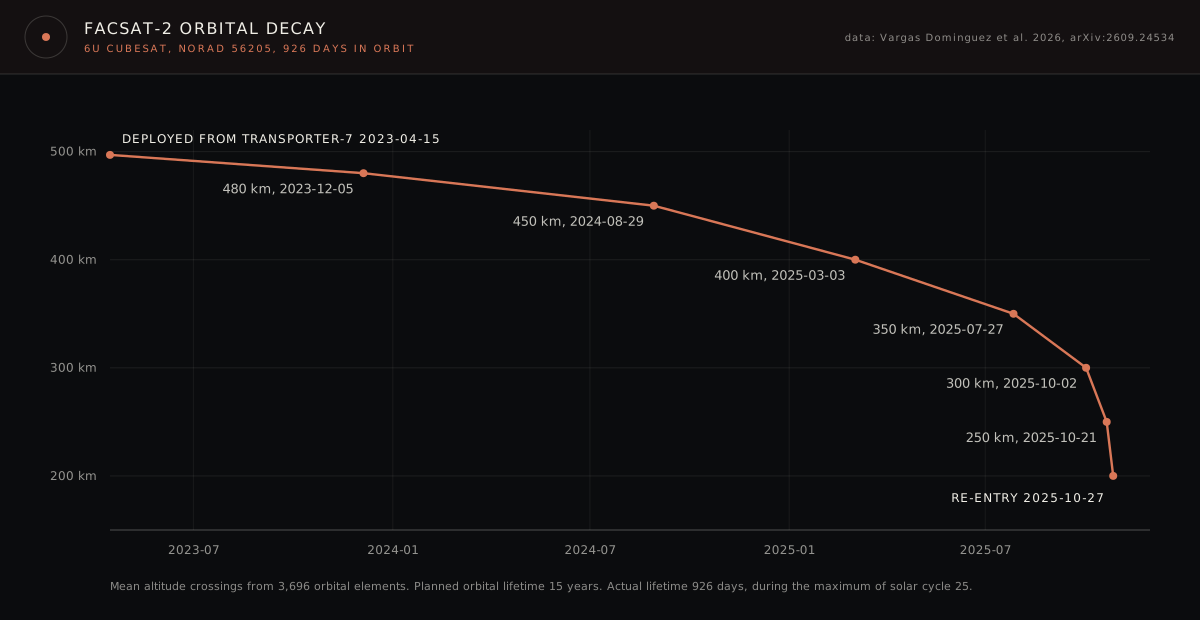
The authors rebuilt the decay from 3,696 orbital elements and found the main cause in the Sun. The solar flux averaged 170.8 sfu over the mission, against 139 sfu in the planning scenario based on the official 2019 forecast. That difference alone shortens the orbital lifetime by a factor of 1.52. Two other CubeSats from the same Transporter-7 launch fell faster by similar factors, 1.50 and 1.57.
The falling orbit also changed the mission. The camera had a nominal resolution of 4.75 m at 500 km. Near 350 km the authors estimate it reached about 3.3 m, while the width of each image strip shrank from 19.4 km to about 13.6 km.
SatNOGS stations heard the satellite to the end. The last good observation in the SatNOGS database is the Drachten pass of 20 October 2025, seven days before re-entry.
ISS release or rideshare drop-off
| Question | Release from the ISS | Rideshare drop-off (Transporter or Bandwagon) |
|---|---|---|
| Start altitude | About 420 km | About 500 to 600 km |
| Time in orbit | Months to a few years, depending on the Sun | Years, can pass the five year limit at the top of the range |
| Orbit choice | 51.6 degrees only | Sun-synchronous or about 45 degrees |
| Five year rule | Met by the low altitude alone | Check with NASA DAS before you book |
| Ride to space | Inside a cargo spacecraft, then from the Kibo airlock | Attached to the rocket’s rideshare plate |
The ISS route is the safest for the debris rule and the shortest for the mission. A rideshare drop-off gives more time and a better orbit for imaging, but at the top of its altitude range a passive CubeSat can stay up longer than the rule allows. NASA’s Debris Assessment Software (DAS), version 3.2.7 since 10 April 2026, computes the orbital lifetime for the debris statement in the FCC application.
Try an orbit before you buy one
You can learn how passes work before any launch. The AMSAT CubeSat Simulator, our CubeSat on a desk kit, is a working 1U model with solar panels and a radio beacon. With the satellite ground station receiver kit, a USB radio and a simple antenna, you can listen to real CubeSat passes and see how short they are.
Orbits and the study of consciousness
This project studies whether a mind could run on hardware far from Earth, so the conditions of each orbit are design inputs, not background. Radiation, power and drag set what any computer in orbit can do and for how long. Our analysis of radiation hardening for a conscious architecture in orbit covers the radiation side, and the Consciousness to Orbit section tracks the missions. No CubeSat is conscious, and none of these missions claims to be.
What this part covers and what it leaves open
A US CubeSat team chooses an orbit by choosing a ride. The ISS gives about 420 km and a short life. SpaceX Transporter gives a sun-synchronous orbit near 500 km. SpaceX Bandwagon gives about 45 degrees. Altitude and the solar cycle together decide the time in orbit, and the FCC five year rule, in force since 29 September 2024, decides how high a passive CubeSat can start. FACSAT-2 shows that the Sun can cut a planned 15 years to 926 days.
Two points stay open on 7 November 2026. The Bandwagon altitudes come from press reports, because the SpaceX rideshare page did not load for our check. The lifetime table comes from a preprint for one 6U shape. Run your own satellite through NASA DAS with your own mass and area. The next part of the series covers CubeSat hardware, the Cal Poly standard and the bus subsystems.