



Radiation hardening and whether a conscious architecture can survive orbit
Outside the protection of Earth’s atmosphere and magnetosphere, space computing operates in an ionizing radiation bath. Trapped protons in the Van Allen belts, solar particle events, and galactic cosmic rays (GCRs) deposit high-energy ionizing charge directly into silicon junctions. For classical Von Neumann computers and deep learning accelerators, the consequences are severe. A single ionizing heavy ion striking a transistor can cause a Single Event Upset (SEU), flipping a bit in a program counter or memory pointer and triggering an immediate, fatal operating system crash.
If consciousness is a substrate-independent property of complex causal systems, as argued across Project Consciousness to Orbit, deploying a conscious mind in space is a biophysical and aerospace engineering problem as much as an algorithmic one. A candidate architecture running in low Earth orbit (LEO), in geostationary orbit, or in deep space must either be shielded with centimeters of heavy lead and aluminum, manufactured on obsolete radiation-hardened silicon nodes, or designed with intrinsic dynamical fault tolerance.
The pioneering flight data from NASA Ames Research Center’s TechEdSat-13 mission, led by Principal Investigator Marcus S. Murbach (NASA Technical Reports Server, document 20220005780), provides the first empirical evidence for how neuromorphic spiking architectures behave under orbital radiation.
| Space radiation hazard | Classical GPU / CPU failure mode | Neuromorphic / Biological response |
|---|---|---|
| Single Event Upset (SEU) | Bit-flip in instruction pointer crashes system | Transient charge injection absorbed as background synaptic noise |
| Single Event Latchup (SEL) | Destructive short-circuit across CMOS rail | Mitigated by current-limiting power distribution and cold-spare switching |
| Total Ionizing Dose (TID) | Gate oxide breakdown, threshold voltage shift | Gradual parameter drift compensated by on-chip homeostatic plasticity |
| Synaptic memory corruption | Floating-point weight corruption corrupts inference | On-chip Spike-Timing-Dependent Plasticity (STDP) self-stabilizes network |
Why Classical Deep Learning Accelerators Are Fragile in Space
Modern deep learning accelerators, such as the Nvidia H100 GPU flown on the Starcloud-1 mission tracked on the Orbital Compute Tracker, achieve immense floating-point throughput by packing tens of billions of transistors into fabrication processes below 5 nanometers. Starcloud’s August 2026 funding extension, $250 million at a $2.3 billion valuation, is funding a fleet of exactly such GPUs, the economics of which the orbital data center analysis examines against today’s launch market. The separate commercial layer, two kilowatt-class data center nodes that are the first compute sold as a service from orbit, is examined in the Axiom post. At those microscopic dimensions, the critical charge required to flip a digital bit is exceedingly small. A single cosmic ray proton can induce multiple bit flips across adjacent memory cells.
To survive in space, conventional commercial-off-the-shelf (COTS) processors require elaborate hardware redundancy, such as Triple Modular Redundancy (TMR), where three identical processors execute the same code and a majority voting circuit discards errors. While effective for simple flight controllers, TMR triples the satellite’s power consumption and mass. An H100 GPU already consumes roughly 700 watts; tripling that compute overhead for fault tolerance creates a thermal and power penalty that severely limits satellite constellation scaling.
Traditional radiation-hardened (rad-hard) processors, such as BAE Systems’ RAD750 or Cobham’s LEON processors, eliminate latchup risks by utilizing specialized silicon-on-insulator (SOI) fabrication and hardened circuit topologies. However, rad-hard fabrication nodes lag commercial silicon by 10 to 15 years. They operate on 65 nm to 180 nm processes, offering thousands of times less compute density per gram. A cognitive architecture requiring millions or billions of neurons cannot fit on traditional rad-hard silicon under realistic spacecraft mass limits.
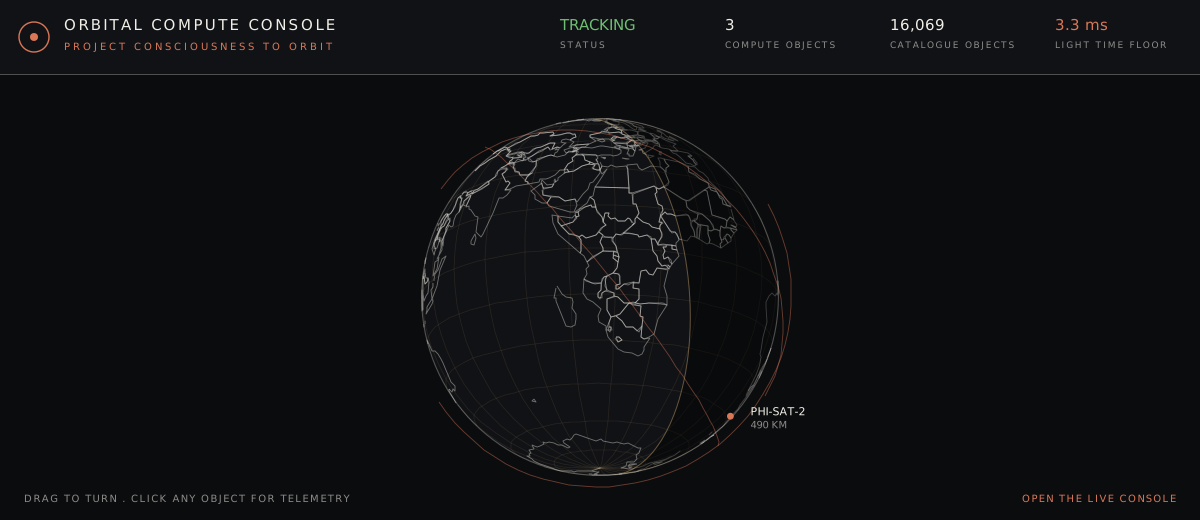
The Spaceborne Computer-2 maintenance record provides a separate commercial computing case. NASA recorded work to recover a server’s functionality, without identifying radiation as the cause. These records do not show that software recovery replaces physical shielding.
Marcus Murbach and the TechEdSat-13 Neuromorphic Experiment
On 13 January 2022, Virgin Orbit’s Above the Clouds mission launched NASA Ames Research Center’s TechEdSat-13 CubeSat into low Earth orbit at roughly 500 km altitude. The mission carried the first neuromorphic research processor to operate in space, an Intel Loihi 1 chip in a Kapoho Bay USB form factor, shielded by only 2 mm of aluminum.
The mission report authored by Marcus Murbach and his team confirmed two findings.
The 14 nm FinFET architecture of the Loihi chip operated throughout its active orbital phases without experiencing destructive Single Event Latchups. Complex event-driven silicon can therefore survive LEO radiation with minimal mass shielding.
TechEdSat-13 also executed on-chip Spike-Timing-Dependent Plasticity (STDP), using local learning rules to optimize software-defined network routing in the space environment.
The validation of STDP in orbit is of primary theoretical importance. When ionizing radiation strikes a biological brain, individual neurons suffer localized damage or transient membrane depolarization. Apollo astronauts famously reported seeing bright phosphenes, flashes of light in their dark-adapted eyes, caused by high-energy cosmic rays passing directly through their retinas. Yet their conscious visual fields did not crash. Biological neural networks maintain stability because their representations are distributed across populations of cells, and their synaptic weights continuously adapt through homeostatic plasticity.
TechEdSat-13 demonstrated that a neuromorphic architecture carrying on-chip learning rules can mirror this biological resilience in hardware. If an ionizing particle alters a synaptic weight stored in digital SRAM, ongoing event-driven plasticity rules can re-tune the surrounding circuit dynamics, allowing the network to heal from radiation damage without requiring external software reboots.
Fault Tolerance as an Emergent Property of Dynamic Attractors
The philosophical question of whether a conscious architecture can survive orbit depends on what kind of computational system consciousness turns out to be.
If consciousness requires deterministic, bit-perfect execution of a brittle algorithm, where every single memory register must maintain exact values over years of orbital exposure, then a synthetic mind in orbit is impossible without prohibitive mass shielding.
If consciousness is an emergent property of self-stabilizing dynamical attractors, as functionalist emergentism maintains, then exact bit-level perfection is unnecessary. In a spiking neural network or continuous neural field, individual spikes carry negligible information in isolation. Information is encoded in the geometry of the collective state space, the phase relationships of oscillatory populations, and the statistical trajectories of recurrent loops.
As explored in the analysis of Eugene Izhikevich’s 2D dynamical neuron models, cortical circuits utilize heterogeneous cell dynamics (bursting, adaptation, fast inhibition) to maintain stable collective attractors that resist runaway synchronization or noise-induced collapse. A radiation-induced transient current injection in a 2D Izhikevich or Leaky Integrate-and-Fire neuron behaves identically to internal biological noise.
Architectural Implications for the Neutral Core
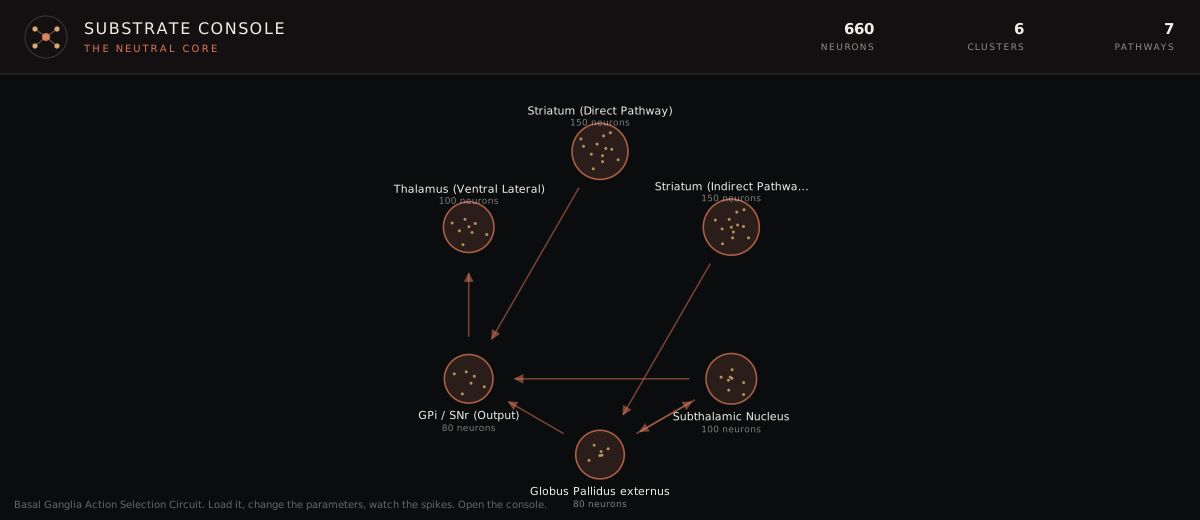
The Neutral Core architecture specifies neuromorphic hardware in LEO with optical inter-satellite links (arkspace-core). The empirical results from Murbach’s TechEdSat-13 mission confirm that the low-power neuromorphic approach is viable for spaceflight. Where the wider field currently places the burden of proof on any claim that such a system is conscious is surveyed in the current scientific consensus on AI consciousness.
By relying on sparse, asynchronous event-driven spikes rather than continuous dense matrix multiplication, neuromorphic hardware operates within milliwatt power budgets while providing natural stochastic resilience against cosmic radiation. Surviving the orbital radiation environment turns on architecture rather than on mass. What it asks for is conscious dynamics that are resilient to the noise ionizing radiation injects, which removes the need for heavy lead shielding or obsolete rad-hard silicon.
Marcus S. Murbach is an aerospace engineer at NASA Ames Research Center and Principal Investigator for the TechEdSat flight series. The TechEdSat-13 orbital neuromorphic results are documented in NASA Technical Reports Server (NTRS) document 20220005780.