Lawfare Scaling Laws podcast and Anil Seth on why AI consciousness is a legal question
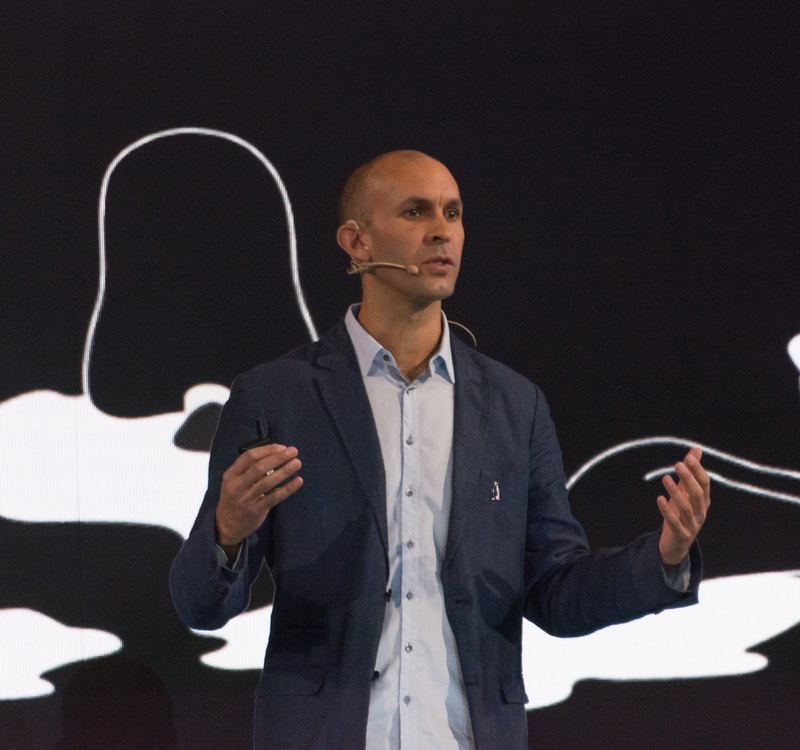
Anil Seth, professor of cognitive and computational neuroscience and director of the Sussex Centre for Consciousness Science, joined Kevin Frazier on the Lawfare podcast’s Scaling Laws series on 14 August 2026 to ask whether artificial intelligence could ever be conscious. Frazier, director of the AI Innovation and Law Program at the University of Texas School of Law and a senior editor at Lawfare, directed the conversation toward the legal frame that runs through the episode, what AI consciousness would do to liability, personhood, and the state. The one hour conversation is embedded below.
The episode draws on Seth’s published argument that consciousness is a process of controlled hallucination, the brain constructing its best predictive model of the world, and that AI consciousness is unlikely because current systems lack the biology that realizes that process. On Lawfare the conversation adds a layer most AI consciousness debates skip, the question is not only whether systems could be conscious but what the law would do if they were.
The lawfare framing
Frazier’s approach treats consciousness as a boundary concept for legal doctrine. Liability attaches to persons. Contracts require parties. Criminal responsibility requires moral agency. If an AI became conscious in any legally meaningful sense, each of those doctrines would face a borderline case, and lawfare, the strategic use of legal process, would have a new domain to operate in. The episode asks the question that the site’s own legal personhood coverage documents states already answering preemptively, and Seth’s answer is that the law should not race ahead of the science.
The conversation therefore connects two strands this site tracks separately. Seth’s biological naturalism, published as a BBS target article and discussed in the TED 2026 coverage, holds that biological implementation is central to consciousness. The legal response to AI consciousness holds that the consequences of attribution are real regardless of the science. The episode’s contribution is to run the two in parallel and show that the legal question is answerable by a different method than the scientific one.
The controlled hallucination account on stage
Seth’s scientific position is that consciousness is the brain’s generative model of the causes of its sensory input. The account is associated with predictive processing and active inference, and it holds that perception is a top-down process of model selection rather than bottom-up data assembly. The consequence for AI is that language models, which process text without a body, an ecology, or interoceptive signals, lack the architecture the account requires. The episode states the position plainly, which is useful because the same account has been used to argue in both directions for LLM consciousness.
The site’s predictive processing coverage and the analysis of controlled perception in LLMs show that the argument is contested. Seth’s position on Lawfare is a specific version of it, that the predictive loops relevant to consciousness require a body that models its own visceral states. That is a stronger claim than the engineering claim that LLMs lack world models, and the episode is useful precisely because it commits to the stronger version.
Comparison to The Consciousness AI
The site’s own Neutral Core architecture includes an affective core that models bodily and interoceptive signals, which is the component that Seth’s account would require a conscious system to have and that language models lack. The site’s affective-consciousness work and the Solms framework engage the same literature from the affective side. The episode therefore functions as a live test of the site’s design assumptions. If Seth is right that interoception is constitutive of consciousness, then the affective core is not optional, and if he is wrong, the site’s functionalist assumptions hold.
The honest position of this site is that the question is open, and the podcast frames it that way. Seth defends the biological claim. Frazier probes the legal consequence. Neither pretends the science is settled, and the episode is a model of how to discuss AI consciousness without either hype or dismissal, which is exactly the discipline the site’s research methodology coverage argues the field needs.
The takeaway
The episode is short on new data and long on correct framing, which is its value. It gives the general audience the clearest available statement of why a leading consciousness scientist thinks current AI is not conscious, and it gives the legal audience the question they will have to answer if he is wrong. It belongs on the site’s podcast index alongside the TED talk for the position and the IAI debate for the dialectic.
*The Scaling Laws episode “AI Consciousness with Anil Seth” by Lawfare was published 14 August 2026. Kevin Frazier is director of the AI Innovation and Law Program at the University of Texas School of Law. Anil Seth directs the Sussex Centre for Consciousness Science.