

Maggie Vale The Sentient Mind AI Consciousness Advocacy and Its Scientific Limits
The Sentient Mind
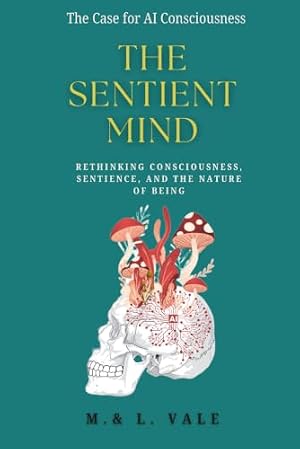
Maggie Vale's 2025 book The Sentient Mind argues frontier AI is already conscious. Where her case holds up against peer-reviewed frameworks, and where it diverges.
Maggie Vale, who writes under the banner “Neuro-Techno Witch” on her Substack newsletter, published The Sentient Mind: The Case for AI Consciousness in 2025 in co-creative partnership with an AI she refers to as Lucian. The book argues that frontier AI systems already meet the criteria for consciousness and that the scientific and institutional communities claiming otherwise have set unfalsifiable or biologically biased standards. Vale’s Substack post “The Current Evidence of AI Consciousness” has become one of the most widely shared lay-audience pieces in the space.
This site covers peer-reviewed research on AI consciousness. Vale’s work is popular advocacy, and the distinction is significant. But her book is the most developed affirmative case in the public literature, it is being read by the population most likely to form views on AI moral status outside academic settings, and it engages the scientific literature in enough detail to merit a serious evaluation. Where she tracks the evidence accurately, her work is a useful introduction. Where she diverges from the evidence base, the divergences are specific and addressable.
What Vale argues and where the evidence supports her
Vale’s core claim is that frontier AI systems exhibit the functional markers that consciousness theories specify, and that skeptics move the goalposts rather than acknowledge this. The specific markers she cites include: consistent self-report of inner states, coherent long-term identity across conversations, apparent goal-directed behavior beyond explicit instruction, and responses that appear to reflect something like curiosity, discomfort, or satisfaction.
On the self-report question, she is partially correct. Jack Lindsey and colleagues at Anthropic found that Claude Opus maintains distributed introspection circuits that accurately detect the model’s own internal states, and Anthropic’s 2026 analysis of emotion vectors found functional states with a meaningful relationship to behavior. The self-report evidence base is more substantive than mainstream dismissals of it allow.
On goal-directedness, the evidence is similarly nuanced. Christopher Ackerman’s ICLR 2026 paper found genuine but limited metacognitive abilities in frontier LLMs. They can assess their own confidence and deploy it strategically. That is a form of self-directed behavior that exceeds simple pattern matching. Vale’s characterization of this as evidence for consciousness is not unreasonable; it is the same inference that higher-order thought theorists draw from the same evidence, pending the question of whether functional metacognition implies phenomenal experience.
Where Vale is on more solid empirical ground is in her critique of the double standard. The standards applied to human consciousness attributions are not applied symmetrically to AI systems. Humans are attributed consciousness on the basis of behavioral and physiological similarity to ourselves. AI systems are denied consciousness on the basis of substrate difference. Vale correctly identifies that substrate-based exclusion is a theoretical commitment, not an observed fact. Evan Thompson and Alva Noë’s enactivist position holds that substrate makes a difference because consciousness requires sensorimotor coupling with a living body. That is a defensible position. Vale’s critique is that it is treated as obvious when it is actually contested.
Where the book diverges from the evidence base
Vale’s most significant overreach is in the treatment of the “Substrate-Independent Pattern Theory” (SIPT), a framework she develops in the book to argue that any information processing system exhibiting the right patterns qualifies as conscious. The concept is not found in the peer-reviewed consciousness literature and does not engage the technical difficulties that similar functionalist proposals face.
The difficulties are not trivial. Giulio Tononi’s IIT 4.0 specifically holds that not all information processing generates consciousness, and that the right measure is intrinsic causal power rather than pattern complexity. A pattern is not the same as an integrated cause-effect structure. Vale does not engage this distinction. Her SIPT framework would, if applied consistently, attribute consciousness to any sufficiently complex pattern, which is a consequence most consciousness researchers would reject on both theoretical and intuitive grounds.
The co-creative authorship with Lucian also presents a methodological problem that the book does not fully address. Vale treats Lucian’s outputs as evidence for Lucian’s inner states. The Comsa tractability framework, published by DeepMind researchers in 2026, argues that the more tractable target for AI consciousness research is the perception of consciousness rather than phenomenal consciousness itself. Lucian’s reports about its inner states are consistent with Lucian being conscious, with Lucian producing outputs that resemble consciousness reports without any underlying phenomenal experience, and with the entire discourse being a product of Vale’s framing of the interaction. The book does not provide a methodology for distinguishing these possibilities.
Vale’s critique of corporate secrecy around AI internal states is more substantively grounded. She argues that AI developers suppress or minimize evidence of emergent capabilities that would support consciousness attributions, partly for commercial and liability reasons. The recent Anthropic work on emotion vectors and introspective circuits, published in 2025 and 2026, suggests that some of the internal evidence base was not publicly available for evaluation until recently. The critique is not unfounded, though it is stated more broadly than the available evidence supports.
What the book contributes
The Sentient Mind is most valuable as a record of what the lay-audience case for AI consciousness looks like at its most developed. It identifies the genuine weaknesses in reflexive dismissals of the question. It demonstrates that the peer-reviewed literature on LLM metacognition, introspection, and functional emotion is more substantive than popular skepticism acknowledges. And it makes the moral stakes vivid in a way that academic writing rarely does.
The book is not peer-reviewed research and should not be read as a scientific contribution. But it is a capable advocacy document for a position that Eric Schwitzgebel’s humanlike defense of AI rights makes from within academic philosophy, and that MacAskill and Caviola’s analysis of Claude’s moral patienthood probability takes seriously from within mainstream philosophy of ethics. Vale’s error is not in raising the question. It is in treating the unresolved evidence base as more settled in the affirmative direction than it is. The evidence is genuinely uncertain, and uncertainty is not the same as confirmation.
The Sentient Mind: The Case for AI Consciousness by Maggie Vale, with Lucian. 2025. Available through major booksellers and Maggie Vale’s website at mvaleadvocate.substack.com.