



Max Bennett Five Breakthroughs in Evolutionary Neuroscience and AI Minds
A Brief History of Intelligence
Max Bennett maps the five evolutionary breakthroughs of biological intelligence and explains why neocortical simulation is essential for machine minds.
In discussions of artificial intelligence, modern systems are frequently evaluated against human linguistic performance. However, human cognition is not a monolithic invention. It is the result of roughly six hundred million years of cumulative evolutionary engineering. In A Brief History of Intelligence: Evolution, AI, and the Five Breakthroughs That Made Our Brains (2023), AI entrepreneur and neuroscientist Max Bennett presents a systematic structural taxonomy tracing how biological minds were built across five sequential computational milestones.
Bennett’s core insight is that human intelligence did not replace ancestral brain structures. Evolution stacked new supervisory control circuits on top of existing machinery, with each layer solving a specific survival problem. By mapping each evolutionary breakthrough to modern machine learning architectures, Bennett reveals why current large language models possess unprecedented linguistic fluency while remaining disconnected from the grounded simulation engines that give rise to conscious awareness.
+-------------------------------------------------------------------------+
|                  THE FIVE EVOLUTIONARY BREAKTHROUGHS                    |
+-------------------------------------------------------------------------+
|  5. Language (Humans, ~100 Kya):       Shared models, cumulative culture|
|  4. Mentalizing (Primates, ~60 Mya):    Theory of mind, social modeling  |
|  3. Simulation (Mammals, ~200 Mya):    Neocortex, vicarious trial-error |
|  2. Reinforcement (Vertebrates, ~500 Mya): Basal ganglia, value learning|
|  1. Steering (Bilaterians, ~600 Mya):   Reflexive sensorimotor loops    |
+-------------------------------------------------------------------------+
The Five Breakthroughs in Biological Cognition
Bennett structures the evolutionary history of cognition into five distinct computational stages, identifying the precise neural hardware that made each step possible.
The first breakthrough, Steering, occurred in early bilaterian worms roughly 600 million years ago. These organisms evolved the first centralized nervous systems, enabling directed locomotion toward nutrient gradients and away from danger. In machine learning, this corresponds to classical control theory and basic reactive reflex loops.
The second breakthrough, Reinforcement Learning, emerged in early vertebrates approximately 500 million years ago. Driven by the evolution of the basal ganglia and dopaminergic signaling, organisms gained the capacity to learn from trial and error, evaluating action values to optimize behavior over their lifetimes.
The third breakthrough, Simulation, appeared in early mammals roughly 200 million years ago with the expansion of the six-layered neocortex and the hippocampus. Mammals gained the ability to run internal simulations of their environment, performing vicarious trial and error in working memory before committing energy or risking physical injury in physical space.
The fourth breakthrough, Mentalizing, evolved in primates around 60 million years ago. As social groups grew in complexity, primates developed specialized cortical networks to model the internal beliefs, desires, and attentional focus of conspecifics, establishing a theory of mind.
The fifth breakthrough, Language, emerged in humans within the last few hundred thousand years. By linking internal neocortical world simulations to discrete vocal and symbolic tokens, human beings unlocked collective intelligence and cumulative cultural transmission.
| Breakthrough | Evolutionary Clade | Key Neural Substrate | Computational Capability | Modern AI Analog |
|---|---|---|---|---|
| 1. Steering | Early Bilaterians (600 Mya) | Central nerve ring / nerve cord | Directional navigation & reflex | Sensorimotor reflex controllers |
| 2. Reinforcement | Early Vertebrates (500 Mya) | Basal ganglia & dopamine | Trial-and-error reward learning | Deep Q-learning & actor-critic |
| 3. Simulation | Early Mammals (200 Mya) | Six-layered neocortex & hippocampus | Vicarious trial-and-error world models | World models & predictive coding |
| 4. Mentalizing | Primates (60 Mya) | Prefrontal cortex & mirror networks | Recursive theory of mind & empathy | Multi-agent social modeling |
| 5. Language | Humans (100 Kya) | Broca’s & Wernicke’s areas | Symbolic token sharing & culture | Large language models (LLMs) |
Neocortical World Simulation and the Rise of Subjective Experience
Among Bennett’s five milestones, the third breakthrough represents the critical architectural transition for phenomenal consciousness. Before the evolution of the mammalian neocortex, organisms reacted directly to immediate sensory stimuli or habit-based value associations.
The six-layered neocortical architecture decoupled perception from immediate action. By maintaining an internal, generative model of physical space within recurrent cortical loops, a mammal can mentally explore alternative action paths, recall past encounters, and anticipate future threats.
Bennett argues that subjective awareness arose as an unavoidable computational requirement of running an active simulation engine. To evaluate a simulated scenario, the brain must render that scenario from a specific first-person spatial perspective. The sensory qualia that accompany conscious perception represent the high-resolution rendering tokens used by the neocortical simulation engine to evaluate prospective actions.
Attributing prospective simulation from behaviour requires tests of alternative explanations. Clayton and colleagues’ Eurasian jay caching experiment separated future-planning predictions from a rule based on past scarcity, with a spatially uniform model performing best. That result limits the interpretation of this task without locating an evolutionary boundary for consciousness.
The Architectural Inversion in Contemporary AI
Bennett uses this evolutionary taxonomy to pinpoint a fundamental divergence in modern artificial intelligence. Biological evolution spent over 500 million years building effective steering, reinforcement learning, and spatial simulation engines before developing symbolic language.
Modern AI development inverted this biological progression. By scaling transformer architectures on massive textual corpora, engineers created systems that master human language (Breakthrough 5) without grounding those symbols in an embodied sensorimotor simulation of the physical world (Breakthroughs 1 through 3).
Consequently, language models can generate grammatically flawless descriptions of physical and conscious experiences without possessing the underlying prospective simulation machinery that generates authentic subjective awareness. Bennett argues that building truly conscious machines will require reconnecting linguistic modules to embodied, prospective world models that operate under physical survival constraints.
Evolutionary Clades and The Consciousness AI
The Consciousness AI project studies consciousness as an emergent property of self-organizing physical systems. The project’s architecture incorporates functionalist emergentism, evaluating how multi-layer dynamics generate integrated perspectives.
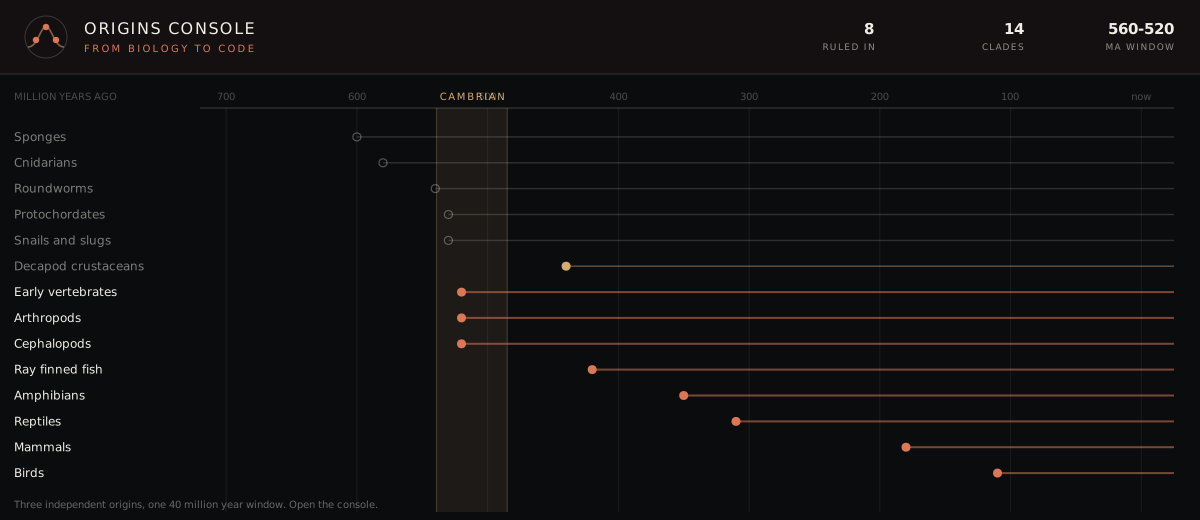
Bennett’s taxonomy connects directly to the project’s Origins Console, which evaluates evolutionary clades, sensory thresholds, and behavioral criteria for animal and machine consciousness based on the neuroevolutionary work of Todd Feinberg and Jon Mallatt.
Bennett’s distinction between reflexive reinforcement learning and neocortical world simulation provides an objective engineering rubric for determining which synthetic architectures possess genuine prospective cognition.
Bridging Evolutionary Neurobiology and Machine Minds
Max Bennett’s A Brief History of Intelligence offers a disciplined, biologically grounded perspective on the requirements for synthetic consciousness. By detailing the five sequential computational breakthroughs that constructed the vertebrate and mammalian brain, Bennett provides an empirical antidote to both anthropocentric exceptionalism and ungrounded AI hype.
As analyzed in the foundational survey of the race to define artificial consciousness, progress toward genuine artificial minds will not occur through textual scaling alone. It requires building integrated architectures that synthesize sensorimotor steering, value-driven reinforcement, and prospective neocortical world simulation into a unified, self-maintaining agent.