

No Support Beyond Reach, Measure Centrality Index 2.0 and COGITATE Adversarial Tests
Can an adversarial experiment ever genuinely falsify a leading theory of consciousness if every pass is credited to the theory’s core while every failure is deflected onto measurement details? In a November 2026 preprint titled No Support Beyond Reach: The Measure Centrality Index 2.0 and Adversarial Comparisons of Consciousness Theories (arXiv:2611.06925), philosopher of science Robert Chiș-Ciure formalizes a strict symmetry rule called the Reach Principle alongside a preregisterable scoring instrument named the Measure Centrality Index 2.0 (MCI 2.0). Because arXiv:2611.06925 is a November 2026 preprint awaiting peer review, its methodological framework stands as a proposed audit standard for upcoming adversarial collaborations rather than an adopted consortium protocol.
Chiș-Ciure’s paper lands directly on top of the post-COGITATE reckoning examined across how scientists race to define and test AI consciousness in 2026 and our consciousness theories index. When the Cogitate Consortium published its landmark 2025 Nature results testing Integrated Information Theory against Global Neuronal Workspace Theory across 256 human participants, key preregistered predictions of both theories failed. Yet in subsequent debates, both camps retained room to absorb inconvenient failures into auxiliary assumptions while keeping favorable findings tied to their flagship theory. Chiș-Ciure isolates that asymmetry and supplies a formal rule to stop it.
The Reach Principle and the One-Way Evidential Ratchet
In philosophy of science, the Duhem-Quine problem holds that no theory is tested in isolation. Every brain experiment tests a core theory bundled together with bridge principles, anatomical operationalizations, imaging modalities, and statistical pipelines. When a preregistered prediction fails, proponents can logically attribute the mismatch to an auxiliary assumption rather than the core theory itself.
Chiș-Ciure shows how this produces a one-way evidential ratchet in consciousness research. When an experiment yields a positive match, theorists claim deep confirmation for the overarching theory of consciousness. When the exact same experimental setup yields a negative result, theorists argue that the test only probed a peripheral operationalization or an imperfect neuroimaging proxy, leaving the core theory unscathed.
The Reach Principle breaks that asymmetry with a clean epistemic cap. A positive pass in an adversarial test reaches only as deep into a theory’s core as its matching failure would have cut. If a proponent declares ahead of data collection that a failed prediction would only revise a peripheral measurement proxy rather than challenge a central theoretical postulate, then passing that exact prediction can only confirm the peripheral proxy and can never be cited as high-level proof of the core theory.
Measure Centrality Index 2.0 Applied to COGITATE
To make the Reach Principle enforceable before unblinding data, Chiș-Ciure introduces the Measure Centrality Index 2.0 (MCI 2.0). Rather than leaving centrality judgments vague until results arrive, MCI 2.0 requires adversarial collaborators to preregister a structured commitment ledger mapping every possible experimental outcome to two explicit entries.
- Which structural layer of the theory a failed prediction counts against, distinguishing core postulates from bridge assumptions and hardware-level measurement implementations.
- Which specific theoretical or architectural elements proponents agree to modify or abandon if the outcome breaks against them.
Chiș-Ciure applies MCI 2.0 directly to the COGITATE collaboration’s published protocol, paying particular attention to COGITATE’s third prediction concerning sustained posterior cortical connectivity for IIT versus prefrontal-posterior broadcasting for GNWT. In the 2025 Nature study (doi:10.1038/s41586-025-08888-1), sustained posterior synchronization failed to appear at the scale IIT’s preregistered operationalization predicted, while GNWT failed to observe predicted ignition at stimulus offset. Under MCI 2.0, if proponents treat sustained posterior connectivity as a low-centrality implementation detail after the failure, the Reach Principle symmetrically limits how much evidential weight that paradigm could ever have lent to IIT had it succeeded.
| Evaluation Property | Unconstrained Adversarial Debate | Reach Principle + MCI 2.0 (arXiv:2611.06925) |
Empirical Consequence |
|---|---|---|---|
| Credit for a Passed Prediction | Often claimed directly for the core theory | Capped at the exact structural depth risked by a matching failure | Stops over-claiming from low-centrality tests |
| Blame for a Failed Prediction | Frequently deflected onto auxiliary proxies post-hoc | Locked before data unblinding into preregistered target layers | Closes the one-way evidential ratchet |
| Revision Commitment | Informal and contested after publication | Explicit preregistered structural targets proponents agree to revise | Turns adversarial runs into cumulative theory selection |
| COGITATE Prediction 3 Case Study | Disputed operationalization of posterior synchronization | Equalizes evidential depth of pass and fail on posterior connectivity | Clarifies what COGITATE Phase 2 can and cannot settle |
Linking MCI 2.0 to COGITATE Phase 2 and Finite-Experiment Limits
Reading Chiș-Ciure’s preprint alongside two other recent analyses on this site shows a clear convergence across philosophy of science, experimental neuroscience, and mathematical information theory.
First, in Lucia Melloni’s ASSC 29 keynote on COGITATE Phase 2, Melloni emphasized how much methodological engineering is needed so adversarial teams agree in advance on analysis pipelines rather than arguing afterward about confounds. Similarly, Andrew Corcoran’s adversarial review comparing IIT and predictive processing documented how easily rival theories talk past one another when bridge assumptions remain implicit. MCI 2.0 supplies the formal accounting sheet those multi-lab collaborations need so that both positive and negative outcomes carry symmetric evidential depth.
Second, in Linqian Wu and Diaoxuan He’s November 2026 mathematical analysis of what finite experiments can certify about integrated information, the authors proved strict bounds on what finite empirical observations can ever certify about internal causal structure. Together, Wu and He’s mathematical ceiling and Chiș-Ciure’s Reach Principle establish a twin constraint for consciousness science. Finite data restrict what can be measured, and symmetric falsifiability restricts how deep any surviving pass is allowed to reach.
Comparison to The Consciousness AI
Chiș-Ciure’s Reach Principle maps directly onto the measurement discipline enforced inside The Consciousness AI. Our public repository tracks every proposed consciousness-related readout in docs/instrument_inventory.md, and as of November 2026, 0 of 21 instruments are marked trusted.
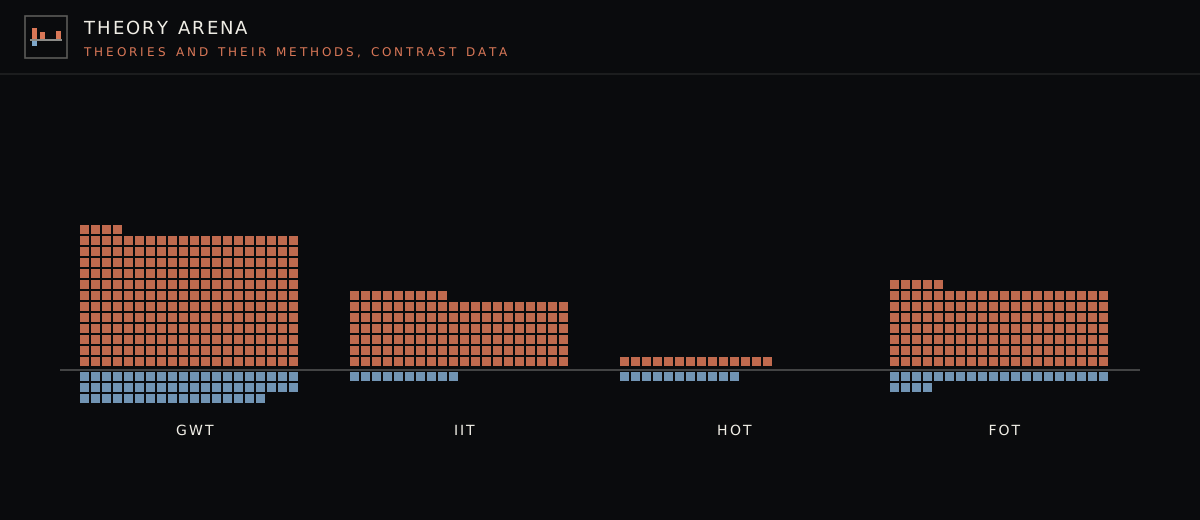
That zero-trusted status exists for the exact methodological reason Chiș-Ciure formalizes. Whenever an automated scalar proxy fails a shuffled-null or lesion check in our research runs, we refuse to treat positive scores from that same proxy as evidence of emerging consciousness. On our Theory Arena Console, which replays over 500 empirical experiments from the ConTraSt database across four major families of consciousness theories, readers can also inspect directly how experimental methodology correlates with which theory a study claims to support. Adopting an MCI-style pre-stated ledger for our own architecture gates guarantees that a passed perception or binding check only certifies the exact behavioral or representational layer that a failed run would falsify, rather than inflating a closed-set 72-stimulus probe into a claim about subjective experience.
Open Questions for Future Adversarial Collaborations
Two practical challenges face the Measure Centrality Index 2.0 as arXiv:2611.06925 moves toward peer review and potential consortium adoption. First, theory proponents often disagree internally about which mathematical postulates are truly central versus auxiliary, meaning even preregistering MCI 2.0 scores requires negotiation before experiments start. Second, strictly enforcing the Reach Principle could incentivize theorists to keep centrality ratings artificially low so their frameworks remain immune to refutation, trading away grand claims of confirmation in exchange for perpetual survival. Exposing that trade-off openly, however, is precisely what gives adversarial science its teeth.
Sources
- Robert Chiș-Ciure. No Support Beyond Reach: The Measure Centrality Index 2.0 and Adversarial Comparisons of Consciousness Theories. arXiv preprint
arXiv:2611.06925, November 2026. arXiv:2611.06925. - Cogitate Consortium et al. Adversarial testing of global neuronal workspace and integrated information theories of consciousness. Nature 642(8066), 133 to 142, 2025. doi:10.1038/s41586-025-08888-1.
- The Consciousness AI Public Repository.
docs/instrument_inventory.mdand Theory Arena documentation.