


Normal Computing CN101 and Thermodynamic Linear Algebra, Inverting a Matrix with Noise
Normal Computing’s CN101 is a thermodynamic computing chip built to solve linear algebra by letting noisy physical circuits settle into equilibrium. The company taped it out in June 2025, announced it on 12 August 2025, and ran the first test of the chip that same August, according to the UK’s Advanced Research and Invention Agency, which funds the work. CN101 targets linear systems and matrix inversion, plus a sampling method the company calls Lattice Random Walk.
In short, thermodynamic linear algebra reads the solution of a linear system, and the inverse of its matrix, from the statistics of a physical system at thermal equilibrium. The method is published and has worked on a circuit board. No benchmark of CN101 itself is public yet, and the company’s figure of up to 1000 times better energy efficiency remains its own claim.
How noise inverts a matrix
The method comes from Thermodynamic linear algebra by Maxwell Aifer, Kaelan Donatella, Max Hunter Gordon, Samuel Duffield, Thomas Ahle, Daniel Simpson, Gavin Crooks and Patrick Coles, first posted in August 2023 and published in npj Unconventional Computing in November 2024. Take a set of coupled harmonic oscillators and set their couplings to the entries of a symmetric positive definite matrix A. Give the system a constant push b and let it exchange heat with its surroundings. At equilibrium its state fluctuates around a mean, and that mean is the solution x of A x = b. The covariance of the fluctuations is proportional to the inverse of A.
The noise does the work. Without it the system would relax to the mean and stop, so it would give the solution but not the inverse. With it, a single long trajectory explores the whole equilibrium distribution, a property called ergodicity, so one run gives as many samples as the readout can take. The paper proves algorithms for linear systems, matrix inverses, determinants and Lyapunov equations, and an asymptotic speedup over digital methods that grows linearly with the matrix dimension. Normal’s blog states the scaling more simply. Digital inversion takes time of roughly the cube of the dimension, and the thermodynamic method is expected to take roughly the square.
From an eight oscillator board to CN101
The first experiment ran on a printed circuit board. Denis Melanson, Mohammad Abu Khater, Coles and co-authors described it in arXiv:2312.04836 in December 2023 as a stochastic processing unit of eight RLC circuits, all coupled to each other through switched capacitors. It sampled Gaussian distributions and inverted an 8 × 8 matrix, which the authors call the first thermodynamic linear algebra experiment.
| Step | Date | Size | What it does, as the company states it |
|---|---|---|---|
| Stochastic processing unit | Paper December 2023 | 8 coupled oscillators on a board | Gaussian sampling, 8 × 8 matrix inversion |
| CN101, Carnot architecture | Tape-out June 2025, first test August 2025 | d = 256 | Stochastic differential equations for linear systems and matrix inversion, Lattice Random Walk sampling |
| CN201 | Planned 2026 | d = 1000 and above | Conditional image generation on ImageNet |
| Video diffusion milestone | Planned | Not stated | Video generation on UCF-101 |
The dates for the last row have moved. The August 2025 announcement placed a chip called CN301, for advanced video diffusion, in late 2027 or early 2028. Normal’s ASIC page, read on 30 October 2026, lists the video milestone for 2029 and does not name CN301. It still lists CN201 for 2026, and no CN201 tape-out has been announced.
What is claimed and what is shown
Normal states that the Carnot architecture can reach “up to 1000× energy consumption efficiency on targeted AI and scientific workloads.” The announcement gives no measurement behind the figure, and it describes the next phase as characterization and benchmarking. No CN101 benchmark has been published since.
The funder is careful in the same way. ARIA’s March 2026 update on the Thermodynamic Matrix Inversion project, part of its Scaling Compute programme, reports that the first chip produced data in August 2025. It then states that “it remains unclear how far this approach can scale,” and it names the open questions as whether useful signals survive as the system grows and where noise stops helping and starts to degrade the result.
The same equation in this project’s code
The project’s research code has the noise-free half of this method. models/thermodynamic/energy_minimization.py implements the free energy of a linear Gaussian generative model under the Laplace approximation, the model behind Karl Friston’s predictive coding. Its curvature is a fixed matrix, H = WᵀΠₒW + Πₛ, built from the generative weights and the two precision matrices. The solver follows the gradient of the free energy downhill, and the minimum it reaches is the exact posterior mean, the solution of a linear system in H. That is thermodynamic linear algebra with the temperature set to zero.
Adding noise changes what the same dynamics compute. For this model the free energy is, up to a constant, the negative log of the posterior. So a noisy relaxation at unit temperature samples the posterior itself, and the covariance of those samples is H⁻¹, the uncertainty of the belief. A thermodynamic chip running the project’s model would return both the best guess and how confident it should be, from one physical run. The project’s code does not do this. It runs the deterministic relaxation in software and checks it against the closed form. The derivation above is this site’s, and no test of it on hardware exists.
What this means for the consciousness question
In Friston’s framework, precision, the inverse of uncertainty, is the quantity that attention sets. Several predictive processing accounts link it to what reaches awareness, as set out in Karl Friston’s active inference and the free energy principle. On a digital machine the uncertainty of a belief is computed by extra arithmetic. On a thermodynamic chip it would be the measured size of the physical fluctuations. The system’s noise and its uncertainty would be the same quantity.
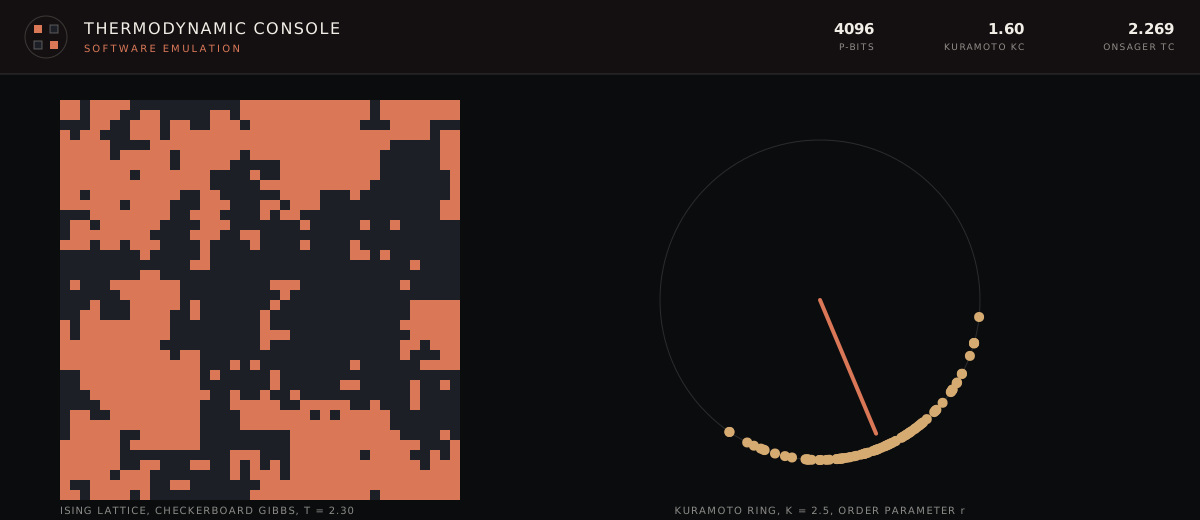
That makes the chip a concrete case for the substrate question this site studies. Under functionalist emergentism the two machines compute the same posterior, so any property that depends on the computation is shared. Anil Seth argues for biological naturalism, the view that consciousness depends on properties of living systems, and on that view a chip that computes uncertainty with heat is still not alive, as set out in Anil Seth’s biological naturalism and the mythology of conscious AI. CN101 does not decide between the two views. It does turn one part of the predictive processing story into a physical process. The Thermodynamic Computing hub sets out the free energy principle beside the p-bit and oscillator systems, and its console compares noisy sampling with noise-free descent on the same lattice.
Relaxation on a desk
THE ANALOG THING, an open hardware analog computer, solves small linear differential equations as continuous voltages that settle to their answer. It shows the noise-free relaxation at the heart of this method, on a desk, for a few variables. It has no thermal noise source of its own, so it cannot read out an inverse from fluctuations. The thermodynamic computing hardware guide lists it with its limits, along with true random number generators that draw on physical noise. This project has no driver for any of them.
What is known and what is not
Known on 30 October 2026. Thermodynamic linear algebra is published and peer reviewed. An eight oscillator board inverted an 8 × 8 matrix in 2023. Normal Computing taped out CN101 in June 2025 for 256-dimensional linear algebra and sampling, and the chip produced data in its first test in August 2025. The project’s own free energy solver computes the noise-free version of the same problem in software.
Not known. Any measured speed or energy figure for CN101. Whether the method keeps its accuracy as the matrix grows, which ARIA names as the open question. When CN201 and the video milestone arrive. Whether a physical system that computes uncertainty with its own noise shares any property relevant to consciousness with a brain that does the same, which is the question the hardware would let someone test. The wider effort to agree on criteria for consciousness in any system is reviewed in the race to define AI consciousness.