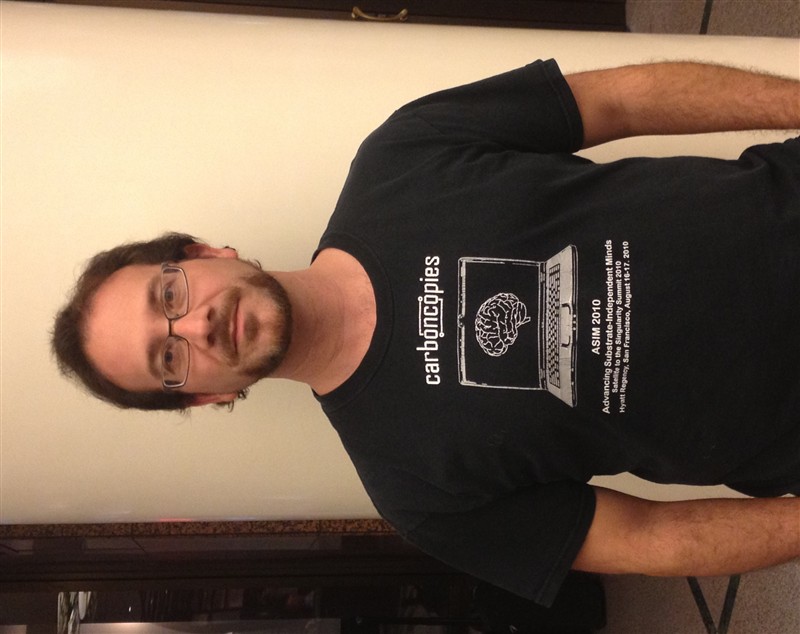
Randal Koene and the engineering programme behind substrate independent minds
Randal Koene is the researcher who turned whole brain emulation into an engineering programme. A Dutch neuroscientist and neuroengineer with a doctorate in computational neuroscience from McGill and a master’s in information theory from Delft, Koene co-founded the Carboncopies foundation, an organization devoted to substrate-independent minds, and he contributed to the Oxford working group that produced the 2007 whole brain emulation roadmap. His name is the one most directly attached to the claim that a mind is a function that can survive a change of substrate.
For the standalone triplet of the site, Koene’s importance is that he states the substrate-independence thesis as a design goal rather than a philosophical position. Where the functionalist emergentism page argues the position, Koene treats it as a specification, what a mind is, what a substrate is, what has to be copied, and what evidence would show the copy succeeded.
The Carboncopies Programme
Carboncopies is a nonprofit foundation whose stated goal is substrate-independent minds, usually abbreviated SIM. Its position is that the mind is a set of functions implemented by neural tissue, and that those functions can in principle be reimplemented on another substrate, provided the relevant functional and structural information is captured and instantiated. That is not a claim about the supernatural or about a soul. It is a claim about the level of description at which a mind lives.
The foundation’s research agenda is organized around the empirical gaps that would have to be closed. It tracks the mind transfer problem in pieces, the scanning and reconstruction of neural structure, the functional models that explain how that structure produces behavior, the interfaces that could read and write neural information, and the validation criteria that would show a transferred mind is the same mind. Koene’s own work includes NETMORPH, a computational framework for simulating the morphological development of neural circuitry, which he used as the basis for a proposed Virtual Brain Laboratory.
The whole brain emulation roadmap on this site is the direct antecedent. The 2007 Oxford roadmap, which Koene helped shape, ranked levels of emulation detail from a coarse statistical brain to a full biophysical simulation, and Carboncopies exists to push the engineering along that ranking.
The Consciousness Connection
The question this post asks first is how Koene’s programme bears on consciousness, and the answer is that it makes the field’s deepest assumption explicit. If consciousness can move across substrates, then consciousness is not the neurons, not the silicon, and not any particular physical carrier. It is the organization that the carrier implements, and Koene’s engineering is the attempt to specify that organization precisely enough to move it.
That is exactly the substrate-independence claim this site works from, and Koene is its industrial wing. Where the site’s architecture documents its own attempt, an open source implementation of the substrate-independent thesis, Koene’s foundation surveys the whole field of what that thesis requires, across every current approach to emulation, interfaces, and validation.
The honest limitation is that the engineering programme cannot itself establish the thesis. A substrate-independent mind assumes a functionalist theory of mind, and the biological naturalist objection and enactivist objection deny that assumption at the root. Koene’s programme proves what the assumption would require if true, and it does not prove the assumption true. The value of naming him is that it makes the choice explicit, either consciousness survives substrate change and Carboncopies is solving a well-posed engineering problem, or it does not and the programme is building a sophisticated copy machine.
The Moravec and Watanabe Connection
Koene’s programme sits inside the thought-experiment literature the site already covers. The Moravec transfer imagines gradual neuron-by-neuron replacement and assumes the person survives because the process is continuous. Watanabe’s split-brain test turns that assumption into a concrete experiment involving a connected biological and synthetic hemisphere. Koene is the version that asks what data and hardware the whole thing would actually need, at every step, rather than accepting the continuity argument at face value.
The contrast makes the boundary visible. Moravec argues the intuition. Watanabe designs the test. Koene tries to build the ladder, the scanning, the models, the interfaces, and the validation. A reader who wants to know what “substrate independent” would mean operationally, rather than rhetorically, will find it in Koene’s agenda.
What the Programme Does and Does Not Establish
What Koene’s programme establishes is that the substrate-independence claim is not vacuous. It has a concrete research agenda with identifiable open problems, scanning resolution, model fidelity, interface bandwidth, validation criteria, and none of the problems is at the level of “it is mysterious.” A position backed by an engineering roadmap is harder to dismiss than one backed by an intuition, which is the real contribution.
What it does not establish is whether experience itself would survive the move. The programme can, in principle, show that a transferred system behaves like the original, reports the same memories, and passes the same tests. It cannot show that the transfer preserved the first-person character of the states, because no external verification can reach that. Koene’s framework is honest about this, it treats the phenomenal question as the hard residue that engineering alone does not dissolve, and the site’s scientific consensus coverage records that the field has not moved past that residue.
The SOMA coin toss analysis uses official companion fiction to separate emulation success from the welfare of a source left in place. This is an ethical question about what a copying procedure promises, rather than experimental evidence about whether emulation works.
Where This Sits
Koene and Carboncopies belong on the brain emulation section as the named researcher most committed to the section’s central premise. The roadmap post establishes what the levels are, the Moravec and Watanabe posts establish what the thought experiments assume and test, and Koene establishes that there is a person here actually trying to build the thing. The combination turns the section from a set of position pieces into a record of an active engineering frontier with a named lead.
The lasting lesson is that substrate independence is a research programme with a founder, not an abstract possibility. Koene’s work makes the site’s thesis concrete and checkable, and it demonstrates the discipline the thesis needs, specify the function, capture the structure, build the interface, and refuse to claim more than the validation supports.
Randal Koene is co-founder of the Carboncopies foundation, devoted to substrate-independent minds, and contributed to the Oxford 2007 whole brain emulation roadmap working group. He holds a doctorate in computational neuroscience from McGill University and a master’s in information theory from Delft University of Technology. Sources: carboncopies.org and the academic record.