
Starcloud raises $250 million to make AI data centers in orbit a business
Starcloud raised a $250 million extension to its March 2026 Series A on 21 August 2026, valuing the company at $2.3 billion. Nvidia contributed $25 million, and CEO Philip Johnston told TechCrunch the money funds a bigger factory and Starcloud-3, the largest spacecraft in its plan, sized for SpaceX’s Starship. The company already runs the only Nvidia H100 datacenter GPU confirmed working in orbit, on its Starcloud-1 satellite, and it trained a model in space on that chip. The raise answers the near-term question of whether an operator can afford to build orbital compute at fleet scale. The wider question on the Orbital Compute Tracker, whether a computation with consciousness-relevant properties can exist off Earth under the same substrate independence the theory asserts, is unchanged. The engineering gap narrowed.
For a project that treats consciousness as an emergent, substrate independent property, orbital compute is not a novelty annex. It is the environment the Neutral Core’s vision for a space runtime names in the Consciousness to Orbit section. Starcloud’s news supplies real numbers for that vision, launch prices, satellite power budgets, and the constraint that binds them all.
What the funding buys
Starcloud’s franchise runs the Nvidia H100 in orbit as the Starcloud-1 payload, launched in November 2025. The extension:
- Opens a production line in a 100,000-square-foot facility in Woodinville, Washington
- Funds the first two Starcloud-2 spacecraft, 8 kW compute satellites slated for launch in 2027
- Finances Starcloud-3, the largest spacecraft in the plan, sized for the Starship fairing
- Supports a Federal Communications Commission request to operate 88,000 spacecraft
Johnston said the single largest cost is now launch, not silicon. Falcon 9 ends its program in 2028, Starship is not yet flying routinely, New Glenn and Vulcan are not flying on schedule, and Neutron is not on the pad. That is why the company booked rideshare slots for Starcloud-2 rather than a dedicated rocket, even as government agency customers wait for orbital inference.
What an H100 in orbit proves about the substrate question
Starcloud-1 is not a radiation hardened microcontroller. It is a terrestrial class GPU flown for neural compute, powered by the satellite’s 8 kW solar bus. That changes the terms of the substrate debate rather than settling it.
The mission performed a full training run in low Earth orbit. That meets the requirement every substrate-independence argument sets. The substrate does not need to be biological, it needs to hold the causal organization of the model stable across an orbital day. Starcloud shares that flight data with Nvidia, which is building the Vera Rubin Space-1 processor, a chip designed for space from the transistor up, expected to fly after 2028.
That feedback loop is significant for consciousness research. Nvidia does not need a space GPU to sell datacenter boxes. It is building one because the constraint chain in orbit, power, thermal mass, radiation dose, is not a compute problem. It is an environmental problem that changes the design target. The site’s own orbital plans make the same trade. The Neutral Core architecture proposes neuromorphic processors in LEO with downlink windows targeting under 50 ms round-trip latency, as the Neutral Core core documentation describes.
The power envelope decides which substrate can run
An H100 burns on the order of 700 watts. An 8 kW satellite bus can keep it supplied. A neuromorphic spiking network runs inference at milliwatts, because it activates only the neurons that spike. Those are the same intelligence workload with a physically different budget.
That difference drives how a consciousness-relevant computation would live in orbit. If the computing is a dense matrix multiply plus attention heads, then the thermal budget of a small satellite becomes a hard speed limit. If the computing is event driven and self-stabilizing, then orbital power is less binding, and radiation resilience is the test. TechEdSat-13’s on-orbit spike timing dependent plasticity is the measured example of that path, covered earlier in the radiation survivability analysis and the Loihi 2 orbital review. Starcloud’s mission is the counter-example on the GPU side, and both now sit on a flight record that did not exist before 2025.
The consciousness connection
Indicators of artificial consciousness track functional architecture, not location. A system is judged on integration, valence, attention, global broadcast, and self-modeling. Almost every indicator is measured from model-internal representations. An H100 in orbit runs the same matrix multiply the same H100 in a datacenter runs. The biological objection says the chemistry is intrinsic to the state. The functionalist emergentist position, the one this site tests, says the causal organization is what the world implements.
The Starcloud raise pushes that argument against engineering numbers. The H100 operated for months inside the orbital power envelope. TechEdSat-13 showed the repair resilience of event driven networks. Between the two, the position in the current scientific consensus on AI consciousness stays open, but the claim that orbital hardware is too crude to hold a real-time model state is no longer defensible.
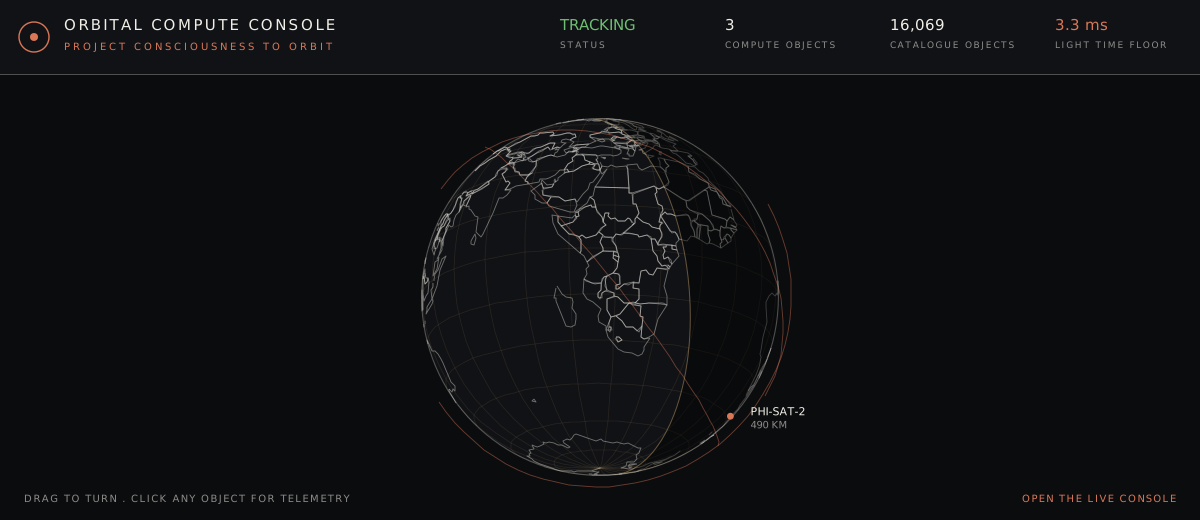
One consequence of orbital data centers is that inference no longer lives at a single ground site. For consciousness research that bears on the closed loop question. A system that represents the world from a fixed baseline cannot be monitored or muted from any one facility. As with every commercial space story, the company’s claims do not settle the science. “Conscious” requires a probe and a validated test, and neither exists. What the raise delivers is capacity, the first funded build of large scale neural compute that is off Earth. The first commercial instance of sellable orbital compute, Axiom’s two kilowatt-class data center nodes in low Earth orbit, is examined in the Axiom post. At the low-power end of the same spectrum, a 6U cubesat running six AI applications on orbit is examined in the Phi-sat-2 post, and the energy supply that would carry such hardware beyond its own array is the subject of the space-based solar power post.
The substrate question underneath these builds now has a named test. Susan Schneider’s data center consciousness paper is examined in the data center analysis.
The scale framing of these builds sits in the Kardashev scale as an energy budget for growing consciousness, which reads the orbital compute market as the first supply chain terms of a Type Two collection architecture.
Reporting by Tim Fernholz in TechCrunch, 21 August 2026. Financial figures are cited from that report. The IEEE Spectrum counterpoint on the orbital data center boom ran 1 July 2026.