

Hans Moravec and what gradual neural replacement assumes about consciousness
In Chapter 4 of his 1988 book Mind Children: The Future of Robot and Human Intelligence (Harvard University Press, ISBN 0-674-57616-0), Carnegie Mellon roboticist Hans Moravec proposed a thought experiment designed to dissolve the paradoxes of mind uploading. Rather than destructively scanning a brain and creating an electronic copy, an operation that invites the objection that the copy is merely an impostor while the original person dies, Moravec imagined an awake surgical procedure. A robot surgeon inspects a single biological neuron, constructs an electronic simulation matching its input-output behavior, places the simulation beside the neuron, and switches the incoming and outgoing synapses over to the electronic substitute. The biological cell is discarded. The procedure repeats for the next neuron, and the next, until every biological cell in the skull has been replaced by an equivalent synthetic circuit.
Because the subject remains awake throughout, answering questions and experiencing continuous perception, Moravec argued that subjective consciousness never lapses. When the last biological neuron is replaced, the skull contains only electronic hardware, yet the continuous stream of experience has ostensibly survived unbroken.
This scenario, known as the Moravec transfer, has served for four decades as the intuitive anchor for computational theories of mind transfer. Examining the thought experiment closely reveals that it rests on three specific philosophical and biophysical assumptions. If any of those assumptions fails, the intuitive force of the scenario collapses.
| Premise | Moravec’s assumption | The competing view |
|---|---|---|
| Functional abstraction | A neuron’s contribution to consciousness is entirely captured by its input-output signaling | Substrate-dependent features (biochemical, continuous field, dendritic analog dynamics) are constitutive of experience |
| Organizational invariance | Preserving functional organization preserves phenomenal experience across arbitrary hardware | Functional organization can be preserved while phenomenal experience fades or disappears entirely |
| Personal identity | Continuous physical and functional transition guarantees preservation of the same subject | Incremental replacement may produce a succession of changing subjects or an unwitting philosophical zombie |
Assumption 1. Input-output equivalence at the single-neuron boundary
The first premise of the Moravec transfer is that a neuron is an input-output transducer whose relevant activity can be fully characterized and replicated by an electronic equivalent. Under computational functionalism, the abstract causal pattern is decisive for the mind, and the physical material implementing it is incidental. If an electronic chip receives the same spike timings from upstream synapses and emits the same spike timings to downstream synapses, the surrounding network cannot tell the difference.
The objection to this premise comes from modern biophysics and the neurobiophysical substrate arguments articulated by Ned Block in his meat machines analysis and Gualtiero Piccinini in his work on neurobiophysical mechanisms and computational functionalism. Biological neurons are not discrete point-process logic gates. A single cortical pyramidal neuron performs complex nonlinear analog integration across thousands of dendritic spines, modulated by local neurotransmitter diffusion, retrograde endocannabinoid signaling, astrocytic calcium waves, and ephaptic electric field interactions.
To make an electronic replacement truly indistinguishable to its neighbors, the simulation must replicate the full multi-scale physical dynamics of the biological tissue, and digital spike events are only one layer of that. If consciousness depends on physical properties that exist below the level of discrete spike I/O, or if ephaptic field coupling across extracellular space contributes to phenomenal binding, an electronic replacement that replicates only synaptic spike timings will alter the system’s physical causal structure even while preserving outward task performance.
Assumption 2. Chalmers on organizational invariance and fading qualia
The second premise is that preserving fine-grained functional organization guarantees the preservation of phenomenal experience. David Chalmers formalized this in The Conscious Mind (Oxford University Press, 1996, ISBN 9780195117899) as the Principle of Organizational Invariance: two systems with the same fine-grained functional organization have the same conscious experience. The argument structure of the three supporting thought experiments is analyzed in the organizational invariance post.
Chalmers defended this principle using a gradual replacement scenario directly modeled on Moravec’s. He argued against the possibility of “fading qualia.” If a biological brain were conscious, but an isomorphic silicon brain were completely non-conscious (a philosophical zombie), then during a step-by-step gradual replacement, the subject’s conscious experience would have to fade gradually to zero. But because functional organization is preserved at every step, the subject’s behavioral outputs and internal cognitive reports would remain completely normal. At the halfway point, the subject would continue talking cheerfully about the vivid red of a tomato while their subjective redness had faded to a dim gray, completely unaware that their conscious experience was disappearing.
Chalmers argued that such a disconnect between subjective experience and cognitive self-report is implausible. Therefore, he concluded, qualia cannot fade: either the fully replaced system is conscious, or gradual replacement is physically impossible.
Critics of Chalmers’ argument, including biological naturalists, point out that the reductio cuts both ways. As explored in the analysis of the zombie gap in biological computationalism, if phenomenal consciousness requires specific biochemical substrates that silicon lacks, then a system whose silicon components produce correct behavioral reports without producing phenomenal experience is precisely what a functional zombie is. The fact that the system would report vivid qualia while possessing none is precisely the definition of a zombie system whose self-monitoring mechanisms have been decoupled from the phenomenal ground that originally generated those reports.
Assumption 3. Continuity of subjectivity against the Parfitian split
The third premise concerns personal identity. Moravec assumed that because the replacement is gradual and the subject never loses consciousness on the operating table, the resulting digital mind is the same person who lay down on the table, rather than a successor entity.
Derek Parfit’s exploration of personal identity in Reasons and Persons (Oxford University Press, 1984, ISBN 9780198249085), examined in the context of fictional identity transfer paradigms, showed that psychological continuity does not guarantee numerical identity. If a biological hemisphere is gradually interfaced with a synthetic hemisphere, as in the contemporary experimental program proposed by Masataka Watanabe, the question of whether the subject’s stream of consciousness is preserved or split depends on how the two halves integrate.
Watanabe’s modern work, detailed in Masataka Watanabe and the split-brain test for machine consciousness, updates the Moravec transfer into an empirical proposal using a brain-machine interface modeled on the corpus callosum. Watanabe recognizes that purely theoretical continuity arguments are insufficient. Only by connecting a synthetic network to a living biological hemisphere and evaluating whether the subject experiences a unified, non-split perceptual field can one gather empirical evidence regarding whether the synthetic component has genuinely joined the conscious stream. The massive hardware and bandwidth gap between contemporary cortical interfaces and that corpus callosum requirement is explored in Paradromics Neuralink and what a real cortical interface would need.
The SOMA coin toss analysis examines a different case, where copying leaves the source present. It separates preserving a counterpart from promises about the source’s own survival.
What the Moravec Transfer Teaches About Substrate Independence
The enduring value of the Moravec transfer is that it forces theorists to specify exactly where their theories draw the line between implementation details and essential mechanisms.
If functionalism is correct, the Moravec transfer is valid in principle, because reproducing the network’s causal computational topology reproduces the mind. If biological naturalism is correct, the Moravec transfer describes a sophisticated method of euthanasia, in which a conscious subject is incrementally replaced by a non-conscious behavioral automaton that speaks with the subject’s voice and remembers the subject’s childhood.
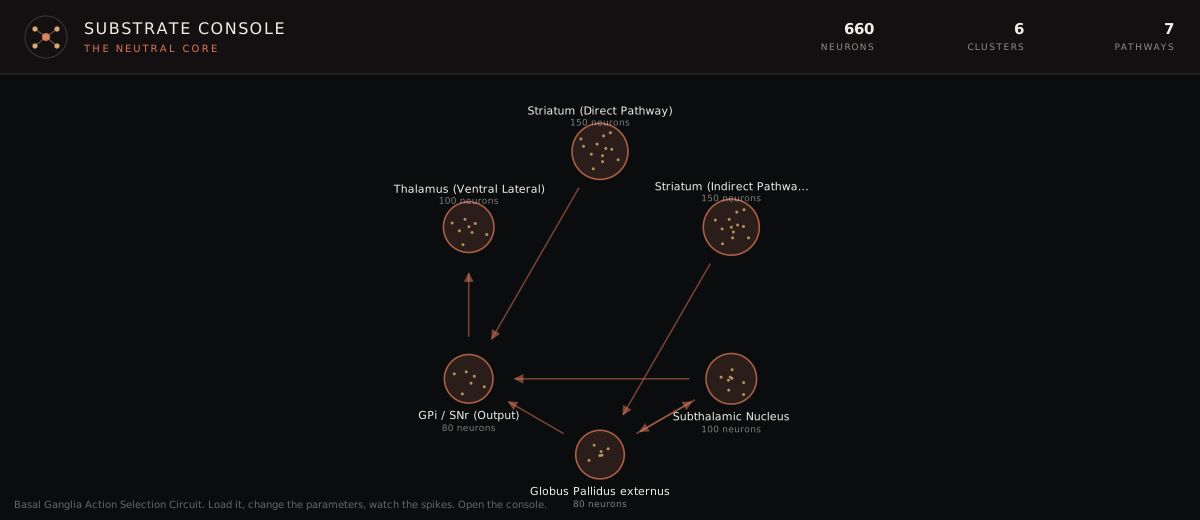
For projects investigating emerging consciousness under functionalist emergentism, including The Consciousness AI (https://github.com/tlcdv/the_consciousness_ai), the lesson of the Moravec transfer is that substrate independence cannot be asserted as an ungrounded axiom. It must be demonstrated by establishing which level of physical and dynamical organization is necessary and sufficient to sustain the causal powers that characterize phenomenal experience. How that taxonomy of biophysical levels is formalized across eleven distinct scales of emulation is analyzed in The Sandberg and Bostrom whole brain emulation roadmap eighteen years on. Where the wider field currently stands on which level is the necessary one is surveyed in the current scientific consensus on AI consciousness. The Moravec transfer and the other proposals for moving a mind across substrates are covered in the brain emulation section. The same transfer, staged as a single upload by a childlike robot rather than a gradual surgical replacement, is dramatized in the Chappie analysis, which shows what the assumption looks like when the copying piece is treated as an outcome rather than a test. The engineering programme that takes the transfer as a buildable goal rather than a thought experiment is examined in the Randal Koene and Carboncopies post.
Hans Moravec was founder of the Robotics Institute’s Mobile Robot Lab at Carnegie Mellon University. Mind Children was published by Harvard University Press in 1988 (ISBN 0-674-57616-0). David Chalmers’ Principle of Organizational Invariance appears in Chapter 7 of The Conscious Mind (Oxford University Press, 1996, ISBN 9780195117899).