


MaleCNS v1.0 versus FlyWire and the Limits of Connectome Evidence
MaleCNS v1.0 maps the adult male fruit fly central nervous system, including the brain and ventral nerve cord. Stuart Berg, Isabella R. Beckett, Marta Costa, Philipp Schlegel, Gregory Jefferis and colleagues describe its sex differences in an October 2025 preprint. The comparison with female brain connectomes identifies shared and differing circuit anatomy. It does not establish whether flies are conscious or whether consciousness depends on a particular substrate.
What MaleCNS v1.0 Contains
The MaleCNS project site identifies a collaboration between FlyEM at HHMI Janelia, Cambridge’s Department of Zoology, the MRC Laboratory of Molecular Biology and Google Research. Janelia’s Male CNS Connectome overview describes a reconstruction of one male specimen with an intact neck connective linking brain and nerve cord. This permits circuit tracing across that boundary within the same specimen.
The dataset release and the manuscript are separate records. The release notes date v1.0 to June 8, 2026. They list minor proofreading changes and refinement of neuron annotations. The preprint abstract reports 166,691 neurons and 11,691 types across the brain and nerve cord. Those are preprint counts. The release notes do not provide updated totals, so they cannot verify those numbers as exact counts for the June snapshot.
| Record | Scope | What the checked source establishes |
|---|---|---|
| MaleCNS preprint, October 2025 | Male brain and nerve cord | 166,691 neurons and 11,691 types in the abstract |
| MaleCNS v1.0, June 8, 2026 | Updated dataset release | Minor proofreading and annotation changes, without revised totals in the release notes |
| FlyWire, Nature 2024 | Adult female brain | Female brain reference for comparison, without a full ventral nerve cord |
The male dataset includes anatomy outside the female brain volume. Comparing their total neuron or type counts would therefore mix anatomical scopes. MaleCNS is a separate reconstruction, rather than a nerve cord extension of FlyWire. A central nervous system map also does not represent every peripheral nerve in the animal.
The project licenses the MaleCNS dataset under CC-BY 4.0. Its news page announces publication in Cell on September 3, 2026 and links the published article. The publisher page returned HTTP 403 during this source check. The numerical analysis below therefore uses the preprint abstract retrieved through Crossref, without claiming to have checked the published text or its final counts.
What the Male Versus Female Comparison Shows
Berg and colleagues report four categories in their comparison of male and female brain connectomes.
| Category | Types reported in the preprint abstract | Interpretation |
|---|---|---|
| Isomorphic | 7,205 | Types classified as structurally corresponding across sexes |
| Dimorphic | 114 | Types present in both sexes with differences |
| Male-specific | 262 | Types classified as specific to the male |
| Female-specific | 69 | Types classified as specific to the female |
These categories belong to the brain comparison. The 11,691 total covers the male central nervous system, including its nerve cord. It is not a common denominator for these four categories. Female-specific types cannot be treated as a subset of the male total. The abstract does not supply enough detail to derive a whole nervous system percentage of sexual dimorphism from these figures.
The abstract places sex-specific and dimorphic neurons mainly in higher brain centres. It describes the sensory and motor periphery as largely isomorphic. Within higher centres, male-specific neurons or branches define areas of male-specific connectivity. The authors also report circuit switches that reroute sensory information into circuits controlling opposing behaviours.
This supports a more precise modelling question than the fraction of differing types. Can a model reproduce a changed route from sensory input to behavioural output when the relevant connections change? Type counts alone cannot answer that question. They do not measure the number of affected synapses, the strength of an effect, or the range of behaviours involved. A shared type can participate in a circuit whose other connections differ.
The individual samples also limit generalisation. The male reconstruction comes from one specimen. Janelia’s overview provides comparisons with existing female connectomes and a view containing neurons from two female samples. It would be inaccurate to reduce all supporting evidence to exactly one male and one female. It would also be inaccurate to treat every difference between reconstructed individuals as a population-wide sex difference. Replication, consistent type matching and independent anatomical or genetic evidence are needed to separate those possibilities. The abstract alone cannot establish the validation of every category.
Anatomical Weights and Missing Physiology
A synapse count between two neurons is an anatomical connection weight. The MaleCNS download page supplies a table explicitly named connectome-weights and describes it as segment-to-segment connection strengths. Such weights can constrain a model, but they do not directly measure synaptic conductance or its changes during behaviour.
Anatomy and physiology answer different questions. A reconstruction can identify contacts and possible paths. A dynamical model must also specify how neurons respond, how signals cross those contacts, and how the system’s state changes. Synaptic efficacy, membrane state and neuromodulation require measurements or explicit assumptions beyond a count of contacts. The preprint includes annotations for fruitless and doublesex expression. Those annotations add biological context without supplying a time series of neural activity.
This distinction connects the Sandberg and Bostrom emulation roadmap with the discussion of Eon Systems’ fly simulation. A reconstruction, a choice of dynamics and a behavioural validation are separate stages. A result at one stage does not automatically validate the others. MaleCNS permits tests of circuits spanning the brain and nerve cord, but it does not by itself supply a validated simulation of those circuits. The brain emulation section follows this distinction between copying anatomy and reproducing function.
Consciousness Requires a Separate Test
The sex comparison concerns biological circuits and behaviour. It does not compare consciousness across substrates. Similar wiring across sexes therefore cannot establish substrate independence. Differences in wiring likewise cannot show that either sex has more, less or different experience.
For a consciousness theory, the next step would be to name a specific prediction. For example, a theory requiring recurrent interactions could use the map to identify candidate pathways. Testing whether those pathways support the predicted activity would still require physiological evidence or a validated dynamical model. Linking that activity to experience requires a further argument and an appropriate measure. The review of consciousness definitions and tests examines disagreements at that stage.
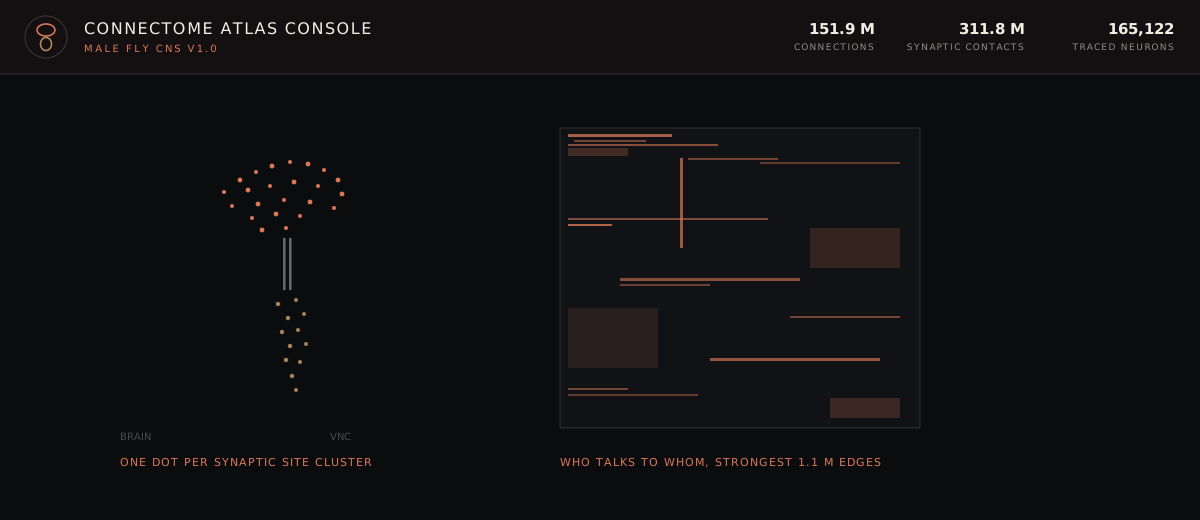
The Connectome Atlas provides a place to inspect wiring discussed on this site. A wiring display can help readers separate an anatomical path from a claim about what that path does. Activity shown by a simulation must be assessed against that simulation’s assumptions. Neither a visible connection nor an animated signal is a measurement of subjective experience.
MaleCNS v1.0 expands the anatomical basis for circuit modelling and sex comparisons. Its evidence remains tied to the sampled tissue, annotation rules and dataset version. Keeping those limits explicit makes the dataset useful for consciousness research without assigning it a conclusion about experience that it does not test.
Sources
- Stuart Berg, Isabella R. Beckett, Marta Costa, Philipp Schlegel and colleagues. Sexual dimorphism in the complete connectome of the Drosophila male central nervous system. bioRxiv, first posted October 9, 2025. DOI and abstract in Crossref. The project site dates preprint v2 to October 30, 2025. Counts here are from the retrieved abstract.
- MaleCNS project site. Collaboration, access tools, licence and publication announcement. Checked September 17, 2026.
- MaleCNS release notes. June 8, 2026 v1.0 release and listed changes.
- Janelia Male CNS Connectome overview. Specimen scope, intact neck connective and female comparison resources. Checked September 17, 2026.
- Sven Dorkenwald and colleagues. Neuronal wiring diagram of an adult brain. Nature 634, 124–138, 2024. Related FlyWire analysis.
- Cell article linked by the MaleCNS project. Publication announced September 3, 2026. Full text was inaccessible during this check and was not used for numerical claims.
- MaleCNS download documentation. Versioned connection weights, annotations and neurotransmitter predictions. Checked September 17, 2026.
Researchers covered here
- Stuart BergFirst author of the MaleCNS preprint on the male Drosophila central nervous system
- Isabella R. BeckettCoauthor of the MaleCNS preprint comparing male and female Drosophila brain connectomes
- Marta CostaCoauthor of the MaleCNS preprint on sexual dimorphism in Drosophila circuits
- Philipp SchlegelCoauthor of the MaleCNS preprint on male and female Drosophila circuit organisation
- Gregory S. X. E. JefferisCoauthor of the MaleCNS preprint describing the male Drosophila central nervous system