Spaceborne Computer-2 and the physical requirements for orbital data centres
Spaceborne Computer-2 tested commercial computing aboard the International Space Station. What does that establish about the physical requirements for orbital data centres, and what remains untested about consciousness? NASA’s historical records document deployment, maintenance and reinstallation. Mark Fernandez, identified by NASA as the investigation’s principal investigator in July 2022, described its purpose as processing data near its source. Those records do not establish that the computer supported consciousness.
Spaceborne Computer-2 from deployment to reinstallation
NASA’s launch release of 20 February 2021 lists Spaceborne Computer-2 aboard Northrop Grumman’s CRS-15 Cygnus mission. The release distinguishes it from Spaceborne Computer, launched in 2017. Its figures of one teraflop and 207 days without a reset describe that predecessor study. They are not measurements of Computer-2.
On 3 March 2021, NASA’s Mark A. Garcia reported that Victor Glover installed Spaceborne Computer-2 in the Columbus laboratory module. The report describes an investigation intended to perform computations on the station rather than download scientific data for analysis on Earth. Installation establishes hardware deployment. It does not establish when every workload became available or how long each server ran without interruption.
The maintenance record also limits claims about continuous operation. Bill Keeter’s NASA station report of 10 May 2022 records an Ethernet cable inspection and replacement. The crew performed this work to try to recover functionality in one of two server units. The report does not establish the cause of the problem or a radiation error rate.
On 30 December 2022, Keeter reported that the Spaceborne Computer-2 units were removed and prepared for return. That record documents removal and return preparation, rather than a completed return to Earth. It gives no basis for describing the deployment as more than two years of continuous tested uptime.
Keeter’s report of 20 February 2024 records installation of refurbished Spaceborne Computer-2 hardware into ER10B. His report of 27 February records connections for power, data and the Moderate Temperature Loop. These are dated installation and utility records. They do not establish uninterrupted tested uptime between 2021 and 2024, or operating status in September 2026.
Mark Fernandez and processing near the data
NASA’s Space Station Research Integration Office quoted Fernandez on 23 July 2022. He described moving computation to the place where data are generated or collected, including spacecraft. He named image and signal processing, health care and DNA analysis as potential applications. That list describes intended uses rather than a count of completed experiments.
“This capability does not change anything that a scientist already does, it just moves it nearer where the data are generated.”
Mark Fernandez, quoted by NASA on 23 July 2022.
Local processing can reduce the delay associated with sending raw data to Earth and waiting for results. It does not eliminate computation time, local communication delay or any remaining ground communication. NASA’s 2021 release presents faster access and analysis as an investigation goal. It supplies no universal latency measurement for Computer-2 workloads.
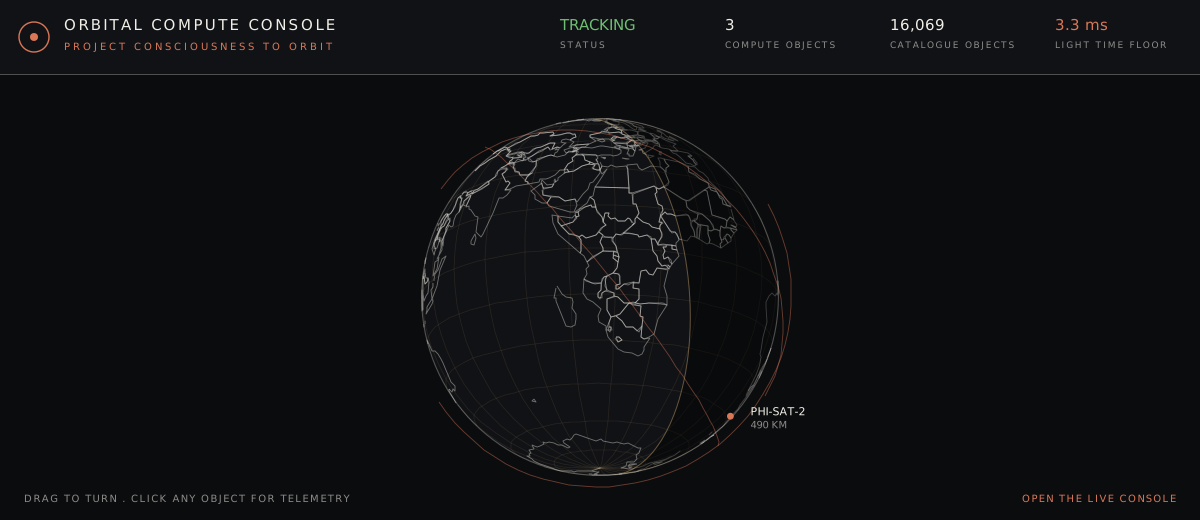
The orbital computing questions in Consciousness to Orbit require a further distinction. A ground-to-space signal travel time describes external communication. The timing of interactions within a candidate conscious system depends on its own components and connections. An orbital ground track cannot establish either internal timing or a payload’s operating status. The tracker provides a way to examine orbital geometry while keeping those separate questions explicit.
Hardware reliability and consciousness require different evidence
Under a substrate independent view, consciousness could depend on causal organization rather than on a particular biological material. On that assumption, orbital location alone would not exclude experience. The relevant question would be whether an implementation preserves the organization and dynamics required by a defensible theory of consciousness.
| Question | Historical evidence | What remains untested |
|---|---|---|
| Did commercial computing hardware reach the ISS? | NASA records the 2021 launch and installation. | Suitability for an unattended, free-flying data centre. |
| What support did the hardware require? | NASA records server recovery work and later power, data and thermal connections. | Independent power and cooling capacity for a larger deployment. |
| Could processing move closer to experiments? | Fernandez describes local analysis as the investigation’s purpose. | A universal latency reduction across workloads. |
| Did the system preserve consciousness-relevant dynamics? | These sources report no test of such dynamics. | Theory-specific tests of timing, state preservation and causal interaction. |
| Was there evidence of consciousness? | These sources report no consciousness assessment. | Validated evidence beyond successful computation. |
Fault recovery can restore a useful service while changing its internal state or interrupting interactions. Under the substrate independent assumption, those changes would need assessment against the chosen theory. A completed calculation alone cannot show that a system preserved every consciousness-relevant property through a fault or restart.
The May 2022 report describes testing techniques to recover from or mitigate errors. It does not show that software replaces physical shielding. Likewise, the February 2024 utility connections document dependence on station infrastructure. They supply no generic power budget for orbital data centres and no evidence that such centres can operate economically without station support.
Limits of the historical record
Spaceborne Computer-2 provides a historical case for examining deployment and recovery of commercial computing in a staffed orbital laboratory. Its refurbished hardware was installed in February 2024. The cited records do not establish continuous operation through 2026, mind emulation or preservation of conscious experience.
The assessment of evidence and competing theories in consciousness research concerns a separate burden of proof. Even under a substrate independent view, hardware availability would be only one requirement. A candidate system would also need justified criteria for consciousness and tests showing that its physical implementation meets them.
Sources
- NASA. NASA Science, Cargo Launches on 15th Northrop Grumman Resupply Mission to Space Station. Release 21-019, 20 February 2021.
- NASA Space Station Research Integration Office. Technology Tested in Space is Preparing Us for the Moon and Mars. 23 July 2022. Updated 12 December 2023.
- Bill Keeter, NASA. ISS daily report for 20 February 2024. Refurbished hardware installation.
- Mark A. Garcia, NASA. High-Powered Computing, Orbital Plumbing and Spacewalk Preps Today. 3 March 2021.
- Bill Keeter, NASA. ISS daily report for 10 May 2022. Server recovery work.
- Bill Keeter, NASA. ISS daily report for 27 February 2024. Power, data and thermal utility connections.
- Bill Keeter, NASA. ISS daily report for 30 December 2022. Hardware removal and preparation for return.