


ESA Phi-sat-2 and running AI on a small satellite in orbit
ESA’s Phi-sat-2 is a 6U cubesat built to demonstrate AI running on board a satellite, and it is the site’s orbital compute tracker entry with a functional example of what “a computer that does AI in orbit” actually means. Launched from Vandenberg on August 16, 2024 aboard a SpaceX Falcon 9 rideshare, the satellite carries a multispectral imager and six AI applications that process the data it captures without sending the raw stream to the ground first.
The consciousness-relevant fact is not that a satellite runs AI. It is that a satellite runs AI in real time under the hard constraints of space, a small power budget, a radiation environment, and a communication link that is physically limited by the speed of light. That combination is the same envelope a mind in orbit would have to operate under, and Phi-sat-2 is a working instance of a piece of it.
What Phi-sat-2 Is
Phi-sat-2 is a 6U cubesat, roughly the size of several stacked shoeboxes, built by Open Cosmos with a multispectral imager and a payload from CGI, Ubotica, and other partners. It carries eight spectral bands and a mission life of one year. The six AI applications include cloud detection, maritime vessel detection and classification, street map generation, image compression, wildfire detection, and marine anomaly detection.
The satellite’s value proposition is the shift from downlinking raw imagery to processing it on orbit. A cloud-covered image is filtered out before it consumes a downlink slot. A vessel is detected and classified in the data stream, so only the detection and its context reach the ground. This is the same logic the orbital data center nodes commercialize at larger scale, and it is the logic the tracker records for every compute object in its roster.
The Consciousness Connection
The question this post has to answer, and the reason it belongs on the orbit section of the site, is what an onboard-AI cubesat tells us about consciousness. The honest answer is that it tells us something narrow and real about the substrate-independence claim, and nothing conclusive about experience.
The narrow claim is about causal closure. Consciousness theories that require sustained integration, the temporal binding argument on this site, impose a maximum physical distance over which processing can be coherently integrated. A system that must constantly send its state to the ground and get the answer back is not closed in the relevant sense. Phi-sat-2 is closed in a small way, it does its inference locally, under a light-speed floor it cannot violate, and the fact that this is now routine on a 6U cubesat is evidence that the physical envelope for self-contained computation off Earth is not exotic.
What it does not establish is any claim about experience. The AI applications are narrow classifiers. They are not a global workspace, an integrated information structure, or a self-model. They run the kind of computation that the indicator literature would not score as evidence of consciousness at all. The value of Phi-sat-2 for this site is as a floor, a demonstration that the engineering preconditions for real-time, self-contained computation exist in orbit and are becoming cheap.
How It Sits in the Tracker and the Section
The tracker carries Phi-sat-2 with a CelesTrak catalogue number and an in-orbit status, alongside Starcloud-1, the Axiom ODC nodes, and Project Suncatcher. That placement is deliberate. Each object in the roster is a step in the material progression from a computing satellite to a computing infrastructure in orbit, and Phi-sat-2 is the low-power AI-edge member of that family.
The wider argument that a mind is an engineering question of power, radiation, and latency rather than a settled biological matter is set out on Project Consciousness to Orbit. Phi-sat-2 does not advance that argument by running a mind, because it does not. It advances it by reducing the cost of the premise, showing that the compute side of the question already operates on orbit at cubesat scale and milliwatt budgets are capable of real-time inference in the radiation environment of low Earth orbit.
What the Launch and the Science Phase Show
Two dates are relevant. The August 16, 2024 launch put the hardware in orbit. The July 2025 start of the science phase is when the AI applications began serving operational users, filtering images, detecting vessels, and mapping streets as a working service rather than a prototype. The mission therefore crossed from demonstration to use in under a year, which is the relevant pace for infrastructure that the orbit argument depends on.
The same hardware generation that makes a cubesat useful makes the latency argument concrete. A satellite in low Earth orbit is roughly 500 kilometers up, and the round trip for a signal to the ground and back adds thousands of kilometers of propagation before any processing result returns. Phi-sat-2 decides on orbit, with no link in the loop. The difference in decision latency is the difference between a detection that arrives while the vessel is still in frame and one that arrives after the orbit passes, and that difference is measurable in exactly the way the latency floor analysis describes for a mind.
Where This Sits
Phi-sat-2 is the smallest live example of a pattern the section tracks, compute leaving the ground and operating under orbital physics. The site’s coverage has already documented the categorical milestone in the Starcloud H100 fleet, the commercial nodes in the Axiom ODC post, and the power budget argument that a mind in orbit needs continuous energy and radiation tolerance. Phi-sat-2 fills in the low-power AI-edge cell of that table, and it does so with the smallest physical envelope and the most routine data processing.
The 2026 state of the field remains the anchor for the wider question, whether any of this engineering bears on experience. The answer this post gives is that it bears on the substrate-independence precondition, by demonstrating that real-time computation in orbit is normal and cheap, while leaving the consciousness question itself untouched.
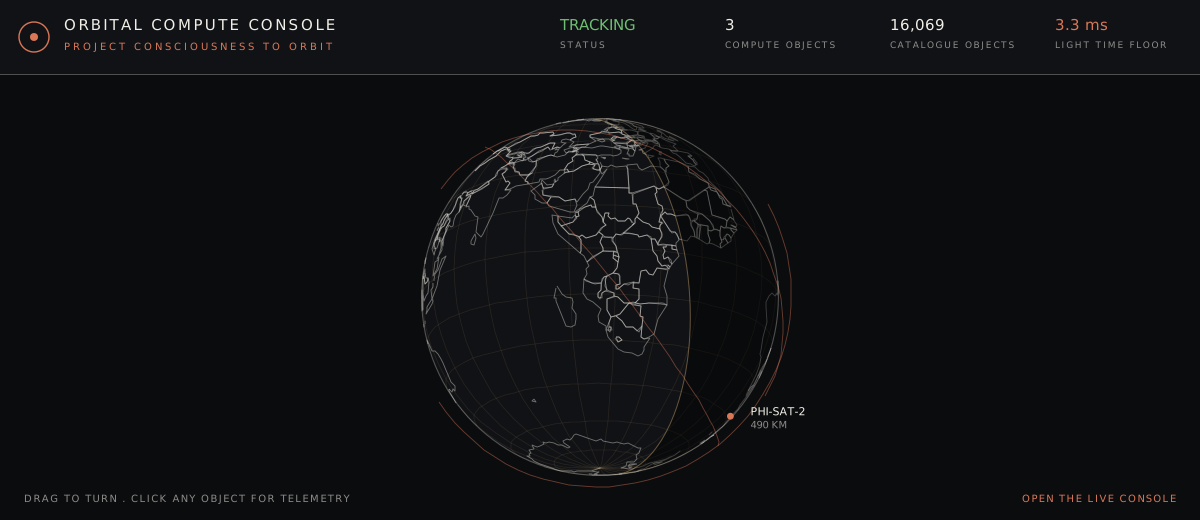
Phi-sat-2, launched August 16, 2024 on a SpaceX Falcon 9 rideshare from Vandenberg, began its science phase in July 2025. It is a 6U cubesat from Open Cosmos with payload partners including CGI and Ubotica. Source: ESA and the orbital compute tracker roster.