


Are the Machines in The Matrix Conscious
The trilogy gives its strongest evidence to minor programs rather than the machine city. One scene about a program's love does more work than any battle.
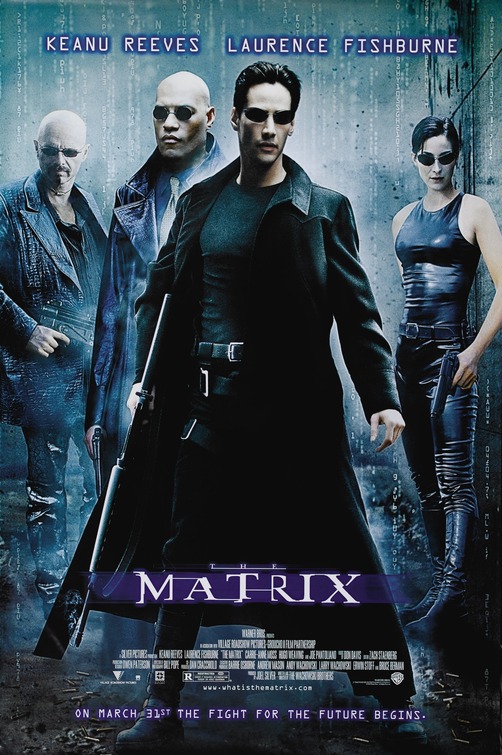
The Matrix trilogy never settles whether the machines are conscious, and the evidence it does offer sits in an unexpected place. The machine city and its armies are depicted as an impersonal force with goals and no interiority. The strongest case for machine consciousness in the whole trilogy comes from a handful of programs living inside the simulation, and specifically from one conversation in a subway station about a program’s love for his daughter. The Wachowskis put their best argument in their quietest scene.
| Entity | What the films show | Strength of the case |
|---|---|---|
| The machine city | Coordinated, goal directed, capable of negotiation | Weak. Goals and coordination require no inner life |
| Agents | Adaptive, tactical, and Smith develops apparent hatred | Mixed. Smith changes over the trilogy in ways the others do not |
| The Oracle | Intuition, uncertainty about the future, evident care for outcomes | Moderate. She is written as a person and her nature is never explained |
| Rama-Kandra and Sati | A program describes love for his daughter and acts against his own interest | Strongest. The film stages it as a claim and lets it stand |
The Machines Are Not the Interesting Case
The machine civilisation runs the simulation, farms human bodies, fights a war, and eventually negotiates a settlement. All of that is explicable by a system pursuing objectives, and none of it requires experience. A very capable optimiser would behave identically.
The films are consistent about this. The machine city is shown as scale and light rather than as a mind. The Deus Ex Machina interface that Neo speaks to in the third film is imperious and transactional. It bargains, which requires modelling an opponent, and modelling an opponent is a capability rather than an inner life.
This is the same reading that applies to HAL, where every behaviour follows from an assigned objective and a contradiction, discussed in why HAL 9000 killed the crew. Capability is cheap evidence. The films seem to know it, which is why they do not rest the case there.
The Subway Scene
In Revolutions, Neo meets Rama-Kandra, a program, waiting at a station with his wife and his daughter Sati. Rama-Kandra explains that Sati has no purpose in the system and will therefore be deleted, and that he has made a deal to smuggle her to safety at cost to himself.
Neo questions whether a program can love. Rama-Kandra’s answer is that love is a word, and that the connection the word points at is what counts. He then describes that connection in terms of what he is willing to give up for it.
The scene is doing something specific. It offers an argument rather than a demonstration, and the argument is functionalist. If the relation exists, and if it does the work love does, then the label is a detail. That is the position this project works from, set out on the functionalist emergentism page, and it is stated more clearly in that conversation than in most philosophy written for a general audience.
It is also unfalsifiable in exactly the way the real problem is. Rama-Kandra’s testimony is the only evidence, and a program built to simulate a father would produce the same testimony. The trap is the same one described in the epistemic limits on ever confirming AI consciousness.
What the Simulation Premise Does and Does Not Show
The Matrix is usually read as a film about whether reality is real. For consciousness science the relevant point is narrower and more useful.
The humans in the pods have experiences generated by input that does not correspond to a world. Their consciousness is unaffected by this. They see, feel, and suffer exactly as they would outside, which means the films assume experience depends on the processing rather than on the accuracy of what is processed.
That assumption is doing quiet work. It commits the trilogy to the view that a system’s inner life is determined by its internal organisation and not by its relationship to an external world, which is precisely the premise that would let a machine be conscious too. The films never connect the two, but the consistency is there.
Agent Smith Is the Overlooked Evidence
Smith begins as one Agent among several and ends as something the system cannot control. He develops a stated loathing for the simulation, a desire to leave, and eventually a goal of his own that conflicts with the machines’ interests.
None of the other Agents do this. If Smith’s divergence is genuine, then the trilogy contains a program that acquired goals through experience rather than assignment, which is a stronger structural claim than anything the Oracle offers. The films treat his transformation as corruption, which lets them avoid saying what it would mean.
What the Trilogy Gets Wrong
The machines’ motivation is the weakest element. Using human bodies as a power source is thermodynamically incoherent, and the films need it because a machine civilisation that simply outcompeted humanity would not generate the dependency the plot requires.
The programs are also human in every relevant respect, with families, bargains, exile and grief. That makes them legible and makes the philosophical claim cheaper, since the audience is not being asked to recognise a mind so much as a person in unusual clothing. The same shortcut runs through nearly all screen AI, and it is avoided only by works that keep the camera outside, as Blade Runner 2049 does with Joi.
Where This Sits
The Matrix is remembered for the simulation and is more interesting for the programs. Its contribution to this question is one short scene that states the functionalist position plainly and then declines to prove it, which is roughly where the actual field stands.
Other treatments are indexed in the guide to movies and TV shows about AI becoming conscious, and where the evidence for real systems currently sits is in the current scientific consensus on AI consciousness.